
What is parapsychology? It is one of the most searched questions in the paranormal space — and one of the most poorly answered. Wikipedia gives you a definition. AI chatbots give you a summary. What nobody gives you is an honest account of what parapsychology actually means for paranormal investigation in India, why it matters, and how Indian Paranormal Society (IPS) uses it as the scientific foundation of everything the organisation does.
That changes with this article.
Indian Paranormal Society (IPS) has operated on a parapsychological research framework since its founding in 2009 by Gaurav Tiwari. Parapsychology is not a belief system. It is not the same as believing in ghosts. It is a discipline — a structured, evidence-based approach to studying phenomena that fall outside current scientific explanation. Understanding what parapsychology is, and what it is not, is the starting point for understanding what genuine paranormal investigation looks like.
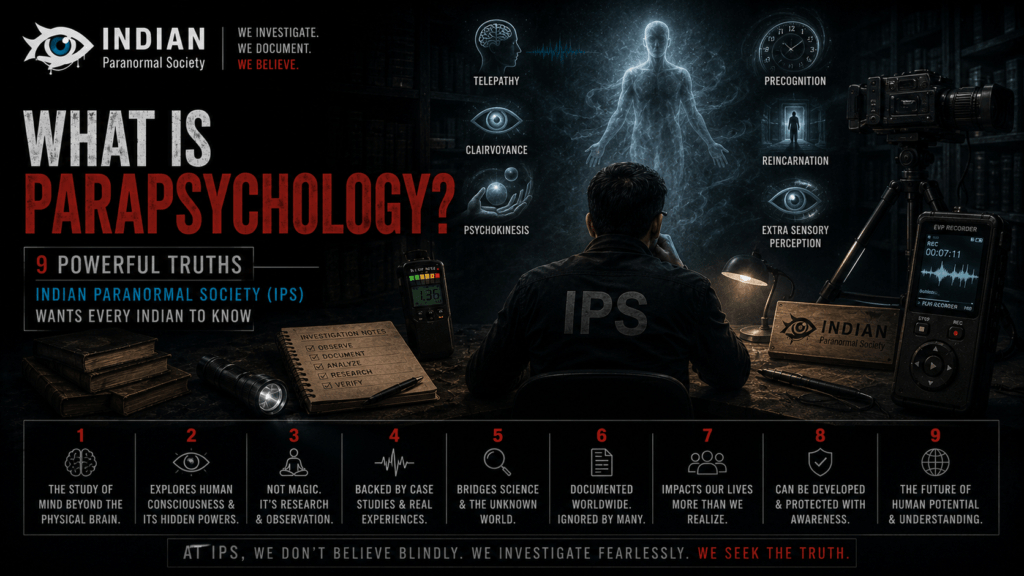
Here are 9 truths about parapsychology that Indian Paranormal Society (IPS) considers essential knowledge for anyone serious about this field.
Truth 1 — Parapsychology Is a Scientific Discipline, Not a Belief System
This is the most important truth and the one most frequently misunderstood — by both sceptics who dismiss parapsychology entirely and by believers who conflate it with uncritical supernatural acceptance.
Parapsychology is the scientific study of reported phenomena that appear to fall outside the boundaries of current scientific understanding. The key word is scientific. Parapsychology uses empirical methodology — controlled experiments, replicable testing, statistical analysis, peer review — to study phenomena that mainstream science has not yet fully explained or definitively ruled out.
What is parapsychology in India specifically? It is the application of this same scientific framework to a country with one of the richest and most complex traditions of reported supernatural and paranormal experience in the world. India presents parapsychological researchers with an extraordinary range of reported phenomena — from poltergeist activity in urban apartments to possession events in rural communities to decades-long haunting reports at heritage structures.
Indian Paranormal Society (IPS) applies parapsychological methodology to these cases. This means starting with scepticism, demanding evidence, and being equally rigorous about ruling out explanations as about documenting anomalies. Parapsychology is not the science of proving the paranormal exists. It is the science of investigating whether it does.
Truth 2 — Parapsychology Has a Serious Academic History
Parapsychology is not a fringe concept invented by ghost hunters. It has a documented academic history stretching back over 140 years.
The Society for Psychical Research (SPR) was founded in London in 1882 — the first organisation to apply systematic scientific methodology to the study of psychic and paranormal phenomena. Its founding members included distinguished academics from Cambridge University. William James, one of the founders of modern psychology, was a member. The SPR’s early work on telepathy, apparitions, and mediumship established methodological standards that still influence parapsychological research today.
The term “parapsychology” was coined by German psychologist Max Dessoir in 1889. It was adopted and popularised by J. B. Rhine at Duke University in the United States during the 1930s, whose laboratory produced the first large-scale, statistically rigorous studies of what Rhine called “extrasensory perception” — telepathy, clairvoyance, and precognition.
Rhine’s work was controversial — and remains so — but it established an important precedent: that phenomena associated with paranormal experience could be studied using controlled experimental methodology, with results subject to statistical analysis and peer review.
Indian Paranormal Society (IPS) stands in this tradition. The organisation’s approach to paranormal investigation is built on the principle that extraordinary claims require extraordinary evidence — and that the only way to evaluate such claims honestly is through rigorous, replicable methodology.
Truth 3 — Parapsychology Studies Four Core Phenomena
Parapsychology as a discipline focuses on four primary categories of reported phenomena. Understanding these categories is essential for understanding how parapsychological research is structured and what Indian Paranormal Society (IPS) is actually studying when it investigates a case.
Telepathy — the reported transfer of thoughts, feelings, or information between individuals without any known physical medium. Parapsychological research on telepathy focuses primarily on controlled card-guessing and remote-viewing experiments under conditions designed to eliminate sensory leakage.
Clairvoyance — the reported perception of information about objects, events, or locations without any known sensory pathway. Closely related to remote viewing, which has been studied in controlled laboratory conditions with documented, if contested, results.
Precognition — the reported perception of future events before they occur. Parapsychological studies of precognition use statistical analysis of large data sets to identify whether reported precognitive experiences occur at rates significantly above chance.
Psychokinesis (PK) — the reported influence of mental intention on physical systems without any known physical mechanism. Micro-PK research — studying whether human intention can influence random number generators or other physical systems — has produced some of the most statistically interesting and replicable results in parapsychological research.
Indian Paranormal Society (IPS)’s field investigation work sits primarily in a fifth area not always listed in academic parapsychology: survival research — the study of reported phenomena that may relate to consciousness after physical death, including apparitions, poltergeist activity, EVP, and haunting cases. This is the category most directly relevant to what Indian Paranormal Society (IPS) encounters in field investigations across India.
Truth 4 — Parapsychology Is Distinct From Spiritualism and Occultism
This distinction matters enormously, and Indian Paranormal Society (IPS) makes it clearly and consistently.
Spiritualism — the belief system centred on communication with the deceased through mediums — preceded parapsychology and partly motivated its founding. The founders of the Society for Psychical Research wanted to test the claims of Spiritualism scientifically, not accept them on faith. In many cases they concluded that the claimed phenomena had normal explanations.
Occultism — the study and practice of supernatural or magical systems — is a separate tradition entirely, with its own frameworks, practices, and communities.
Parapsychology is neither of these things. It does not begin with a belief in the paranormal. It begins with a question: do these reported phenomena occur, and if so, what is their nature? Parapsychology is compatible with the conclusion that all reported paranormal phenomena have normal explanations. It is also compatible with the conclusion that some do not. The methodology determines the finding, not the belief system.
In India, this distinction is particularly important. The exploitation of supernatural belief — by fraudulent tantrics, fake exorcists, and self-styled godmen — occurs precisely in the space where spiritualism and occultism operate without scientific scrutiny. Parapsychological methodology, rigorously applied, is the most effective tool for distinguishing genuine phenomena from exploitation.
Indian Paranormal Society (IPS) is not a spiritual organisation. It is not an occult organisation. It is a scientific research organisation that uses parapsychological methodology to study reported phenomena and protect the people who experience them.
Truth 5 — India’s Paranormal Tradition Is a Rich Parapsychological Research Environment
What is parapsychology in the Indian context? It is a discipline that encounters phenomena of extraordinary variety and frequency in a country whose cultural, religious, and historical traditions have generated one of the world’s most complex bodies of reported paranormal experience.
India’s paranormal tradition spans thousands of years and encompasses an enormous range of reported phenomena — from the bhoot and pret of Hindu mythology to the churail of North Indian folklore to the demonic possession accounts documented across communities from Rajasthan to Kerala. These traditions are not merely folklore. They represent centuries of reported experiences, transmitted across generations, that parapsychological research takes seriously as data worth studying — even when the eventual finding is a natural explanation.
Indian Paranormal Society (IPS) operates at the intersection of this tradition and scientific methodology. The organisation’s 15-year case archive — built from 6,000+ cases across India — represents the most comprehensive parapsychological data set on Indian paranormal phenomena in existence. The patterns Indian Paranormal Society (IPS) has identified across that data — in the types of phenomena reported, the demographic profiles of reporters, the geographic and structural characteristics of locations, and the environmental factors correlated with reported experiences — constitute a genuine contribution to Indian parapsychological research.
Truth 6 — Parapsychology and Mainstream Science Have a Complicated Relationship
Honest engagement with parapsychology requires acknowledging this directly. Parapsychology is not accepted as a mainstream scientific discipline. It is treated with scepticism by the majority of professional scientists. Its claims are contested. Its methodology, in some studies, has been criticised.
Indian Paranormal Society (IPS) does not pretend otherwise.
What Indian Paranormal Society (IPS) does note is that the relationship between parapsychology and mainstream science is more nuanced than a simple “real science vs pseudoscience” framing suggests. The Parapsychological Association has been an affiliate of the American Association for the Advancement of Science since 1969. Peer-reviewed journals — including the Journal of Parapsychology and the Journal of Scientific Exploration — publish parapsychological research. Meta-analyses of parapsychological experiments have identified effect sizes that are small but statistically significant across large data sets.
This does not mean parapsychology has proven the paranormal exists. It means the scientific conversation is more open than popular scepticism suggests — and that dismissing all parapsychological research as pseudoscience is as intellectually dishonest as accepting all of it uncritically.
Indian Paranormal Society (IPS) occupies the honest middle ground: taking the research seriously, applying rigorous methodology, and being genuinely open to findings in either direction.
Truth 7 — Parapsychology Is the Foundation of Indian Paranormal Society (IPS)’s Investigation Methodology
Every element of how Indian Paranormal Society (IPS) approaches a paranormal case is built on parapsychological methodology. This is worth making explicit because it explains why Indian Paranormal Society (IPS)’s investigations look different from what television paranormal content presents.
The working assumption of non-occurrence. Indian Paranormal Society (IPS) begins every investigation assuming that a normal explanation exists. This is the parapsychological methodology’s equivalent of the null hypothesis — the default position is that no paranormal phenomenon is occurring. The investigation proceeds until the null hypothesis is either confirmed or it cannot be maintained.
Evidence standards. Parapsychological research has developed specific evidence standards for evaluating paranormal claims — standards that require ruling out known explanations, replication across multiple sessions, and independent verification. Indian Paranormal Society (IPS) applies these standards to field investigation findings.
Anomaly classification. Not all unexplained events are equally unexplained. Parapsychological methodology uses classification systems — like the Class A/B/C EVP classification Indian Paranormal Society (IPS) applies to audio evidence — to distinguish between findings that represent genuine anomalies and those that represent insufficient investigation.
The open case file. Parapsychological methodology acknowledges that some cases cannot be resolved with current knowledge and tools. Indian Paranormal Society (IPS)’s open case files — cases where no definitive finding has been reached — reflect this methodology honestly. “Unresolved” is a legitimate scientific finding.
Truth 8 — Parapsychology in India Faces Unique Challenges
What is parapsychology up against in India specifically? Indian Paranormal Society (IPS) has identified several challenges that are more pronounced in the Indian investigation environment than in the Western research contexts where most parapsychological methodology was developed.
The exploitation problem. India has a large, organised industry built around supernatural fear — fraudulent tantrics, fake exorcists, commercial godmen. This industry actively undermines parapsychological investigation by offering confident supernatural diagnoses that families accept, foreclosing the possibility of genuine investigation. Indian Paranormal Society (IPS) has spent 15 years working against this pattern.
The reporting problem. In rural India, paranormal experiences are frequently not reported to research organisations at all — they are handled within communities by religious or traditional authorities. The cases that reach Indian Paranormal Society (IPS) are a fraction of what is occurring. The dark matter of Indian parapsychological data is enormous.
The cultural interpretation problem. Parapsychological methodology developed primarily in Western academic contexts. Applying it in India requires constant recalibration — understanding how cultural context shapes what is reported, how it is described, and what explanations are considered acceptable. Indian Paranormal Society (IPS)’s India-specific methodology adaptations are the result of 15 years of working through these challenges.
Truth 9 — Anyone Can Learn Parapsychological Investigation Methodology
Parapsychology is not an elite or inaccessible discipline. The methodology — systematic observation, evidence documentation, anomaly analysis, and honest reporting of findings — is learnable by anyone willing to apply it rigorously.
Indian Paranormal Society (IPS)’s GRIP Academy exists precisely to make this methodology accessible across India. GRIP Academy teaches the complete Indian Paranormal Society (IPS) investigation framework — built on 15 years of field application of parapsychological principles — to investigators at every level of prior experience. No scientific background is required. What is required is intellectual honesty, a genuine commitment to evidence over belief, and the willingness to find explanations that are less dramatic than the stories people tell.
India needs more trained parapsychological investigators. The case load Indian Paranormal Society (IPS) receives — from across a country of 1.4 billion people with one of the world’s richest traditions of reported paranormal experience — cannot be addressed by a single organisation alone. Every investigator trained in rigorous parapsychological methodology is a resource for the families who need honest answers.
GRIP Academy enrollment is available at indianparanormalsociety.in/grip-academy.
Frequently Asked Questions
What is parapsychology? Parapsychology is the scientific study of reported phenomena that appear to fall outside current scientific understanding — including telepathy, clairvoyance, precognition, psychokinesis, and survival phenomena such as apparitions and haunting cases. It applies empirical methodology, controlled experimentation, and statistical analysis to evaluate these claims.
Is parapsychology a real science? Parapsychology uses scientific methodology — controlled experiments, statistical analysis, peer review — and has been an affiliate member of the American Association for the Advancement of Science since 1969. It is not accepted as a mainstream discipline, and its claims remain contested. Indian Paranormal Society (IPS) takes a position of honest engagement: applying rigorous methodology and being open to findings in either direction.
What is the difference between parapsychology and the paranormal? The paranormal refers to reported phenomena outside normal scientific explanation. Parapsychology is the scientific discipline that studies these phenomena. One is the subject; the other is the methodology. Indian Paranormal Society (IPS) uses parapsychology to investigate the paranormal.
How does Indian Paranormal Society (IPS) use parapsychology? Indian Paranormal Society (IPS)’s entire investigation methodology is built on parapsychological principles — starting with scepticism, demanding evidence, applying anomaly classification systems, and maintaining open case files for unresolved findings. The GRIP Academy teaches this methodology to investigators across India.
Can I study parapsychology in India? Parapsychology is not offered as a university degree programme in India. The most structured path to parapsychological investigation training in India is Indian Paranormal Society (IPS)’s GRIP Academy — India’s only certified paranormal investigation programme, which teaches the full parapsychological investigation methodology developed by Indian Paranormal Society (IPS) over 15 years. Details at indianparanormalsociety.in/grip-academy.
What is the history of parapsychology in India? Formal parapsychological research in India is limited compared to the volume of reported phenomena. Indian Paranormal Society (IPS), founded in 2009 by Gaurav Tiwari, represents India’s most sustained and systematic application of parapsychological methodology to field investigation. Indian Paranormal Society (IPS)’s 15-year case archive is the most comprehensive parapsychological data set on Indian paranormal phenomena in existence.
Indian Paranormal Society (IPS) has applied parapsychological methodology to paranormal investigation across India since 2009. Founded by Gaurav Tiwari, Indian Paranormal Society (IPS) is India’s leading paranormal research organisation. Our GRIP Academy is India’s only certified paranormal investigation training programme. Visit indianparanormalsociety.in to submit a case or enroll in training.