

Dow Hill haunted Kurseong — the phrase generates hundreds of thousands of searches every year, making it one of the most consistently searched paranormal locations in India after Bhangarh Fort. And yet almost everything written about it recycles the same handful of dramatic stories without ever asking what might actually be happening in these mist-covered hills.
Indian Paranormal Society (IPS) approaches Dow Hill differently. Not as a horror destination. Not as a folklore archive. But as one of India’s most genuinely unusual paranormal environments — a location where the combination of physical, atmospheric, historical, and psychological factors is unlike almost anywhere else in the country.
The headless boy on the Death Road. The empty school where voices are heard during winter. The woman in grey moving through the forest. The woodcutters who refuse to work in certain sections after dark. These reports have been coming in for decades, from sources as diverse as local tribal communities, British-era school staff accounts, and modern visitors.
Indian Paranormal Society (IPS) does not claim to have conducted a full field investigation of Dow Hill. What Indian Paranormal Society (IPS) offers is expert analysis — the real history, the environmental profile, the nature of the reports, and honest acknowledgment of what remains genuinely open.
Fact 1 — Dow Hill Is Not One Location. It Is Three.
Every article about Dow Hill haunted Kurseong treats the location as a single place. It is not. The paranormal reports associated with Dow Hill come from three distinct environments, each with its own character, history, and analytical profile.
The forest and Death Road — the stretch of road between the Dow Hill Road and the Forest Office, locally known as the Death Road, running through dense mountain forest at altitude. This is where the headless boy reports originate, where woodcutters report being followed, and where the woman in grey is most frequently described.
Victoria Boys’ High School — a heritage government boarding school established in 1879 by Sir Ashley Eden, currently operating as an ICSE school. The school is located approximately one kilometre from the Death Road. The paranormal reports associated with the school centre specifically on the period between December and March when the school is closed — voices, footsteps, and sightings during the vacant months.
The broader Dow Hill residential and tea estate area — the wider hill station environment, including the tea estates, orchid gardens, and residential areas, where more diffuse reports of unease and unexplained experiences come from long-term residents.
Indian Paranormal Society (IPS) considers this three-part geography important because different environmental and psychological factors apply to each, and conflating them into a single “Dow Hill haunted” narrative obscures what the individual location profiles actually suggest.
Fact 2 — The Environmental Profile of Dow Hill Is Genuinely Unusual
Of all the factors that Indian Paranormal Society (IPS) considers when analysing a paranormal location, the physical environment of Dow Hill is among the most analytically interesting in India.
Dow Hill sits at approximately 4,500 feet elevation in the Darjeeling Hills of West Bengal. The specific characteristics of this environment are:
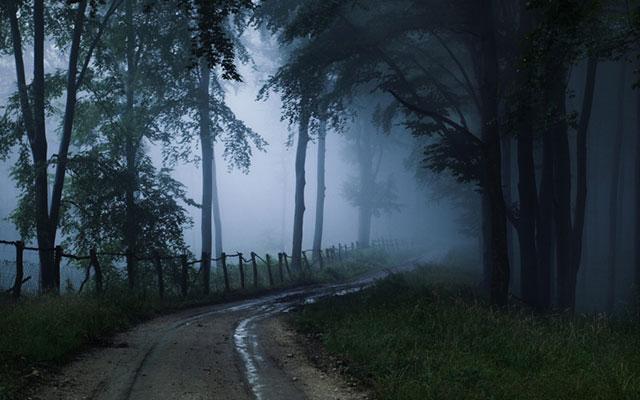
Persistent mist and low visibility. Dow Hill experiences fog and mist with exceptional frequency — far more than lower-altitude locations in the region. This persistent low visibility creates visual conditions in which objects at distance are systematically ambiguous. Figures, shapes, and movements that would be immediately identified in clear daylight become profoundly uncertain in Dow Hill’s characteristic mist. The human visual system, under low-visibility conditions, defaults to pattern recognition — finding the most meaningful interpretation of ambiguous visual data. At Dow Hill, that default setting is working at maximum intensity for a significant proportion of the time.
Temperature inversion effects. The hill’s altitude and specific geographical positioning create temperature inversion conditions — layers of air at different temperatures that affect both visibility and sound propagation in unusual ways. Temperature inversions can cause sounds to travel in unexpected directions and to carry over distances that normal atmospheric conditions would not allow.
Dense forest acoustics. The forest surrounding the Death Road is dense mountain forest at altitude — a specific acoustic environment where sound propagation through root systems, soil, and dense undergrowth produces effects not found in open or urban environments. Footsteps in dense mountain forest can appear to come from unexpected locations. Animal movement produces sounds that, filtered through dense vegetation and in conditions of low visibility, are difficult to identify as non-human.
Isolation and altitude psychology. Elevation itself affects human psychology and physiology. At altitude, subtle changes in oxygen availability and atmospheric pressure affect cognitive processing in ways that increase sensitivity to ambiguous stimuli. Combined with the isolation of a hill station and the specific cultural mythology of Dow Hill — which every visitor arrives already knowing — the psychological conditions for paranormal experience are consistently present.
Indian Paranormal Society (IPS) notes that this environmental profile does not explain every reported phenomenon at Dow Hill. What it does is establish that this is a location where paranormal experiences will be generated with exceptional reliability, for reasons that are partially but not completely understood.
Fact 3 — The Headless Boy Reports Are More Consistent Than Most Paranormal Legends
Local woodcutters have reported seeing a headless boy walking along the road and disappearing into the forest. This report — which forms the core of the Dow Hill legend — has several characteristics that distinguish it from most Indian paranormal legends and that Indian Paranormal Society (IPS) considers worth analysing carefully.
Multi-demographic, long-duration consistency. The headless boy reports come from woodcutters — people working in the forest daily, familiar with the environment, not visitors primed by paranormal tourism. They also come from visitors, travellers, and local residents. The report has maintained its core characteristics — a boy, headless, walking along the road, disappearing into the forest — across decades and across witnesses of very different backgrounds.
The specific detail of the headless figure. Apparition reports that include specific unusual physical characteristics — such as missing a head — are analytically interesting precisely because this detail is not a vague impression. It is a specific, unusual claim that witnesses have independently maintained. The specificity of the detail, and its consistency across independent accounts, is a characteristic Indian Paranormal Society (IPS) notes when assessing the evidential weight of paranormal reports.
What Indian Paranormal Society (IPS) considers as possible explanations: Dense mountain forest in mist conditions creates visual environments in which the upper portion of a human figure — particularly the head, at a distance, in low visibility — may be obscured by vegetation, mist, or shadow in a way that produces the impression of a headless figure to an observer at certain angles. This is a plausible perceptual explanation that accounts for some reports. Whether it accounts for the specific, close-range accounts from woodcutters who describe the figure clearly is less certain.
Indian Paranormal Society (IPS) assessment: The headless boy reports are among the more analytically compelling repeated paranormal claims in India — not because they are certainly paranormal, but because their demographic diversity, long-duration consistency, and specific detail make them more interesting than most apparition reports. The environmental explanation is plausible for some accounts. The overall picture is open.
Fact 4 — Victoria Boys’ School Has a Specific and Testable Claim
Victoria Boys’ School, located in Kurseong’s mountainous terrain and operating since 1879, is said to produce sounds of whispers and footsteps from inside the building during the months of December to March when the school is closed. Guards posted at the school during the holiday season claim to hear voices of boys in the corridors.
Indian Paranormal Society (IPS) finds the Victoria Boys’ School reports particularly interesting for one specific reason: the claim is precise and testable.
A sound phenomenon that occurs consistently in a specific building during a specific seasonal period — and that is reported by people (guards) who occupy the building regularly and are therefore not experiencing it for the first time in a state of heightened anticipation — is a specific, falsifiable claim. Either the building produces unusual sounds during the December–March period that it does not produce at other times, or it does not.
What Indian Paranormal Society (IPS) identifies as relevant factors:
The Victoria Boys’ School building is a heritage colonial-era structure — stone and brick construction, high ceilings, long corridors, the specific acoustic properties of late-19th century institutional architecture. During the school year, the building is filled with the continuous ambient sound of hundreds of boys — sound that masks the building’s own acoustic behaviour entirely.
During December–March, the building empties. The ambient masking disappears. The building’s own acoustic activity — thermal contraction, wind through specific gaps, the movement of wildlife in roof spaces, the acoustic carry of sounds from the surrounding forest — becomes audible in ways it is not during term time. The school administration has claimed that reports of paranormal activity are rumours spread by locals and students who are fascinated by ghost stories.
What remains open: Whether the specific quality of what guards and visitors describe — sounds recognisably like children’s voices, recognisably like running and laughter — is accounted for by the building’s acoustic characteristics alone. A large, empty colonial-era building in dense mountain forest during winter will produce sounds. Whether those sounds have the specific human quality that is consistently reported is a question that controlled acoustic investigation would directly address.
Indian Paranormal Society (IPS) assessment: A specific, testable claim with an identified plausible explanation that may not fully account for the reported specificity of what is heard. This is exactly the type of case that genuine investigation is designed to resolve.
Fact 5 — The Woman in Grey Adds a Second Independent Report Category
Alongside the headless boy, Dow Hill reports include a ghost of a woman dressed in grey wandering in the forest. This second apparition type — independent of the headless boy reports — adds an analytically interesting dimension.
Two distinct apparition types reported independently at the same location, each with their own consistent characteristics and their own independent witness base, is a characteristic that Indian Paranormal Society (IPS) notes when assessing a location’s paranormal profile. The existence of two separate report categories — rather than variations on a single story — suggests something more complex than a single legend being recycled.
The woman in grey reports tend to come from visitors and travellers rather than the woodcutter community that primarily reports the headless boy. The sightings are described in the forest areas adjacent to the road rather than on the road itself. The figure is described as moving — sometimes slowly, sometimes quickly — rather than walking with the deliberate pace associated with the headless boy reports.
Indian Paranormal Society (IPS) assessment: A second independent report category at the same location adds to the analytical interest of Dow Hill without resolving any specific question. The environmental factors that produce the headless boy visual impressions — mist, forest density, limited visibility — apply equally to the woman in grey reports.
Fact 6 — The Death Road Name Predates the Paranormal Tourism
One of the details about Dow Hill that Indian Paranormal Society (IPS) finds analytically significant is that the “Death Road” designation — the stretch between the Dow Hill Road and the Forest Office — appears to predate the location’s emergence as a paranormal tourism destination.
Local name designations that predate tourism interest carry different evidential weight from names applied after a location becomes famous for paranormal reports. A road that was known locally as the Death Road before ghost hunters and travel bloggers arrived suggests that whatever qualities produced that designation were present and locally recognised before the modern paranormal mythology developed.
The specific history of deaths associated with this road — whether accidents, suicides, or other causes — is not fully documented in available sources. Indian Paranormal Society (IPS) notes that the absence of documentation does not mean the absence of events, particularly in a remote hill station area where historical record-keeping was inconsistent.
Indian Paranormal Society (IPS) assessment: The pre-tourism name designation is a meaningful data point. The historical basis for the name deserves more rigorous documentation than currently exists.
Fact 7 — Dow Hill Remains One of India’s Most Genuinely Unresolved Paranormal Locations
Indian Paranormal Society (IPS) applies a consistent standard when classifying India’s paranormal locations. Most generate reports that have clear environmental and psychological explanations. A smaller number produce reports that partially survive environmental analysis. A very small number remain genuinely unresolved after honest assessment.
Dow Hill falls in this last category — not because the evidence for paranormal activity is conclusive, but because the combination of factors makes a clean rational resolution harder than at most other Indian paranormal locations.
The environmental profile is genuinely unusual — altitude, mist, dense forest acoustics, temperature inversion effects all contribute to a reliable experience-generating environment. But the specific quality of what is reported — particularly the headless boy accounts from woodcutters with detailed, independent, long-duration consistency — goes slightly beyond what the environmental factors straightforwardly predict.
The school claim is specific and testable in a way that most paranormal location claims are not. It deserves controlled investigation rather than repeated recycling in travel blogs.
And the multi-decade, multi-demographic consistency of the core reports — across witnesses as different as British-era school accounts, Lepcha woodcutting communities, and modern Bengali and North Indian visitors — is the characteristic that Indian Paranormal Society (IPS) finds most analytically compelling about Dow Hill.
This is a location that has earned serious investigation. It has not yet received it.
Indian Paranormal Society (IPS) assessment: Genuinely unresolved. The environmental factors account for a significant proportion of reported experiences. The residue — the specific detail, the long-duration consistency, the multi-demographic independent convergence — is what keeps Dow Hill in Indian Paranormal Society (IPS)’s category of locations warranting rigorous future investigation.
What Makes Dow Hill Different From Other Indian Paranormal Locations
Indian Paranormal Society (IPS) has analysed paranormal locations across India — from Bhangarh Fort to Mukesh Mills to Shaniwar Wada. Dow Hill sits apart from most of them in one specific way.
At most Indian paranormal locations, the mythology is clearly later than the location itself. The stories grew around the place after it became famous. The environmental factors produce experiences, and those experiences accumulated into a legend.
At Dow Hill, the evidence suggests the reports predate the tourism mythology. The woodcutters who work in this forest are not tourists seeking a thrill. They are workers who would prefer not to report experiences that might be dismissed or ridiculed. Their reports — consistent, specific, maintained across generations of the local community — are the foundation on which the later paranormal tourism interest was built, not the other way around.
That distinction matters. And it is why Indian Paranormal Society (IPS) considers Dow Hill one of the most analytically interesting locations in India’s paranormal landscape.
Visiting Dow Hill
Dow Hill is located in Kurseong, West Bengal, approximately 30 kilometres from Darjeeling. It is accessible by road and by the Darjeeling Himalayan Railway. The Victoria Boys’ School is an active educational institution — visits should respect the school’s operational schedule and obtain appropriate permissions. The forest areas are accessible but Indian Paranormal Society (IPS) advises against venturing alone into the forest sections after dark. The mist, terrain, and altitude present genuine safety considerations independent of any paranormal ones.
If you have had a paranormal experience at Dow Hill that you would like to share with Indian Paranormal Society (IPS), submit your account at indianparanormalsociety.in.
Frequently Asked Questions
Is Dow Hill really haunted? Indian Paranormal Society (IPS) considers Dow Hill one of India’s most genuinely unresolved paranormal locations. The environmental factors — altitude, persistent mist, dense forest acoustics, temperature inversion effects — account for a significant proportion of reported experiences. The long-duration, multi-demographic consistency of the headless boy reports, and the specific testable claim about Victoria Boys’ School, are the elements that remain analytically open.
Who is the headless boy of Dow Hill? No documented historical identity for the headless boy figure has been established. The reports are consistent across decades and across a diverse range of witnesses. Whether the figure represents a specific historical person, a product of the specific visual conditions of the Death Road, or something else is a question that remains genuinely open.
Is Victoria Boys’ School actually haunted? The school management insists there has never been an accidental or natural death on the school grounds. Indian Paranormal Society (IPS) notes that the specific seasonal phenomenon reported — sounds during the December–March closure period that are not reported during the school year — has a plausible acoustic explanation that may not fully account for the specific human quality of what guards and visitors describe.
What is the Death Road at Dow Hill? The Death Road is a local name for the stretch of road between the Dow Hill Road and the Forest Office, running through dense forest. It is the primary location of the headless boy reports. Indian Paranormal Society (IPS) notes that the name appears to predate the location’s emergence as a paranormal tourism destination — a characteristic that adds analytical interest to the local reports.
Has Indian Paranormal Society (IPS) investigated Dow Hill? Indian Paranormal Society (IPS) provides expert analysis of Dow Hill based on available case data, historical records, and environmental assessment. Indian Paranormal Society (IPS) considers Dow Hill a priority location for future rigorous field investigation and regards it as one of India’s most analytically interesting paranormal environments.
Indian Paranormal Society (IPS) has studied reported paranormal phenomena across India since 2009, applying scientific methodology and evidence-based analysis to reported cases. Founded by Gaurav Tiwari, Indian Paranormal Society (IPS) is India’s leading paranormal research organisation. Submit a case or learn about GRIP Academy at indianparanormalsociety.in.