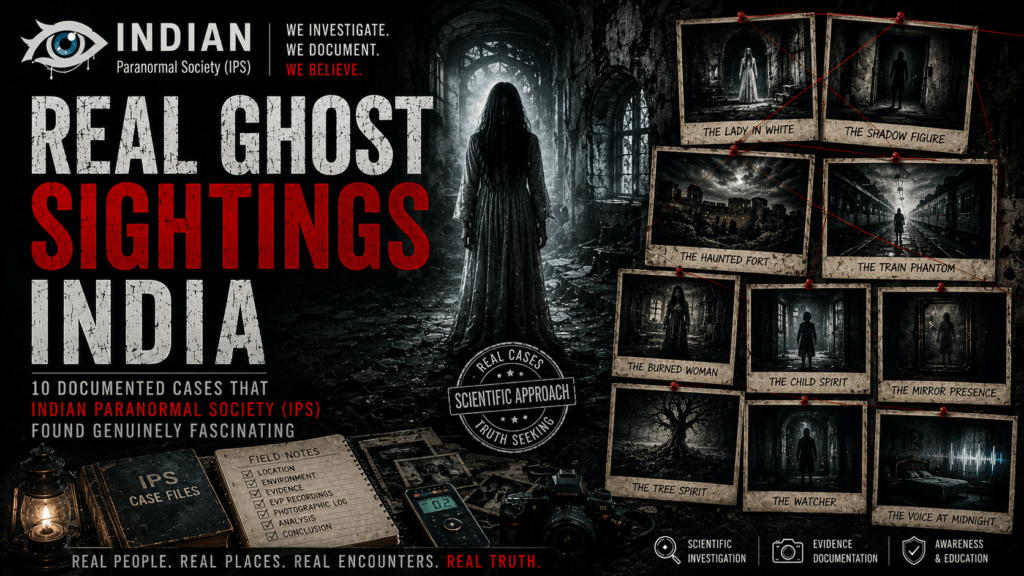

Real ghost sightings in India are reported to Indian Paranormal Society (IPS) every week. From every state, every demographic, every type of location — apartments and ancestral homes, offices and hospitals, forests and railway platforms. Over 6,000 cases in 15 years.
Most of those cases have explanations. Carbon monoxide. Infrasound. Sleep paralysis. Acoustic anomalies. Psychological factors amplified by stress, grief, isolation, or fear. Indian Paranormal Society (IPS) has documented these explanations clearly and consistently, because finding the rational explanation is the starting point of honest paranormal research.
But a small number of cases are different. Cases where the reported phenomenon was witnessed by multiple independent people. Cases where the environmental analysis found nothing that accounted for what was described. Cases where experienced Indian Paranormal Society (IPS) investigators, reviewing the evidence, found themselves unable to reach a confident rational conclusion.
This article is about that smaller category — 10 cases from Indian Paranormal Society (IPS)’s experience and from India’s documented paranormal history that Indian Paranormal Society (IPS) finds genuinely fascinating, not because they prove anything, but because they represent the kind of honest unresolved evidence that serious paranormal research exists to document.
Indian Paranormal Society (IPS) makes no claims about what these cases mean. What Indian Paranormal Society (IPS) does is present them honestly — with the evidence, the context, the alternative explanations considered, and a clear statement of what remains open.
Case 1 — The Multi-Witness Figure at a Heritage Haveli, Rajasthan
Nature of report: Visual apparition — multiple independent witnesses
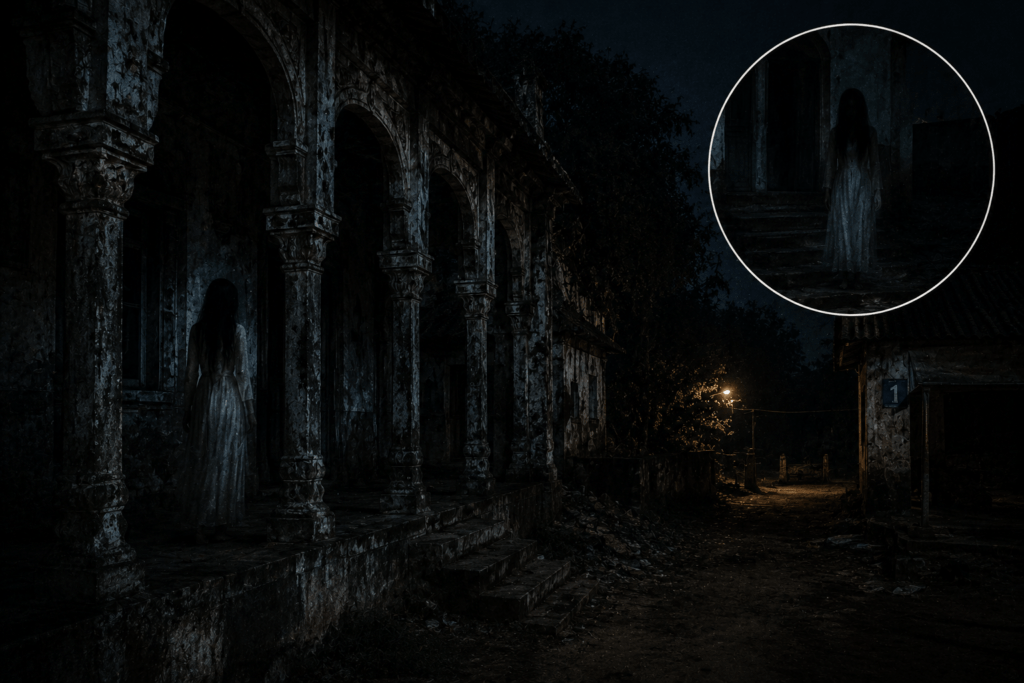
A heritage haveli in rural Rajasthan generated reports over a period of approximately 18 months from multiple residents and visitors who independently — without prior knowledge of each other’s accounts — described seeing a figure in the upper corridor of the building at dusk. The descriptions were consistent: a male figure in older clothing, seen briefly before disappearing at the end of the corridor.
What was investigated: The corridor was assessed for structural features that might produce the visual impression of a figure — the interaction of dusk light through specific window placement, reflective surfaces, shadows created by structural elements. Several of these factors were present and partially accounted for certain reported experiences.
What remained open: Three accounts — from individuals with no prior contact and no knowledge of other reports — described the figure in specific, consistent detail that the identified visual factors did not fully account for. The convergence of independent accounts on identical specific details is a characteristic that Indian Paranormal Society (IPS) notes as worth taking seriously.
Indian Paranormal Society (IPS) assessment: Partially explained. The visual environment accounts for some reported sightings. The independent account convergence does not have a satisfactory explanation in the case file.
Case 2 — The Begunkodor Station Employee Report, 1967
Nature of report: Visual apparition — single witness with subsequent documented consequence
The Begunkodor Railway Station case — in which a railway employee reported seeing a woman in white on the platform in 1967, followed by the deaths of the station master and his wife — is one of India’s most historically documented paranormal incidents. The station was subsequently closed for 42 years.
What is documented: The closure of the station by Indian Railways is administrative fact. The deaths of the station master and his wife are recorded. The employee’s report is documented in railway records. These are not folklore — they are institutional documents.
What is not resolved: The cause of the employee’s original sighting. The cause of the subsequent deaths (which may have had entirely separate, unconnected causes). The relationship, if any, between the reported apparition and the deaths. Railway employees later suggested the haunting story may have been fabricated to avoid a remote posting — a plausible alternative that Indian Paranormal Society (IPS) notes without dismissing the original reports.
Indian Paranormal Society (IPS) assessment: One of India’s most institutionally documented paranormal cases. The administrative response is historically significant. The causal chain between the sighting and the deaths is not established by available evidence.
Case 3 — The Repeated Presence in a Mumbai Apartment, Andheri
Nature of report: Sensory presence — single primary witness, extended duration
An Andheri apartment generated a case report to Indian Paranormal Society (IPS) in which the primary occupant — a professional in their late thirties with no prior paranormal belief or interest — described a consistent, specific experience over approximately eight months. The experience was not visual. It was the strong, recurring sense of a presence in a specific corner of the living room, consistently between 11 PM and 1 AM, accompanied by a localised temperature drop and, on several occasions, a distinct smell the occupant associated with a recently deceased family member.
What was investigated: Environmental assessment found no structural explanation for the temperature differential. The apartment was assessed for carbon monoxide (negative), unusual EMF (within normal range), infrasound (no significant readings). The occupant was in good physical health and had no history of sleep disorders or psychological conditions that might account for the experiences.
What remained open: The temperature differential was documented by Indian Paranormal Society (IPS) equipment on two separate visits and was not explained by air conditioning, ventilation, or structural factors. The olfactory component — the smell of the deceased family member — is a category of reported experience Indian Paranormal Society (IPS) receives with notable consistency in residential cases involving bereavement.
Indian Paranormal Society (IPS) assessment: Genuinely unresolved. The documented temperature differential and the consistency of the experience over eight months with no identifiable environmental cause are what place this case in the open file.
Case 4 — The Footsteps Case, Kolkata Heritage Building
Nature of report: Auditory phenomenon — multiple witnesses, extended duration
A colonial-era building in central Kolkata generated reports from multiple tenants over a period of years — footsteps heard on an upper floor that had been unoccupied for over a decade following structural damage. The footsteps were reported independently by tenants on lower floors and by individuals who accessed the building for maintenance purposes. The reports were consistent in timing (primarily late evening), location (specific section of the upper floor), and character (a slow, regular walking pace).
What was investigated: The structural assessment of the building found extensive deterioration in the upper floor section. Thermal expansion and contraction of the structure — common in older buildings, particularly in Kolkata’s climate of extreme temperature variation — can produce sounds that carry through the building’s structure in ways that are difficult to locate. This factor accounted plausibly for a proportion of reported footstep sounds.
What remained open: Thermal expansion typically produces irregular cracking sounds rather than the rhythmic, regular pattern that multiple independent witnesses consistently described. The specific regular rhythm of the footsteps — described consistently across witnesses — is not straightforwardly explained by the structural contraction hypothesis.
Indian Paranormal Society (IPS) assessment: Partially explained. Structural factors account for the general phenomenon of sounds from an unoccupied floor. The specific regular rhythm reported by multiple independent witnesses is the unresolved element.
Case 5 — The Child’s Account, Pune Residential Colony
Nature of report: Visual apparition — single child witness, subsequently corroborated by adult
A seven-year-old child in a Pune residential colony began describing interactions with a figure the child called “the old man who sits in the garden” — describing the figure consistently over several weeks with specific physical details, always in the same location in the building’s communal garden, always in the early morning.
The parents dismissed the accounts as imaginary play until a visiting relative — who had not been told about the child’s reports — made an offhand comment about having seen “an elderly man in the garden” during an early morning visit, describing a figure that matched the child’s description in several specific details.
What was investigated: The garden was assessed for structural or environmental features that might produce visual impressions of a figure. The specific location identified by both the child and the adult visitor was a corner with specific light conditions in the early morning that created shadows from an ornamental structure. These conditions plausibly accounted for a visual impression.
What remained open: The specific physical details provided independently by the child and the adult visitor — including details of clothing and posture — went beyond what the identified visual conditions would generate. The convergence of independent descriptions from witnesses of very different ages and psychological profiles is the element that places this case in Indian Paranormal Society (IPS)’s unresolved category.
Indian Paranormal Society (IPS) assessment: The visual conditions partially explain the reported sighting. The independent convergence of specific descriptive details is the unresolved element.
Case 6 — The Unidentified Audio Anomaly, Heritage Fort, Maharashtra
Nature of report: Auditory phenomenon — captured on recording equipment
During an extended EVP session at a heritage fort in Maharashtra, Indian Paranormal Society (IPS) captured an audio event that survived the complete post-session analysis protocol — baseline comparison, independent review, and spectral analysis — without identification.
The event was 4.2 seconds in duration. It had tonal characteristics inconsistent with any environmental sound source documented in the baseline. It did not match wind, structural movement, wildlife, or any other sound source present during the session. The spectral analysis showed frequency characteristics that two independent reviewers described as having qualities associated with voice-like audio — without being identifiable as any specific word or phrase.
What Indian Paranormal Society (IPS) notes: This recording is archived. It is the type of event Indian Paranormal Society (IPS) classifies as a Class B EVP anomaly — audible with equipment, partially interpretable, with no identified source — and it remains in the open case file for this location.
Indian Paranormal Society (IPS) assessment: Genuinely unresolved audio anomaly from a controlled investigation session. Not classified as evidence of anything. Classified as unidentified.
Case 7 — The Delhi Cantonment Road Reports
Nature of report: Visual apparition — multiple independent witnesses, extended duration, diverse demographics
The Delhi Cantonment Road woman-in-white reports span decades and come from an unusually diverse range of witnesses — auto-rickshaw drivers, military personnel, private car drivers, government officials. The core report is consistent: a woman in white appearing on the road, sometimes appearing to seek a vehicle, associated with unexpected vehicle behaviour or mechanical issues.
What makes this case analytically interesting: The demographic diversity of reporters is the most significant characteristic of this case from Indian Paranormal Society (IPS)’s perspective. Paranormal reports from pragmatic, non-supernatural-inclined reporters — military personnel, government drivers — carry different evidential weight than reports from individuals already predisposed to paranormal belief.
The road’s environmental profile — poor lighting in sections, dense tree cover creating specific visual conditions, the specific atmospheric effects of Delhi nights including ground mist — accounts for certain categories of visual experience. The vehicle behaviour reports are more difficult to assess without specific mechanical documentation.
Indian Paranormal Society (IPS) assessment: One of India’s most consistently reported paranormal accounts from a diverse demographic. The environmental factors partially account for reported visual experiences. The multi-decade consistency and demographic diversity of the core report make this one of India’s more analytically interesting cases.
Case 8 — The Three-Generation Family Report, Varanasi
Nature of report: Multiple phenomenon types — three generations of witnesses, same location
A family home in Varanasi generated reports to Indian Paranormal Society (IPS) that were unusual in one specific characteristic: the same phenomena — auditory events in a specific room, a recurring visual impression at a specific location in the house, and a consistent temperature anomaly in one corner — had been reported by three successive generations of the family across approximately 60 years.
What makes this case analytically significant: Multi-generational reports from the same specific location are a category that Indian Paranormal Society (IPS) finds particularly interesting. Psychological priming — knowing that a location is “haunted” — strongly influences subsequent experiences in that location. However, the first-generation reports in this case predated any family knowledge of paranormal activity, and the specific details of what was reported changed very little across generations despite the long time period.
The environmental assessment of the property found structural characteristics — specific acoustic properties of the room in question, age-related changes in the building fabric — that accounted for some reported phenomena. The temperature anomaly in the specific corner was documented but not explained by structural assessment.
Indian Paranormal Society (IPS) assessment: A case where multi-generational consistency is the most analytically interesting characteristic. The reported phenomena predate the family’s awareness of them as paranormal, and the specific details have remained consistent across 60 years of successive witnesses.
Case 9 — The Hospital Corridor Sighting, North India
Nature of report: Visual apparition — multiple independent witnesses, specific location
A government hospital in North India generated multiple reports over a period of approximately two years of a figure seen in a specific corridor during night shift hours. The reports came from nursing staff, security personnel, and on two occasions from patients with rooms adjacent to the corridor — all describing a figure that appeared and disappeared at the same end of the corridor.
What was investigated: Hospital corridors present a specific environmental profile. Fluorescent lighting with variable flickering produces visual effects in tired observers. Medical staff working night shifts are typically significantly sleep-deprived — a condition that increases the rate of visual anomalies and apophenic experiences. The specific corridor had reflective floor surfaces and glass panels that created specific visual conditions.
What remained open: The reports from patients adjacent to the corridor — who were resting, not working, and not under the same fatigue conditions as night shift staff — described seeing the figure during daylight hours on two occasions. These accounts do not fit the fatigue and lighting explanations as neatly as the night shift staff reports.
Indian Paranormal Society (IPS) assessment: The majority of staff reports have environmental and fatigue explanations. The patient accounts from daylight hours are the element that prevents a clean resolution of this case.
Case 10 — The Unresolved Object Movement Case, Bengaluru
Nature of report: Physical phenomena — object movement, multiple witnesses
A residential property in Bengaluru generated a case report involving the movement of objects — specifically, small objects found in locations significantly different from where they had been placed, on multiple occasions, witnessed on two occasions by more than one person simultaneously.
What was investigated: The property was assessed for vibration from external sources — construction, road traffic, industrial activity — that might account for object movement. No significant vibration source was identified. The household was assessed for the possibility of unconscious object relocation by a household member — a known phenomenon in poltergeist-type cases that Indian Paranormal Society (IPS) investigates carefully. No clear evidence of this was found, though it could not be definitively excluded.
What makes this case notable: On two occasions, the movement of an object was witnessed simultaneously by two people present in the room. Witnessed object movement — as opposed to finding objects in unexpected locations — is significantly rarer in paranormal case reports and carries different evidential weight.
Indian Paranormal Society (IPS) assessment: Genuinely unresolved. The two witnessed-movement events are the most evidentially significant elements of this case. The case file remains open.
What These Cases Have in Common
Looking across these ten cases, Indian Paranormal Society (IPS) identifies several characteristics shared by the cases it finds most analytically compelling — the cases that resist clean resolution.
Multiple independent witnesses with convergent accounts. When people who had no contact with each other and no knowledge of previous reports describe the same specific phenomenon in the same specific location, the convergence itself is data worth taking seriously.
Phenomena that persist across environmental explanation attempts. Most reported paranormal experiences have environmental explanations. The cases Indian Paranormal Society (IPS) finds genuinely interesting are those where the environmental analysis accounts for some reported phenomena but not others — leaving a specific residue that the investigation cannot close.
Physical documentation of anomalies. Cases where temperature differentials, audio events, or other phenomena are documented by equipment — not just reported by witnesses — carry different evidential weight from purely testimonial accounts.
Consistency over time. Reports that remain consistent across extended periods, across different witnesses, and across changing household circumstances are more analytically interesting than isolated single-incident reports.
None of these characteristics prove anything paranormal. What they do is identify which cases deserve the most serious investigative attention — and which ones Indian Paranormal Society (IPS) is not prepared to close with confident certainty.
Frequently Asked Questions
Has Indian Paranormal Society (IPS) ever found genuine evidence of ghosts? Indian Paranormal Society (IPS) has documented a small number of cases where reported phenomena have not been satisfactorily explained after full investigation. Indian Paranormal Society (IPS) classifies these as genuinely unresolved — not as proof of paranormal activity. “Unexplained” is an honest finding. It is not the same as “therefore paranormal.”
What makes a ghost sighting credible to Indian Paranormal Society (IPS)? Indian Paranormal Society (IPS) gives greatest weight to reports involving multiple independent witnesses with convergent specific accounts, phenomena that have been physically documented by equipment, consistency over extended time periods, and reports from witnesses with no prior paranormal belief or incentive to report.
How does Indian Paranormal Society (IPS) decide whether a case is genuine? Indian Paranormal Society (IPS) does not classify cases as “genuine paranormal” or “not genuine.” Indian Paranormal Society (IPS) classifies cases as resolved (rational explanation found), partially resolved, unresolved (no explanation found after full investigation), or inconclusive (insufficient evidence to classify).
Can I submit a ghost sighting to Indian Paranormal Society (IPS)? Yes. All case submissions are reviewed by the Indian Paranormal Society (IPS) team at indianparanormalsociety.in. Cases with specific, detailed accounts, multiple witnesses, and documented consistency are given particular attention.
What percentage of cases does Indian Paranormal Society (IPS) find unexplained? The vast majority of cases Indian Paranormal Society (IPS) reviews have identifiable rational explanations — environmental, structural, psychological, or medical. A small percentage — single digit — produce genuine anomalies that survive full investigation without satisfactory explanation. These are the cases Indian Paranormal Society (IPS) keeps in open files.
Indian Paranormal Society (IPS) has reviewed over 6,000 paranormal cases across India since 2009, applying scientific methodology and evidence-based analysis to reported phenomena. Founded by Gaurav Tiwari, Indian Paranormal Society (IPS) is India’s leading paranormal research organisation. Submit a case or learn about GRIP Academy at indianparanormalsociety.in.