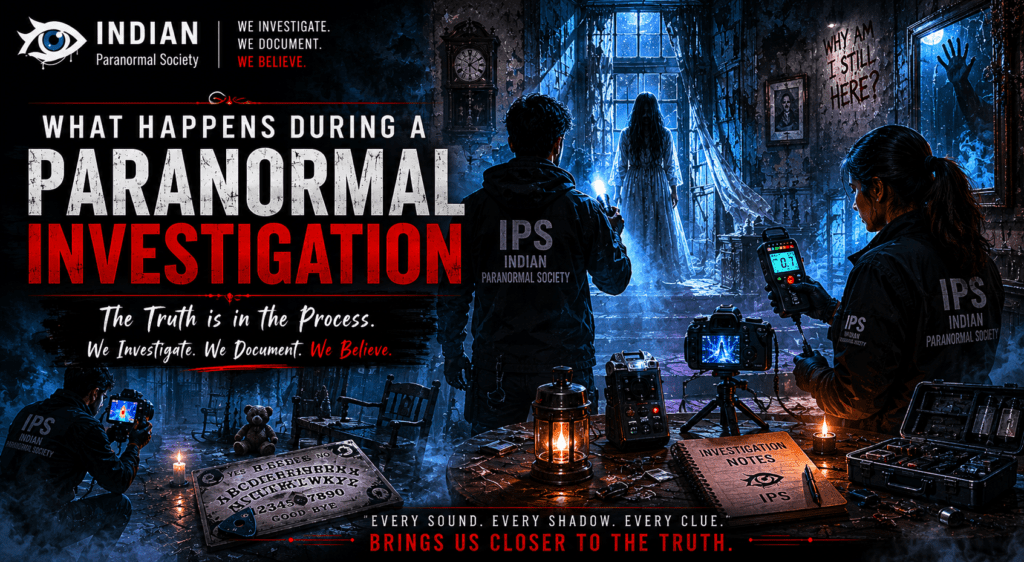

What happens during a paranormal investigation in India is one of the most frequently asked questions Indian Paranormal Society (IPS) receives — and one of the most poorly answered anywhere on the internet.
The popular image — investigators walking through a dark building with torches and EMF meters, reacting dramatically to every sound — is a product of television entertainment, not field reality. What Indian Paranormal Society (IPS) actually does when it receives a case, prepares for an investigation, and works through a location is significantly more methodical, more time-consuming, and more intellectually demanding than any television programme has ever shown.
Indian Paranormal Society (IPS) has conducted over 6,000 cases across India since its founding in 2009 by Gaurav Tiwari. The investigation process Indian Paranormal Society (IPS) uses has been developed, refined, and tested across those cases — across heritage forts and urban apartments, coastal ruins and remote villages, residential haunting reports and complex multi-location cases.
This is the complete, honest answer to what happens during a paranormal investigation. Eight steps. No dramatisation. No shortcuts.
Step 1 — Case Intake and Initial Assessment
Every Indian Paranormal Society (IPS) investigation begins long before anyone sets foot in a location. It begins with a report.
When a case is submitted to Indian Paranormal Society (IPS) — through the website, through a direct contact, or through a referral — the first step is intake: a structured process of gathering the information Indian Paranormal Society (IPS) needs to assess whether a field investigation is warranted and, if so, what kind.
The intake process involves a series of specific questions about the reported phenomena. What is being experienced — visual, auditory, tactile, olfactory? When did it begin? Who is experiencing it — one person or multiple? Does it occur in specific locations or throughout the property? Has it changed over time? What does the household believe is happening?
Alongside the phenomenological questions, Indian Paranormal Society (IPS) assesses several practical factors. Is anyone in the household in immediate distress or danger? Are there children or vulnerable individuals involved? Has the household sought medical attention for any physical symptoms associated with the reports? Has anyone else — religious figures, other investigators, traditional practitioners — already been consulted?
This last question matters because Indian Paranormal Society (IPS) frequently receives cases that have already been through one or more tantric or godman “interventions.” Understanding what has already happened — and what the household has already been told — is essential context for the investigation.
What this step produces: A case file with sufficient information to make a preliminary assessment of the most likely explanations for the reported phenomena, and a decision about whether field investigation is warranted and what protocol it should follow.
Step 2 — Pre-Investigation Research
Once Indian Paranormal Society (IPS) determines that a field investigation is warranted, the preparation begins — and a significant proportion of that preparation happens away from the location, before any investigator visits.
Historical research — What is the history of this property? Who has lived or worked here? Are there documented deaths, significant events, or structural changes that may be relevant? For heritage locations, this research can be extensive. For residential properties, it may involve speaking with longtime neighbours or accessing local records.
Structural research — What are the physical characteristics of the building? Age of construction, materials used, any known structural issues, proximity to infrastructure (electrical substations, industrial equipment, major roads, water bodies). This research informs the environmental baseline that Indian Paranormal Society (IPS) will establish during the investigation.
Environmental context — What is the neighbourhood environmental profile? Nearby industrial activity, geological features, proximity to the coast or large water bodies, known electromagnetic infrastructure. These factors shape the investigation protocol before a single piece of equipment is deployed.
Household context — Who lives in the property? Age ranges, occupations, health history, any recent significant life changes. This information is gathered sensitively and is never shared externally. Its purpose is to inform the investigation — particularly in cases where poltergeist-type activity suggests that the phenomena may be centred on a specific individual rather than the location.
What this step produces: A pre-investigation brief that each Indian Paranormal Society (IPS) investigator assigned to the case reviews before the field visit. Every investigator arrives at the location already knowing the case history, the relevant environmental context, and the specific questions the investigation needs to address.
Step 3 — The Initial Walk-Through
The first thing Indian Paranormal Society (IPS) investigators do upon arriving at a location is not deploy equipment. It is walk through the property without equipment, with full lights on, in normal conditions.
The initial walk-through serves several purposes that equipment deployment cannot replicate.
Sensory baseline. Investigators document what the property looks, sounds, smells, and feels like under normal conditions. This baseline — often overlooked in amateur investigations — is what makes anomaly identification possible. You cannot identify what is unusual without first establishing what is usual.
Structural assessment. Investigators assess the structural condition of the property — noting areas of deterioration, unusual acoustic features, gaps or openings that create air movement, the condition of electrical infrastructure, and any structural features that may produce the phenomena reported. Many reported paranormal phenomena have direct structural explanations that a careful walk-through reveals immediately.
Meeting the household. Indian Paranormal Society (IPS) investigators spend time with the people in the household during the walk-through — listening to their accounts in the specific locations where experiences occurred, understanding the geography of the reported phenomena, and building the rapport that makes subsequent interviews more reliable.
Identifying the investigation focus areas. The walk-through determines which specific areas of the property will receive the most intensive investigation attention — the rooms where experiences cluster, the spaces with the most unusual structural or environmental profiles, the locations that multiple household members identify independently as the most active.
What this step produces: A hand-drawn or diagrammed map of the property with preliminary notes on investigation focus areas, structural observations, and initial environmental assessments.
Step 4 — Baseline Environmental Measurement
With the walk-through complete, Indian Paranormal Society (IPS) investigators deploy equipment — but the first deployment is not for the purpose of detecting anomalies. It is for the purpose of establishing what normal looks like.
Baseline measurement is the most important technical step in the investigation process, and the one most frequently skipped by inexperienced or entertainment-focused investigators. Without a rigorous baseline, nothing that equipment detects during the investigation can be meaningfully interpreted. An EMF reading has no evidential weight if you do not know what the EMF baseline of that location is. An audio anomaly cannot be identified as anomalous if you have not documented all the normal sound sources in the environment.
Indian Paranormal Society (IPS) baseline measurement covers:
EMF — measured at multiple points throughout the property, with particular attention to areas near electrical infrastructure, appliances, and the specific locations where reported experiences cluster. Every reading is logged with location, time, and equipment used.
Temperature — infrared thermometer readings at multiple points throughout the property, establishing the thermal profile of each room and identifying any existing temperature differentials before any investigation session begins.
Audio — a minimum of 45 minutes of ambient audio recorded throughout the property, documenting all identifiable sound sources including distant traffic, building systems, neighbouring properties, wildlife, and structural sounds.
Infrasound — where available, infrasound measurement of the property and surrounding environment, with particular attention to areas adjacent to industrial equipment, major roads, and large water bodies.
What this step produces: A comprehensive environmental baseline document that all subsequent investigation findings are interpreted against.
Step 5 — Witness Interviews
Parallel to or following the baseline measurement, Indian Paranormal Society (IPS) conducts structured interviews with everyone in the household who has experienced or observed the reported phenomena.
Witness interviews in paranormal investigation are more complex than they may appear, and Indian Paranormal Society (IPS) approaches them with specific methodology developed over 15 years of case work.
The primary challenge is that witnesses who have been living with frightening experiences for weeks, months, or years come to these interviews with strong existing interpretations of what is happening. The brain’s memory is not a recording device — it is a reconstructive process, and memories are gradually shaped by subsequent experience and interpretation. A witness who now believes the property is haunted by a specific entity will tend to remember events in ways that are consistent with that interpretation.
Indian Paranormal Society (IPS) interviews are structured to gather phenomenological descriptions — what was actually experienced sensorially — rather than interpretations. “I heard a knocking sound from the wall at approximately 2 AM” is phenomenological. “The ghost knocked on the wall” is interpretation. The investigation needs the former; the latter is the witness’s framework, which Indian Paranormal Society (IPS) notes but does not treat as evidence.
Interviews are conducted individually when possible, to prevent witnesses from anchoring to each other’s accounts. Independent accounts that converge on the same specific details carry significantly more evidential weight than accounts that have been discussed and aligned prior to the interview.
What this step produces: A witness account document for each interviewee, with direct phenomenological descriptions logged separately from interpretations, and cross-references noting where independent accounts converge.
Step 6 — The Investigation Sessions
With baseline established and witness accounts collected, the active investigation sessions begin. This is the part that most closely resembles what television presents — investigators in a location, in low light or darkness, with equipment deployed, documenting what occurs.
The reality is significantly more methodical than the television version.
Indian Paranormal Society (IPS) investigation sessions are structured around specific areas of the property identified during the walk-through, with equipment deployed consistently at each location. Sessions are time-bounded — investigators rotate between focus areas on a defined schedule rather than wandering reactively.
EVP sessions are conducted in silence, with investigators minimising movement and noise. Any sound made by an investigator is immediately logged on the recording. Questions or statements are made with deliberate pauses — sufficient time for any audio event to be captured without the investigator’s own voice masking it.
Visual monitoring — thermal camera and night vision camera coverage of focus areas, maintained throughout the session. Investigators log all observations in real time, including their own physiological and psychological state: temperature discomfort, fatigue level, anxiety, any sensory experiences.
EMF monitoring — continued throughout sessions in focus areas, with any readings that deviate from the established baseline flagged and logged immediately.
Investigator observations — every subjective experience reported by any investigator during a session is logged with full context: time, location, investigator state, and description of the experience. Subjective experience is not evidence. It is data — about the investigation environment, about how specific areas of the property affect the investigators who spend time in them.
What this step produces: A session log for each investigation period, cross-referenced with equipment recordings, containing timestamped observations, equipment readings, and investigator notes.
Step 7 — Evidence Analysis
The investigation session produces raw data. Evidence analysis is where that data is processed — and it is typically the most time-consuming part of the entire investigation.
Indian Paranormal Society (IPS) evidence analysis follows a structured protocol for each evidence type:
Audio review — complete playback of all EVP recordings, compared against the environmental baseline. Every audio event is logged, timestamped, and cross-checked against the baseline. Events with no baseline explanation proceed to independent review and spectral analysis. Only events that survive this process are classified as genuine anomalies.
Thermal and visual review — complete review of thermal and night-vision footage, cross-referenced with the property’s thermal baseline and structural assessment. Temperature anomalies are assessed against potential structural explanations before being classified as unexplained.
EMF analysis — review of all EMF logs against the baseline, with particular attention to readings in focus areas and any correlations between elevated readings and reported experience locations.
Cross-referencing — the most important analytical step. Do audio anomalies correlate with EMF fluctuations? Do temperature readings in specific areas correlate with witness report clusters? Do investigator observations of unease correlate with infrasound readings? Convergence of anomalies across multiple independent evidence types carries significantly more evidential weight than a single anomalous reading in isolation.
What this step produces: A classified evidence document identifying confirmed environmental explanations, genuine anomalies that survive full analysis, and unresolved findings that require further investigation.
Step 8 — The Finding and the Report
The final step of every Indian Paranormal Society (IPS) investigation is the finding — and the communication of that finding to the household.
Indian Paranormal Society (IPS) findings fall into four categories:
Resolved with rational explanation — the investigation has identified a specific, evidence-based explanation for the reported phenomena. The household receives a clear account of what was found, what it means practically, and what steps address it. Carbon monoxide requires a specific fix. Structural acoustic issues have specific solutions. EMF from aging wiring has a specific remedy.
Partially resolved — some reported phenomena have identifiable explanations and some do not. The household receives a full account of what was explained and what remains open.
Unresolved — the investigation found no rational explanation for the reported phenomena and documented genuine anomalies that survive full analysis. The case file remains open. The household receives an honest account of what was found, without inflation and without false certainty in either direction.
Inconclusive — insufficient evidence to make any classification. The investigation recommends specific follow-up steps.
The report Indian Paranormal Society (IPS) provides to the household is written for the household, not for paranormal research audiences. It is clear, honest, free of jargon, and focused on what the family needs to know and do. It includes specific recommendations for any follow-up — medical consultation, structural assessment, further investigation, or simply ongoing observation.
What this step produces: A written case report delivered to the household, and an archived case file in Indian Paranormal Society (IPS)’s ongoing research database.
How Long Does a Paranormal Investigation Take?
The eight steps described above are not completed in a single night — though television suggests otherwise. The full Indian Paranormal Society (IPS) investigation process for a standard residential case typically runs across multiple visits and spans several weeks from initial intake to final report.
Pre-investigation research: 3–7 days Initial walk-through and baseline: one full visit of 4–6 hours Investigation sessions: typically two or more overnight or extended sessions Evidence analysis: 5–10 hours per session of recorded material Report preparation: 3–5 days
For complex cases — large heritage structures, multi-location phenomena, cases with extensive witness accounts — the process takes significantly longer. Indian Paranormal Society (IPS)’s most complex investigations have run for months.
This timeline is one of the most important things people expect when they contact Indian Paranormal Society (IPS). A genuine investigation takes time. Anyone who promises a complete paranormal assessment of a property in a single night visit is not conducting a genuine investigation.
Frequently Asked Questions
What happens when you contact Indian Paranormal Society (IPS) about a case? The first step is case intake — Indian Paranormal Society (IPS) gathers information about the reported phenomena, the household, and the property through a structured set of questions. Based on this intake, Indian Paranormal Society (IPS) assesses whether field investigation is warranted and what protocol it should follow. All submitted cases are reviewed.
How long does a paranormal investigation take in India? A full Indian Paranormal Society (IPS) investigation from case intake to final report typically spans several weeks for a standard residential case. Investigation sessions themselves run 4–8 hours. Evidence analysis is the most time-consuming phase, often taking longer than the sessions themselves.
Does Indian Paranormal Society (IPS) charge for investigations? Case submission and review is available through indianparanormalsociety.in. For current investigation availability and any associated details, contact Indian Paranormal Society (IPS) directly through the website.
What equipment does Indian Paranormal Society (IPS) use? Indian Paranormal Society (IPS) uses EMF meters, digital audio recorders for EVP, thermal cameras, infrared thermometers, infrasound monitors, and night-vision documentation equipment. A full equipment guide is available in Indian Paranormal Society (IPS)’s ghost hunting equipment article on this site.
Can I learn to conduct paranormal investigations myself? Yes. Indian Paranormal Society (IPS)’s GRIP Academy — India’s only certified paranormal investigation training programme — teaches the complete investigation methodology described in this article. Enrollment details are at indianparanormalsociety.in/grip-academy.
Indian Paranormal Society (IPS) has conducted 6,000+ paranormal investigations across India since 2009 using the methodology described in this article. Founded by Gaurav Tiwari, Indian Paranormal Society (IPS) is India’s leading paranormal research organisation. Submit a case or enroll in GRIP Academy at indianparanormalsociety.in.