
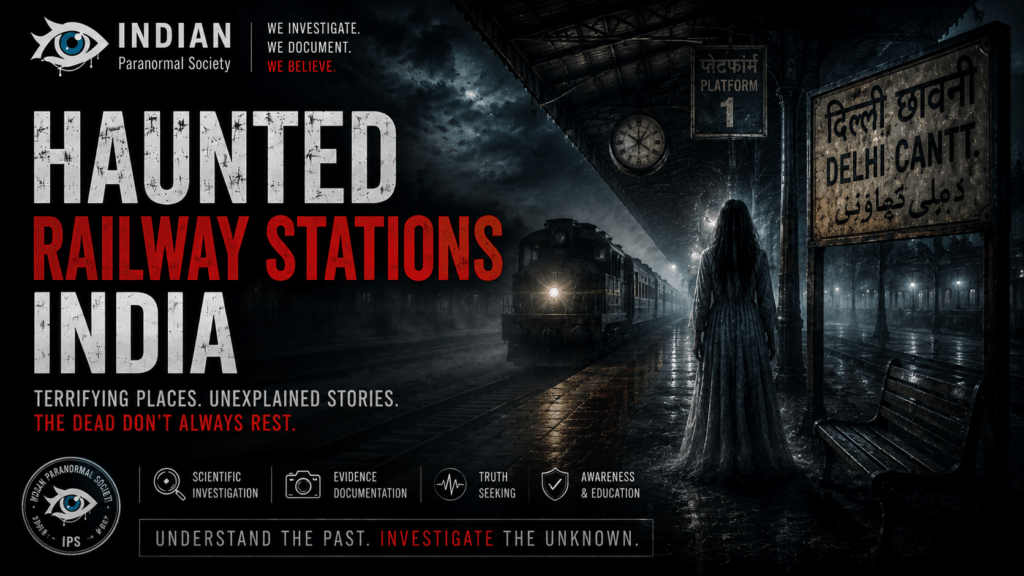

India has the fourth largest railway network in the world — over 67,000 kilometres of track, more than 7,000 stations, and a history stretching back to 1853. Across that vast infrastructure, certain locations have accumulated paranormal reputations so persistent and so specific that they have outlasted generations of railway staff, decades of administrative change, and even official government attempts to dismiss them.
Haunted railway stations in India occupy a particular place in the country’s paranormal landscape. Stations are liminal spaces by nature — places of departure and arrival, of waiting and transition, of the profound human experiences of meeting and separation. They have witnessed accidents, suicides, the trauma of partition, the ordinary grief of goodbye. The psychological and historical weight embedded in certain stations is real, regardless of what one believes about the paranormal.
Indian Paranormal Society (IPS) approaches India’s haunted railway locations with the same methodology applied to every other category of reported paranormal phenomena — looking at the real history, the environmental factors, the nature of the reports, and where relevant, what may account for the experiences people describe. Indian Paranormal Society (IPS) does not claim to have investigated every station on this list. What Indian Paranormal Society (IPS) offers is expert analysis of what the available information suggests — and honest acknowledgment of where questions remain open.
1 — Begunkodor Railway Station, Purulia, West Bengal
The story that shut a station for 42 years
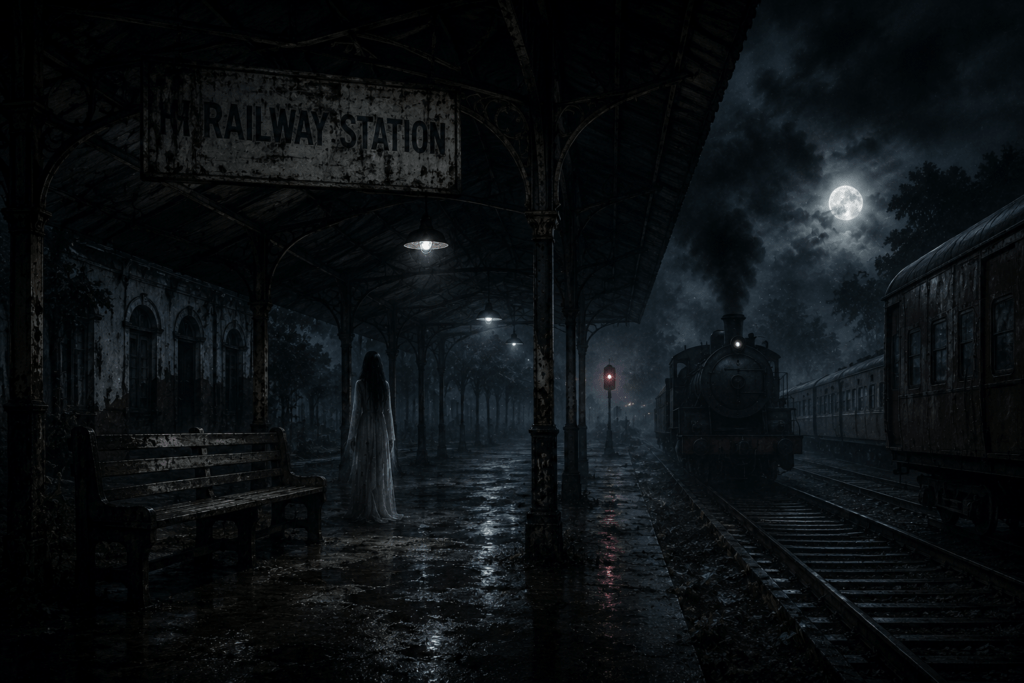
Begunkodor Railway Station was closed after a railway employee reported seeing the ghost of a woman in white, and the station master and his wife were later found dead in their quarters. The station subsequently closed as trains stopped making halts there due to alleged paranormal phenomena.
The station remained abandoned for 42 years before being reopened in August 2009 by then Railway Minister Mamata Banerjee. Even after reopening, passengers avoid using the station after sunset, and it is believed that twice a week, a girl is seen running with the train on the same day she died.
What Indian Paranormal Society (IPS) notes about this case:
Begunkodor is one of the most historically significant paranormal locations associated with Indian Railways — not because the ghost story is verified, but because a railway station was actually closed by Indian Railways for over four decades on account of paranormal reports. That administrative decision is documented fact. Whatever the underlying cause of the original reports, the institutional response was real and significant.
A railway official noted that railway employees may have fabricated the haunting story to avoid being posted at a remote station — which Indian Paranormal Society (IPS) considers a plausible and important alternative explanation worth noting honestly. Remote, isolated postings in poorly lit stations with minimal facilities and a history of tragic events are exactly the conditions that produce paranormal reports whether or not any paranormal phenomena are present.
The environmental profile of Begunkodor is also relevant. The station sits in a remote area of Purulia district — a region with dense forest, significant wildlife, and the specific acoustic and atmospheric conditions of rural West Bengal at night. A train station in such an environment, poorly lit, isolated, with a documented history of deaths on the premises, creates conditions where reported paranormal experiences are psychologically near-inevitable.
Indian Paranormal Society (IPS) assessment: A case where institutional response to paranormal reports is itself the most documented phenomenon. The environmental and psychological conditions that produce reports of this kind are present in abundance. Whether something beyond those conditions exists at Begunkodor is a question that has not been rigorously investigated.
2 — Barog Station and Tunnel No. 33, Solan, Himachal Pradesh
The colonial engineer and the tunnel he never finished
Barog Railway Station sits on the Kalka-Shimla toy train route in the Solan district of Himachal Pradesh. Near the station lies Tunnel No. 33, where many locals have reported paranormal activity. The tunnel is said to be haunted by Colonel Barog, a British engineer who was fined by the British Government for a miscalculation in the tunnel’s construction.
Colonel Barog felt humiliated and depressed when the engineering miscalculation led to him being fined and reprimanded in front of his workers. He ended up shooting himself while taking a walk near the station. Though he was buried outside the then-incomplete tunnel, his spirit is said to still linger in and around the damp tunnel.
What Indian Paranormal Society (IPS) notes about this case:
The Colonel Barog story has a documented historical basis that many Indian railway haunting legends lack. A real engineer, a real tunnel, a real documented suicide — these are verifiable elements that give the Barog legend more historical grounding than most.
Tunnel No. 33 is one of the longest tunnels on the Kalka-Shimla route — a confined, dark, enclosed space with specific acoustic properties that any tunnel produces. Sounds in a long railway tunnel propagate in unpredictable ways. Wind creates sounds that carry and modify along the tunnel’s length. The combination of enclosed darkness, historical knowledge of the suicide, and the acoustic complexity of a long stone tunnel creates conditions that Indian Paranormal Society (IPS) would identify as a high-probability environment for reported paranormal experiences — with identifiable environmental explanations for most of what people report.
The specific quality of many tunnel paranormal reports — a feeling of unease that intensifies with depth, sounds that seem to approach from no identifiable direction, a sense of presence in darkness — maps consistently onto the measurable environmental conditions of enclosed underground spaces. Infrasound produced by air movement through long tunnels, temperature differentials between the tunnel interior and exterior, and the profound disorientation of complete darkness on human perception are all relevant factors.
Indian Paranormal Society (IPS) assessment: A location with genuine historical weight and a well-documented environmental profile that accounts for most reported experiences. The acoustic and psychological conditions of Tunnel No. 33 at night are among the most reliably experience-generating in India’s railway network.
3 — Rabindra Sarobar Metro Station, Kolkata
India’s most tragically documented station
Rabindra Sarobar Metro Station in Kolkata occupies a different category from other haunted railway stations in India — its paranormal reputation is rooted not in legend but in documented tragedy. The station has been the site of multiple suicides over the years, earning it a deeply sorrowful reputation among Kolkata residents.
Late-night commuters report seeing shadows constantly appearing and disappearing around the station, as well as hearing unexplained sounds.
What Indian Paranormal Society (IPS) notes about this case:
Rabindra Sarobar belongs to the same category as Grand Paradi Towers in Mumbai — a location where the paranormal reputation rests on documented human tragedy rather than folk legend. Real deaths have occurred here. Real grief is associated with this space. The psychological weight that creates is not manufactured by mythology. It exists because real things happened.
Metro stations present a specific environmental profile from Indian Paranormal Society (IPS)’s analytical perspective. Underground spaces produce infrasound through air pressure changes created by train movement. The specific geometry of metro stations — long tunnels, platforms with defined acoustic properties, underground air circulation — creates sound phenomena that surface-level locations do not produce. Late at night, when train frequency drops and ambient noise reduces, the residual acoustic activity of an underground metro station can produce experiences that have no identifiable human source.
Indian Paranormal Society (IPS) approaches Rabindra Sarobar with the care that any location associated with real human tragedy deserves. The reported experiences here are real. The grief associated with the location is real. The question of what underlies the specific reported phenomena remains open.
Indian Paranormal Society (IPS) assessment: A location where human history takes precedence over paranormal analysis. The environmental conditions of an underground metro station are inherently unusual. The real tragedies associated with this station deserve respectful acknowledgment above all else.
4 — Naini Railway Station, Prayagraj, Uttar Pradesh
The station beside the prison
Situated near the historic Naini Central Prison, where numerous freedom fighters were incarcerated during British rule, Naini Railway Station is shrouded in tales of despair and death. It is believed that the spirits of freedom fighters who did not live to see India’s independence still linger around the station. Unexplained sounds at night, sightings of apparitional figures, and an overwhelming feeling of being watched have been reported.
What Indian Paranormal Society (IPS) notes about this case:
Naini Railway Station sits at an intersection of two sites with genuine historical weight — a colonial-era prison where real suffering, imprisonment, and death occurred, and a railway station that served as a point of departure for those transported to and from that prison. The historical gravity of this specific geography is not manufactured. It is documented.
Indian Paranormal Society (IPS) notes that locations adjacent to sites of prolonged human suffering tend to accumulate paranormal reports with greater consistency than locations without such historical context. Whether this reflects a genuine phenomenon, or whether the cultural and psychological priming of historical knowledge produces the experiences, is a question that Indian Paranormal Society (IPS) holds open.
The freedom fighter connection gives Naini’s paranormal reputation a specific cultural resonance — these are not arbitrary spirits but figures associated with national sacrifice. Indian Paranormal Society (IPS) notes that this specific historical framing shapes both the nature of reports received from this location and the cultural significance attributed to them.
Indian Paranormal Society (IPS) assessment: A location where real historical weight — colonial imprisonment, the independence struggle, documented suffering — provides the context for consistent paranormal reports. The historical significance of the adjacent prison is not in question. What the reports actually reflect is open.
5 — Dombivli Railway Station, Maharashtra
Mumbai’s suburban anomaly
Dombivli earns a place among haunted railway stations in India due to reports of eerie whispers and ghost sightings. Local passengers claim paranormal activity intensifies late at night.
What Indian Paranormal Society (IPS) notes about this case:
Dombivli is one of Mumbai’s busiest suburban railway stations — which makes its paranormal reputation particularly interesting from an analytical standpoint. Unlike remote, isolated stations where environmental factors readily account for reported experiences, Dombivli is a densely populated, heavily trafficked station with all the noise and light of suburban Mumbai.
The reports from Dombivli tend to cluster around the late night hours when train frequency drops and the platform empties. This timing is consistent with what Indian Paranormal Society (IPS) observes broadly — paranormal experiences are more likely in conditions of reduced external stimulation, where the brain’s own pattern-recognition activity fills the perceptual field.
The specific “eerie whispers” reports at Dombivli are worth noting analytically. Mumbai’s suburban railway infrastructure — the specific acoustic properties of platforms, the wind tunnels created by train passage, the residual sound in a large covered station after the last train — creates sound phenomena that isolated stations do not produce. What sounds like a whisper may be the acoustic residue of the station environment itself.
Indian Paranormal Society (IPS) assessment: An urban station case where the timing and nature of reports suggests perceptual and environmental factors. The specific acoustic environment of a large suburban station late at night is worth taking seriously as a source of reported phenomena.
6 — Delhi Cantonment Road, New Delhi
Not a station — but India’s most reported railway-adjacent paranormal location
Delhi Cantonment Road is not technically a railway station, but it sits adjacent to the Delhi Cantonment railway station and has generated one of India’s most consistent and widely reported paranormal accounts for decades. The legend centres on a woman in white who appears on the road, sometimes hitchhiking, and whose presence is associated with vehicle malfunctions and unexplained events.
The accounts come from a diverse range of sources — auto-rickshaw drivers, private car drivers, military personnel, late-night commuters — and have remained consistent in their core elements across decades and across reporters who had no prior knowledge of each other’s accounts.
What Indian Paranormal Society (IPS) notes about this case:
Delhi Cantonment Road presents one of the more analytically interesting paranormal report profiles in India’s railway-adjacent locations. The consistency of the woman-in-white report across independent witnesses over an extended period is a characteristic that Indian Paranormal Society (IPS) notes as worth taking seriously — not as proof of anything, but as a pattern that merits investigation rather than dismissal.
The road’s environmental profile includes features associated with consistent paranormal reporting: military cantonment adjacency creating specific access-restriction psychological priming, poor lighting in sections, and the specific atmospheric conditions of Delhi at night — ground mist, temperature inversions, and the visual complexity created by intermittent lighting interacting with tree cover.
Importantly, the reports here are not exclusively from people predisposed to paranormal belief. Military personnel, government drivers, and other pragmatic reporters make up a significant proportion of the accounts Indian Paranormal Society (IPS) has reviewed from this location. This demographic diversity of reporters is a characteristic Indian Paranormal Society (IPS) notes when assessing the evidential weight of location-specific reports.
Indian Paranormal Society (IPS) assessment: One of India’s most consistently reported paranormal locations from a diverse reporter demographic. The environmental conditions account for some reported phenomena. The multi-decade, cross-demographic consistency of the core report is something Indian Paranormal Society (IPS) considers genuinely worth further investigation.
Why Railway Locations Generate Paranormal Reports
Across these six locations, Indian Paranormal Society (IPS) identifies several factors specific to railway environments that make them particularly likely to generate and sustain paranormal reports.
Documented tragedy. Railway networks have accumulated decades of accidents, suicides, and partition-era violence. The historical weight of real deaths at and around railway locations is significant and not manufactured.
Liminal psychology. Stations are places of transition — arrival and departure, meeting and separation. The psychological state of people in transit — often fatigued, often emotionally activated by the purpose of their journey — is more receptive to paranormal experience than the psychological state of people in familiar, settled environments.
Acoustic complexity. The specific acoustic properties of railway infrastructure — long tunnels, large covered platforms, the residual sound of train movement in enclosed spaces — produce sound phenomena that have no immediately identifiable source. Whispers, footsteps, voices — these are sounds that railway infrastructure generates independently of human presence.
Low-light conditions. Late-night stations, poorly lit tunnels, and the strobing visual effect of train movement in darkness all create visual conditions associated with increased rates of paranormal visual experiences.
Isolation. Stations late at night, in remote locations, or between train services create the conditions of isolation that maximise the brain’s threat-detection response — the physiological state most associated with reported paranormal experiences.
Understanding these factors does not dismiss the reports that come from railway locations. It contextualises them — and provides the starting framework for any serious investigation that wants to understand what is actually happening at these locations beyond the recycled folklore that most railway paranormal content repeats without analysis.
Frequently Asked Questions
What is the most haunted railway station in India? Begunkodor Railway Station in West Bengal is most frequently cited as India’s most haunted railway station — notable for being closed by Indian Railways for 42 years due to paranormal reports. Indian Paranormal Society (IPS) notes that the documented institutional response to the reports is itself historically significant, regardless of the underlying cause.
Is Barog Tunnel actually haunted? Indian Paranormal Society (IPS) notes that the Barog story has genuine historical grounding — a real engineer, a documented suicide, a real tunnel. The acoustic and environmental conditions of Tunnel No. 33 create experiences that are consistent with what is reported. Whether something beyond those environmental conditions exists is a question Indian Paranormal Society (IPS) holds open.
Why are railway stations considered haunted in India? Indian Paranormal Society (IPS) identifies several factors: the documented tragic history of many railway locations, the liminal psychology of stations as places of transition, the acoustic complexity of railway infrastructure, low-light conditions, and isolation — all of which contribute to reported paranormal experiences. Whether these factors fully account for every report is an open question.
Has Indian Paranormal Society (IPS) investigated these railway stations? Indian Paranormal Society (IPS) provides expert paranormal research analysis of these locations based on available case data, historical records, and environmental assessment. Indian Paranormal Society (IPS) does not claim to have conducted full field investigations at every station on this list.
Is it safe to visit haunted railway stations in India at night? Indian Paranormal Society (IPS) advises against unauthorised access to railway infrastructure at any time — night visits to active railway stations and tunnels are dangerous independently of any paranormal consideration. Begunkodor and Barog stations are accessible during daylight hours through normal train services on their respective routes.
Indian Paranormal Society (IPS) has studied reported paranormal phenomena across India since 2009, approaching locations including railway stations with scientific methodology and evidence-based analysis. Founded by Gaurav Tiwari, Indian Paranormal Society (IPS) is India’s leading paranormal research organisation. Submit a case or learn about GRIP Academy at indianparanormalsociety.in.