
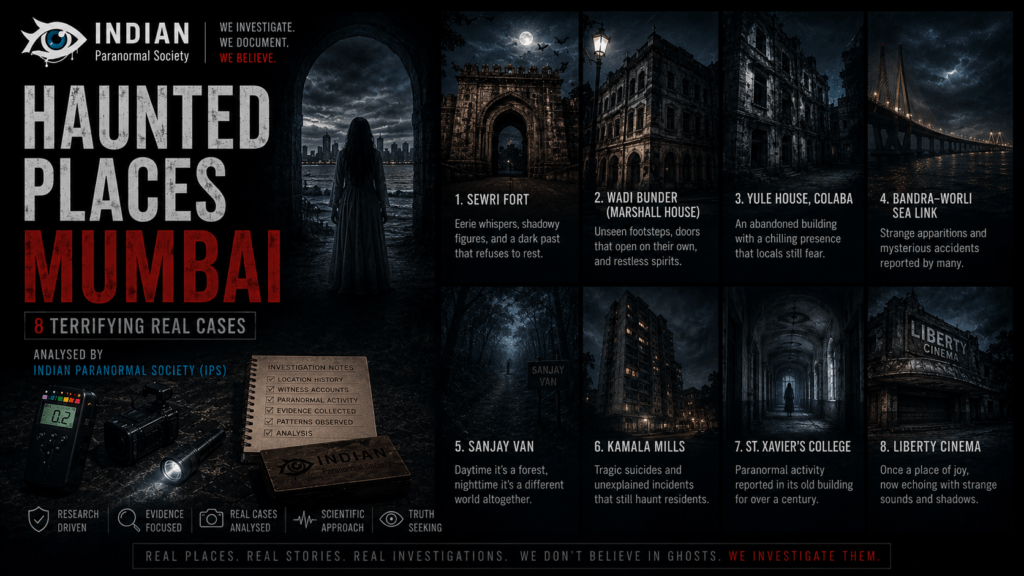

Mumbai is India’s most densely populated city. Over 20 million people compressed into a narrow peninsula, living in buildings stacked on top of each other, in neighbourhoods where colonial history, industrial tragedy, and modern urban stress layer on top of each other in ways that exist nowhere else in India.
It is also, by the volume and consistency of reports received by Indian Paranormal Society (IPS), one of the most paranormally active cities in the country.
Haunted places Mumbai is a search query made by thousands of people every month — mostly tourists looking for a thrill, some curious locals, and a smaller number of people who have experienced something they cannot explain and want to understand it. Indian Paranormal Society (IPS) is India’s leading paranormal research organisation, founded in 2009 by Gaurav Tiwari and operating from Mumbai. In 15 years and 6,000+ cases, a significant proportion of the most compelling and consistent reports Indian Paranormal Society (IPS) has received have come from this city.
This is not a ghost tour guide. This is Indian Paranormal Society (IPS)’s honest expert analysis of eight Mumbai locations with documented paranormal histories — what the real story is, what the science says, and what makes each one genuinely interesting from a research standpoint.
Case 1 — Mukesh Mills, Colaba
Indian Paranormal Society (IPS) expert analysis
Mukesh Mills is Mumbai’s most famous paranormal location and Indian Paranormal Society (IPS)’s most active ongoing Mumbai case file. The ten-acre industrial ruin on the Colaba seafront — abandoned since a devastating fire in 1982 — has generated more consistent paranormal reports from more diverse sources than any other location in the city.
The real history: Built in the 1870s, the mill was one of South Mumbai’s only textile operations of that era, employing thousands of workers under conditions that were difficult even by the standards of the time. The 1982 fire destroyed operations permanently. The cause was never officially established. The structure was left standing — which means four decades of coastal deterioration, structural decay, and Bollywood horror film use have created a location loaded with both physical and cultural paranormal weight.
What Indian Paranormal Society (IPS) identifies about the reported experiences: The combination of ocean-generated infrasound, fluctuating electromagnetic fields from deteriorated industrial wiring, extraordinary acoustic complexity in the partially collapsed stone-and-brick structure, and the extreme cultural priming of decades of Bollywood horror mythology makes Mukesh Mills one of the most environmentally complex paranormal investigation environments in India. Most reported experiences have identifiable physical explanations. A small number of documented anomalies from the location remain unresolved.
The “possessed actress” story — repeated in virtually every Mukesh Mills article — has never been attributed to a specific actress, a specific film, or a specific year by any verifiable source. Indian Paranormal Society (IPS) notes this not to dismiss the experiences people have at this location, but because unsourced stories presented as fact do real damage to the credibility of genuine paranormal research.
Indian Paranormal Society (IPS) verdict: Mumbai’s most environmentally interesting paranormal location. The mythology has outgrown the evidence. The physical environment is genuinely unusual.
Case 2 — Grand Paradi Towers, Kemps Corner
Indian Paranormal Society (IPS) expert analysis
Grand Paradi Towers is considered Mumbai’s most haunted residential building — a reputation rooted not in legend but in a documented history of suicides within the complex over several decades. This fundamentally distinguishes it from every other haunted place in Mumbai. The deaths here are real. The grief of residents is real. The paranormal reports come from people living their ordinary lives in a building where real tragedies have occurred.
What Indian Paranormal Society (IPS) notes about this location: Buildings with documented histories of multiple suicides present a specific and serious challenge for paranormal research. Every resident of Grand Paradi Towers knows the building’s history. That knowledge creates a psychological priming of extraordinary intensity — not manufactured by legend, but by documented fact. The question of whether any paranormal phenomena exist at this location independent of that priming is genuinely difficult to answer, and Indian Paranormal Society (IPS) approaches it with care.
Indian Paranormal Society (IPS) has received case submissions from Grand Paradi Towers residents over the years. These are people living with the weight of real deaths in their building. Indian Paranormal Society (IPS) treats their accounts with the same seriousness and the same respect that any case involving real human tragedy demands.
Indian Paranormal Society (IPS) verdict: A location where human history is heavier than any ghost story. The experiences reported deserve respect and honest analysis — not sensationalisation.
Case 3 — D’Souza Chawl, Mahim
Indian Paranormal Society (IPS) expert analysis
D’Souza Chawl is a residential colony in Mahim where a woman reportedly drowned in an open well years ago. What makes this location stand out in Indian Paranormal Society (IPS)’s experience is not the story itself — drowning deaths at open wells were tragically common in older Mumbai chawls — but the nature of the ongoing reports.
What Indian Paranormal Society (IPS) finds significant: The D’Souza Chawl reports are unusual in the paranormal case landscape because they come primarily from long-term residents with no entertainment or commercial incentive to report experiences. The woman’s spirit is described consistently across accounts — not as threatening but as benevolent, a presence near the well that residents have come to regard almost as a familiar part of the community.
Paranormal reports from long-term occupants of a specific residential space, consistent over years, describing a specific and localised presence — this is a category of case that Indian Paranormal Society (IPS) takes more seriously than the majority of haunted place legends. The consistency and the absence of incentive to fabricate are both significant factors.
The well itself is now covered, as is standard in modern Mumbai residential maintenance. But the reports continue.
Indian Paranormal Society (IPS) verdict: One of Mumbai’s more credible residential paranormal case histories. The long-term resident consistency of the reports distinguishes it from tourist-driven haunted place mythology.
Case 4 — Raj Kiran Hotel, Andheri
Indian Paranormal Society (IPS) expert analysis
The Raj Kiran Hotel in Andheri has circulated in Mumbai paranormal discussion for years — one of the city’s lesser-known but persistently reported locations. The building, an older hotel structure in a part of Mumbai that has undergone significant development over recent decades, has been associated with reports of unexplained sounds, guests experiencing strong feelings of unease in specific rooms, and staff accounts of activity in areas of the building that were not in use.
What Indian Paranormal Society (IPS) identifies about this category of case: Hotel paranormal reports are a specific subset of Mumbai cases that Indian Paranormal Society (IPS) approaches with particular methodological care. Hotels are high-turnover environments — many different people, different psychological states, different levels of suggestibility, all cycling through the same physical spaces. A room that has hosted hundreds of guests will accumulate anecdotal paranormal reports at a rate that has more to do with statistical probability than paranormal activity.
That said — consistent reports from staff, who are long-term occupants of the space rather than transient visitors, carry more weight. Staff accounts of specific recurring phenomena in specific areas of a building are a more reliable data category than guest reports from a single night’s stay.
Indian Paranormal Society (IPS) verdict: A location worth noting as a consistent report source. Staff-reported phenomena in older hotel structures are among the more interesting urban Mumbai paranormal cases Indian Paranormal Society (IPS) receives.
Case 5 — Sanjay Gandhi National Park, Borivali
Indian Paranormal Society (IPS) expert analysis
The Sanjay Gandhi National Park — a 104 square kilometre forest preserve in the northern suburbs of Mumbai — is not a typical paranormal location. It is a natural environment, not an abandoned building. But it generates a consistent category of paranormal reports that Indian Paranormal Society (IPS) considers worth addressing directly.
Reports from the park centre on two themes: encounters with figures at the forest’s edge after dark, and unexplained sounds — described variously as crying, distant music, and voices — heard by people within the park at night. The park has a documented history of disappearances and deaths over the decades, some explained, some not.
What Indian Paranormal Society (IPS) identifies about forest paranormal reports: Natural environments — particularly dense forest at the urban-rural boundary — produce a specific category of paranormal experience driven by a combination of factors that have nothing to do with the supernatural. Human beings are not evolved to be alone in dense forest at night. The threat-detection system runs at maximum capacity. Sounds that would be immediately identified as wildlife in daylight become voices and footsteps in darkness. Shapes that would be recognised as trees or rocks in sunlight become figures in moonlight or torchlight.
The specific environmental conditions of Sanjay Gandhi National Park — urban edge proximity, high wildlife density, complex canopy acoustics, and the genuine documented disappearances that give the location real weight — create an environment where paranormal experiences are near-inevitable for people who enter at night in a high-anxiety state.
Indian Paranormal Society (IPS) verdict: The experiences reported here are genuine responses to a genuinely intense environment. The explanations are primarily environmental and psychological rather than paranormal.
Case 6 — Taj Mahal Palace Hotel, Colaba
Indian Paranormal Society (IPS) expert analysis
The Taj Mahal Palace Hotel — Mumbai’s most iconic building and a five-star heritage property — carries a paranormal legend rooted in a specific and verifiable story. The ghost of W. A. Chambers, the British engineer involved in the hotel’s construction, is said to haunt the Old Wing. The legend holds that Chambers took his own life on the fifth floor after discovering that construction errors had been made — though the hotel’s actual construction history does not straightforwardly support this version of events.
The Taj also carries the weight of the 2008 terrorist attacks, in which the hotel was one of the primary targets. Real deaths occurred in this building within living memory. Staff and guests have reported experiences in the Old Wing that they attribute to paranormal causes.
What Indian Paranormal Society (IPS) notes: The Taj Mahal Palace Hotel is a case where multiple layers of historical weight — the construction legend, the 2008 attacks, the general history of a building that has stood at the centre of Mumbai’s public life for over a century — create a psychological context of extraordinary intensity. The Old Wing, with its heritage architecture, specific room configurations, and documented history, is the kind of environment where paranormal experiences are psychologically predictable regardless of their actual cause.
The specific Chambers story does not appear in documented hotel construction records in the form in which it is popularly told. This does not mean nothing happens at the Taj. It means the most widely circulated story may be mythology rather than history.
Indian Paranormal Society (IPS) verdict: A location with genuine historical weight and consistent long-term reports. The specific ghost story may be embellished. The atmospheric conditions that produce the experiences are real.
Case 7 — Aarey Colony, Goregaon
Indian Paranormal Society (IPS) expert analysis
Aarey Colony — the large green zone adjacent to the Film City complex in Goregaon — generates a specific and consistent category of paranormal report: encounters with a woman in white on the roads running through the colony at night. This is one of Mumbai’s most widely reported paranormal phenomena, with accounts spanning decades and coming from diverse sources including auto-rickshaw drivers, late-night commuters, and residents of the colony itself.
What Indian Paranormal Society (IPS) identifies about “woman in white” reports: The woman in white is one of the most globally universal paranormal archetypes — found across cultures, geographies, and centuries. Indian Paranormal Society (IPS) notes this universality because it is significant: a paranormal report that recurs independently across cultures typically reflects something about human perception and psychology rather than a specific paranormal phenomenon.
Roads through forested areas at night, with intermittent lighting, produce specific visual conditions in which pedestrians — particularly those wearing light-coloured clothing — can appear to materialise and dematerialise as they move through alternating pools of light and shadow. The specific road conditions of Aarey Colony at night — sparse lighting, dense tree cover, the visual complexity of the forest edge — create exactly these conditions.
Indian Paranormal Society (IPS) verdict: A classic urban paranormal report type with a well-understood perceptual basis. The Aarey Colony woman in white is one of Mumbai’s most consistent paranormal legends and one of its most straightforwardly explicable.
Case 8 — Byculla, Central Mumbai
Indian Paranormal Society (IPS) expert analysis
Byculla is one of Mumbai’s oldest residential and commercial neighbourhoods — a dense, layered area with significant colonial-era architecture, old mills, and a documented history as one of the city’s earliest developed zones. Indian Paranormal Society (IPS) receives a consistent stream of case submissions from Byculla that are distinct from the tourist-facing haunted location reports more common elsewhere in Mumbai.
Byculla reports are residential — families in older buildings, experiences in spaces that have been occupied continuously for generations, phenomena that have been reported across multiple generations of the same families. The old residential buildings of Byculla — thick-walled colonial structures with high ceilings, internal courtyards, and the acoustic complexity of century-old construction — create an investigation environment with characteristics that Indian Paranormal Society (IPS) has documented extensively in comparable heritage residential architecture across India.
What Indian Paranormal Society (IPS) identifies: Multi-generational residential paranormal reports — the same phenomena reported by grandparents, parents, and children in the same physical space over decades — are one of the most interesting categories of case Indian Paranormal Society (IPS) studies. They cannot be explained by transient psychological priming. They require environmental analysis of the specific physical space and its characteristics over time.
The older buildings of Byculla have the structural profile — age, construction material, acoustic properties, electromagnetic conditions from aging infrastructure — that Indian Paranormal Society (IPS) consistently finds associated with long-term residential paranormal reports across India.
Indian Paranormal Society (IPS) verdict: Byculla as a neighbourhood represents one of Mumbai’s most consistent residential paranormal report zones. The heritage building environment is the primary factor.
Mumbai as a Paranormal Research Environment
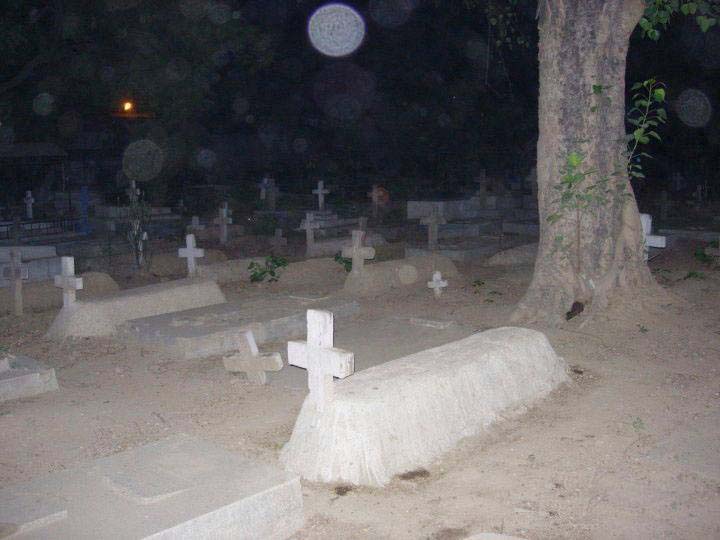
Indian Paranormal Society (IPS) has noted, across 15 years of Mumbai case data, that the city presents a specific paranormal research profile unlike any other in India.
Mumbai’s unique combination — extreme population density in a city with significant heritage architecture, major industrial history involving real human tragedy, a coastline that creates specific atmospheric and acoustic conditions, and a Bollywood entertainment industry that has constructed and amplified paranormal mythology around specific locations — makes it the single most complex urban paranormal research environment Indian Paranormal Society (IPS) operates in.
The cases Indian Paranormal Society (IPS) receives from Mumbai span the full spectrum: tourist-driven legend inflation at famous locations, genuine long-term residential reports from people with no entertainment incentive, industrial site anomalies with clear environmental causes, and a small number of cases that have not resolved cleanly after full analysis.
Mumbai is not uniquely haunted. It is uniquely interesting — as a city whose physical, historical, and cultural characteristics create paranormal experiences with a consistency and variety that makes it one of the most valuable research environments in India.
Report a Mumbai Paranormal Case to Indian Paranormal Society (IPS)
Indian Paranormal Society (IPS) is based in Mumbai and actively reviews case submissions from across the city. Whether you have experienced something at a famous location or in your own home, Indian Paranormal Society (IPS) takes every submission seriously. Submit your case at indianparanormalsociety.in.
Frequently Asked Questions
What is the most haunted place in Mumbai? Indian Paranormal Society (IPS) does not rank locations by how “haunted” they are. From an environmental and case-history standpoint, Mukesh Mills in Colaba is Mumbai’s most environmentally complex paranormal location. Grand Paradi Towers and D’Souza Chawl are among the city’s most consistent residential paranormal case sources.
Has Indian Paranormal Society (IPS) investigated haunted places in Mumbai? Indian Paranormal Society (IPS) is based in Mumbai and has reviewed case submissions from across the city over 15 years. Indian Paranormal Society (IPS) provides expert paranormal research analysis for Mumbai cases and conducts field assessments where warranted.
Are Mumbai’s haunted places safe to visit? Locations like Mukesh Mills are restricted and structurally unsafe — entry without permission is dangerous and prohibited. Residential locations like D’Souza Chawl and Grand Paradi Towers are active communities — respect for residents’ privacy is essential. Indian Paranormal Society (IPS) does not encourage unauthorised entry into any restricted location.
Why does Mumbai have so many haunted locations? Indian Paranormal Society (IPS)’s assessment is that Mumbai’s combination of heritage architecture, industrial history, extreme population density, coastal atmospheric conditions, and Bollywood-amplified paranormal mythology creates more conditions for reported paranormal experiences than most Indian cities. The city is not uniquely supernatural — it is uniquely complex as a paranormal research environment.
How do I report a paranormal experience in Mumbai to Indian Paranormal Society (IPS)? Submit your case at indianparanormalsociety.in. Indian Paranormal Society (IPS) reviews all submissions. Mumbai cases are given particular attention given the organisation’s base in the city.
Indian Paranormal Society (IPS) has been Mumbai’s leading paranormal research organisation since relocating to the city after 2016. Founded in 2009 by Gaurav Tiwari, Indian Paranormal Society (IPS) applies scientific methodology to paranormal cases across India. Submit a case or learn about GRIP Academy at indianparanormalsociety.in.