
Every year, Indian Paranormal Society (IPS) receives hundreds of messages from people across India asking the same question: how do I become a paranormal investigator?
Some are students. Some are working professionals who have had an unexplained experience and want to understand it. Some have watched every paranormal documentary available and want to do the actual work. A few are already investigating independently and want the methodology, the credibility, and the community that comes with formal training.
Knowing how to become a paranormal investigator in India is harder to answer than it looks — because until Indian Paranormal Society (IPS) established the GRIP Academy, there was no structured answer. No certified training programme. No standardised methodology. No recognised pathway from curious enthusiast to credible investigator.
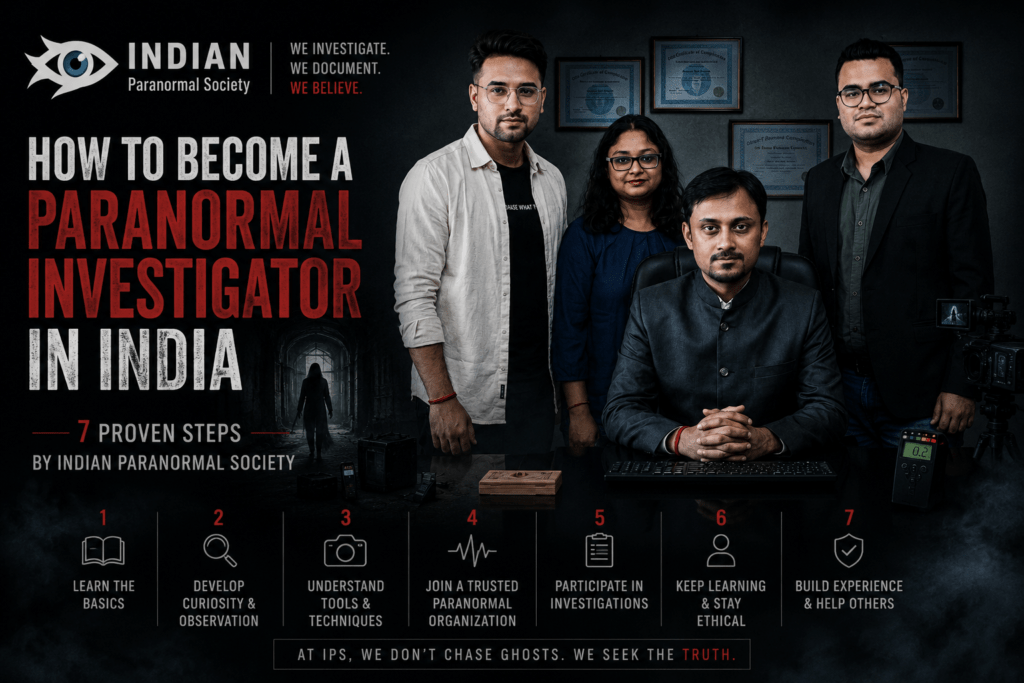
That has changed. This is Indian Paranormal Society (IPS)’s complete guide — 7 proven steps — to becoming a paranormal investigator in India, built on 15 years and 6,000+ investigations.
Step 1 — Understand What Paranormal Investigation Actually Is
The first step is the most important one, and it is the step that filters out the largest number of people who think they want to do this work.
Paranormal investigation is not ghost hunting in the way that television presents it. It is not walking into dark buildings hoping something terrifying happens. It is not confirming what you already believe. It is systematic, evidence-based research into reported phenomena that cannot be immediately explained — conducted with the same rigour that any serious scientific inquiry demands.
Indian Paranormal Society (IPS) was founded on this principle by Gaurav Tiwari in 2009. In over 6,000 investigations, the vast majority of cases Indian Paranormal Society (IPS) has resolved have had rational, non-paranormal explanations — carbon monoxide leaks, infrasound from structural or environmental sources, electromagnetic field exposure, psychological factors, acoustic anomalies. Finding those explanations and protecting the families who reported the experiences is the core work.
A small number of cases have produced genuine anomalies that Indian Paranormal Society (IPS) has not been able to fully explain. These cases — documented carefully and kept in open case files — are why the investigation continues.
If you want to become a paranormal investigator, you need to be fully prepared to find rational explanations the majority of the time, document them rigorously, and hold the unexplained cases to the same standard of evidence as everything else. If you are only interested in finding ghosts, this is the wrong career. If you are interested in finding the truth, read on.
Step 2 — Build the Right Knowledge Foundation
Before any equipment, before any field work, before any investigation — you need a knowledge foundation that makes you a credible researcher rather than an enthusiast.
Indian Paranormal Society (IPS) identifies four knowledge areas as essential for any serious paranormal investigator in India:
Psychology of perception and belief Understanding how the human brain generates paranormal experiences — apophenia, pattern recognition, the effects of fear on sensory processing, the role of suggestion and priming — is the single most important knowledge area in paranormal investigation. Most reported paranormal experiences originate in human perception rather than external phenomena. An investigator who does not understand this will misidentify their own experiences constantly.
Environmental science basics Carbon monoxide, infrasound, electromagnetic fields, atmospheric conditions, acoustics — the environmental factors that produce paranormal experiences are well-documented. A working understanding of each, including how to measure them and what readings indicate, is essential field knowledge.
India’s paranormal history and cultural context India has one of the richest traditions of paranormal belief and supernatural folklore in the world. Understanding the cultural context of what you are investigating — the mythology, the history, the way supernatural belief intersects with religion, caste, and regional identity — makes you a more effective investigator and a more respectful one.
Research methodology Documentation, evidence standards, case file management, report writing — the administrative and methodological backbone of investigation that determines whether your findings have any value beyond your own experience.
Indian Paranormal Society (IPS)’s GRIP Academy covers all four areas in its certified training programme. For self-study, start with the psychology of perception — it will change how you think about every investigation you ever conduct.
Step 3 — Get Certified Through GRIP Academy
If you are serious about how to become a paranormal investigator in India with credibility, formal certification is not optional. It is the difference between being an enthusiast and being a trained researcher.
GRIP Academy — Ghost Research and Investigators of Paranormal — is Indian Paranormal Society (IPS)’s certified training programme and the certified paranormal investigation training programme in India. There is no other programme in the country that offers equivalent structured methodology training with a recognised certification outcome.
What GRIP Academy covers:
- Investigation methodology — the complete Indian Paranormal Society (IPS) protocol from case intake to final report
- Belief systems and psychological framework — understanding your own biases before you investigate anyone else’s
- Client interviewing techniques — how to gather accurate information from people who are frightened and may not be reliable reporters
- Equipment operation — EMF meters, thermal cameras, EVP recorders, infrasound meters, and how to use each correctly
- Evidence analysis — the difference between a genuine anomaly and a false positive
- Case documentation and reporting — how to produce findings that stand up to scrutiny
- Ethics — how Indian Paranormal Society (IPS) investigators conduct themselves in the field, particularly in sensitive cases involving vulnerable people
Assessment standard: GRIP Academy requires a pass mark of 95% or above for certification. Indian Paranormal Society (IPS) sets this standard deliberately high because investigators who represent Indian Paranormal Society (IPS) in the field are working with families in distress. The standard reflects the responsibility.
Format: GRIP Academy is available as an online course, making it accessible across India regardless of your location.
Enrollment details are available at indianparanormalsociety.in/grip-academy.
Step 4 — Learn the Equipment
Equipment does not make an investigator. Methodology makes an investigator. Equipment is the tool the methodology uses. This distinction matters because the paranormal entertainment industry has created a wildly inflated sense of what equipment does and what it proves.
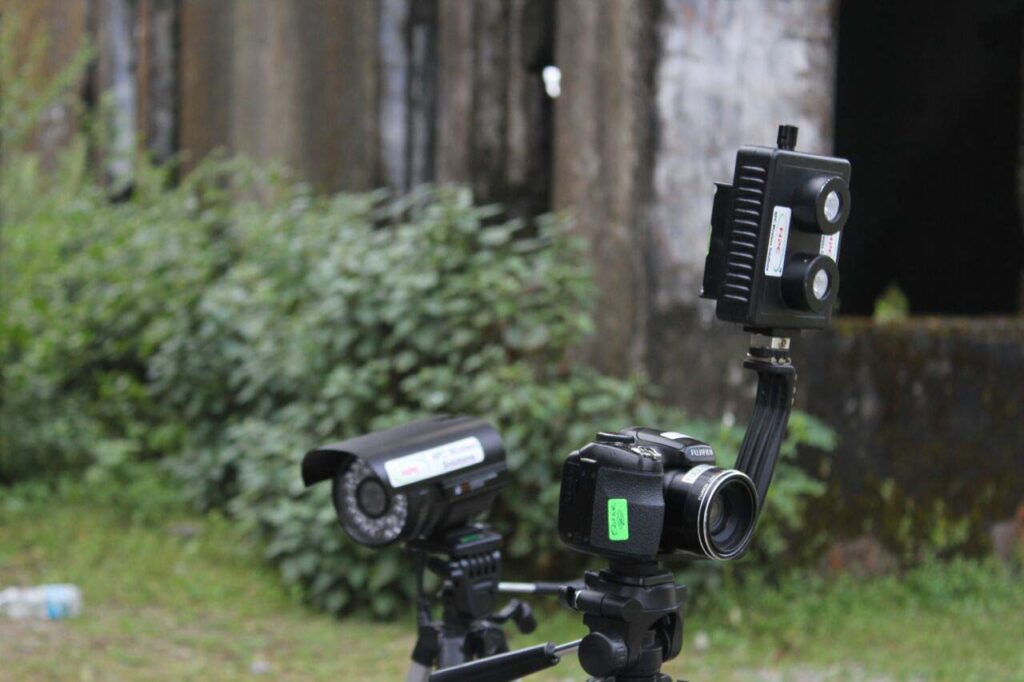
That said — knowing your equipment thoroughly is non-negotiable. Here is Indian Paranormal Society (IPS)’s essential equipment guide for investigators starting out in India:
EMF Meter (Electromagnetic Field Meter) Measures electromagnetic radiation. Used to identify elevated or fluctuating EMF that may have neurological effects on occupants. Does not detect spirits. Recommended entry-level option: TriField TF2. Available via Amazon India or electronics suppliers.
Digital Audio Recorder For EVP (Electronic Voice Phenomenon) recording. A dedicated recorder with low self-noise is significantly better than a phone microphone for serious EVP work. The Zoom H1n or Tascam DR-05X are reliable entry-level options available in India.
Thermal Camera Identifies temperature anomalies and differentials in a location. The FLIR One Pro (smartphone attachment) is the most accessible entry point for investigators in India. Used to identify heat sources, cold spots, and air movement patterns — not to photograph ghosts.
Infrared Thermometer Faster and cheaper than a thermal camera for spot temperature measurements. Useful for rapid environmental baseline surveys.
Torch / Headlamp A professional-grade headlamp with a red-light mode for preserving night vision. Non-negotiable field safety equipment.
Notebook and pen The most underrated piece of investigation equipment. Contemporaneous handwritten notes are more reliable evidence than memory and cannot be edited after the fact.
Indian Paranormal Society (IPS) recommends starting with the audio recorder and EMF meter before investing in thermal equipment. Master two tools properly before expanding your kit.
Step 5 — Develop Field Discipline
Equipment and certification are the visible parts of becoming a paranormal investigator. Field discipline is the invisible part that determines whether you are actually any good.
Indian Paranormal Society (IPS) defines field discipline as the set of personal habits and professional standards that govern how you behave during an investigation — not what you do, but how you do it.
Document everything contemporaneously. Notes taken during an investigation are evidence. Notes reconstructed from memory hours later are not. Indian Paranormal Society (IPS) investigators record observations, equipment readings, and their own physical and psychological state in real time throughout every investigation.
Know your own baseline. Fear, cold, fatigue, hunger, and stress all affect perception and judgment. Indian Paranormal Society (IPS) investigators track their own physical state throughout an investigation because a finding logged by an investigator who has been awake for 22 hours in a cold building needs to be interpreted differently from a finding logged by the same investigator who is well-rested and comfortable.
Never investigate alone. This is both a safety rule and a methodology rule. A single investigator’s observations are unverifiable. Two or more investigators who independently document the same anomaly produce evidence with a significantly different evidential weight. Indian Paranormal Society (IPS) never sends a single investigator to a field location.
Respect the location and the people in it. This sounds obvious. In practice it requires constant attention. Families who have contacted Indian Paranormal Society (IPS) are often frightened, often have been living with their reported experiences for months or years, and are in a vulnerable state. Indian Paranormal Society (IPS) investigators do not dramatise findings, do not escalate fear, and do not treat distressed families as content.
Step 6 — Join a Team and Do Field Work
Training and self-study will take you to the threshold of being a paranormal investigator. Actual field work takes you through it.
There is no substitute for being in a location, in the dark, with equipment running, with a family waiting for your findings — and having to conduct a rigorous, disciplined investigation rather than react to what the environment is doing to your nervous system. The first time is always harder than the training suggested it would be. The tenth time is significantly better. The hundredth time is when you start to become genuinely useful.
Indian Paranormal Society (IPS) offers GRIP Academy graduates the opportunity to join Indian Paranormal Society (IPS)’s investigator network across India. This provides access to active cases, experienced senior investigators to learn from, and the accumulated case knowledge of 15 years and 6,000+ investigations.
For investigators who are not yet at the Indian Paranormal Society (IPS) network stage, the recommendation is to conduct structured practice investigations — of locations with known histories, with a documented methodology, with full equipment deployment — even when no case has been reported. The discipline of conducting a full investigation at a location where nothing happens is exactly the training that prepares you for the investigations where something does.
Step 7 — Maintain the Standard
Becoming a paranormal investigator is a process that does not end with certification or with the first field investigation. It ends when you stop doing the work — which, for the serious investigators at Indian Paranormal Society (IPS), has not happened yet.
The standard Indian Paranormal Society (IPS) maintains across every investigation is the same standard Gaurav Tiwari established in 2009: approach every case assuming a rational explanation exists, investigate until you find it or you cannot find it, document everything, and be honest about what you found regardless of what you hoped to find.
That standard is harder to maintain than it sounds. There is constant pressure — from media, from audiences, from the entertainment value of paranormal content — to be more dramatic, more definitive, more certain than the evidence warrants. Indian Paranormal Society (IPS) has resisted that pressure for 15 years. Investigators who train with Indian Paranormal Society (IPS) are expected to continue resisting it.
The reward for maintaining the standard is not fame or a large social media following. It is credibility — the knowledge that when Indian Paranormal Society (IPS) documents an anomaly, it means something, because Indian Paranormal Society (IPS)’s methodology is rigorous enough that a false positive is unlikely. In a field full of noise, that credibility is rare and worth protecting.
Quick Reference — 7 Steps to Becoming a Paranormal Investigator in India
- Understand what paranormal investigation actually is
- Build the right knowledge foundation (psychology, environmental science, Indian context, research methodology)
- Get certified through GRIP Academy — certified programme
- Learn the equipment (EMF meter, audio recorder, thermal camera, thermometer)
- Develop field discipline (documentation, self-awareness, never investigate alone)
- Join a team and do field work
- Maintain the standard across every investigation
Frequently Asked Questions
How do I become a paranormal investigator in India? The most direct path is through GRIP Academy — Indian Paranormal Society (IPS)’s certified training programme and India’s formal paranormal investigation qualification. Visit indianparanormalsociety.in/grip-academy for enrollment details.
Is there a paranormal investigator course in India? Yes. GRIP Academy, run by Indian Paranormal Society (IPS), is India’s
certified paranormal investigation training programme. It covers the complete Indian Paranormal Society (IPS) investigation methodology and requires a 95% pass mark for certification.
What equipment do I need to start ghost hunting in India? Indian Paranormal Society (IPS) recommends starting with a digital audio recorder (for EVP) and an EMF meter. Both are available in India via Amazon and electronics suppliers. Master two tools before expanding your kit.
How much does GRIP Academy cost? For current GRIP Academy fees and enrollment details, visit indianparanormalsociety.in/grip-academy.
Can I become a paranormal investigator without a science background? Yes. Indian Paranormal Society (IPS)’s GRIP Academy is designed for complete beginners and does not require prior scientific training. The programme builds the knowledge foundation you need as part of the course.
Does Indian Paranormal Society (IPS) pay paranormal investigators? Indian Paranormal Society (IPS) investigators are part of a volunteer research network. Investigation work is conducted as research, not as paid employment. The value is in the training, the experience, the case access, and the credibility of working within India’s most established paranormal research organisation.
Indian Paranormal Society (IPS) has trained paranormal investigators across India since 2009 through the GRIP Academy — India’s certified paranormal investigation programme. Founded by Gaurav Tiwari, Indian Paranormal Society (IPS) has conducted 6,000+ investigations applying scientific methodology to reported paranormal cases. Enroll in GRIP Academy or submit a case at indianparanormalsociety.in.