
What is EVP paranormal? It is the most searched paranormal technique in the world — and simultaneously the most misunderstood, the most faked, and the most scientifically interesting area of paranormal research that Indian Paranormal Society (IPS) has worked in across 15 years and 6,000+ investigations.
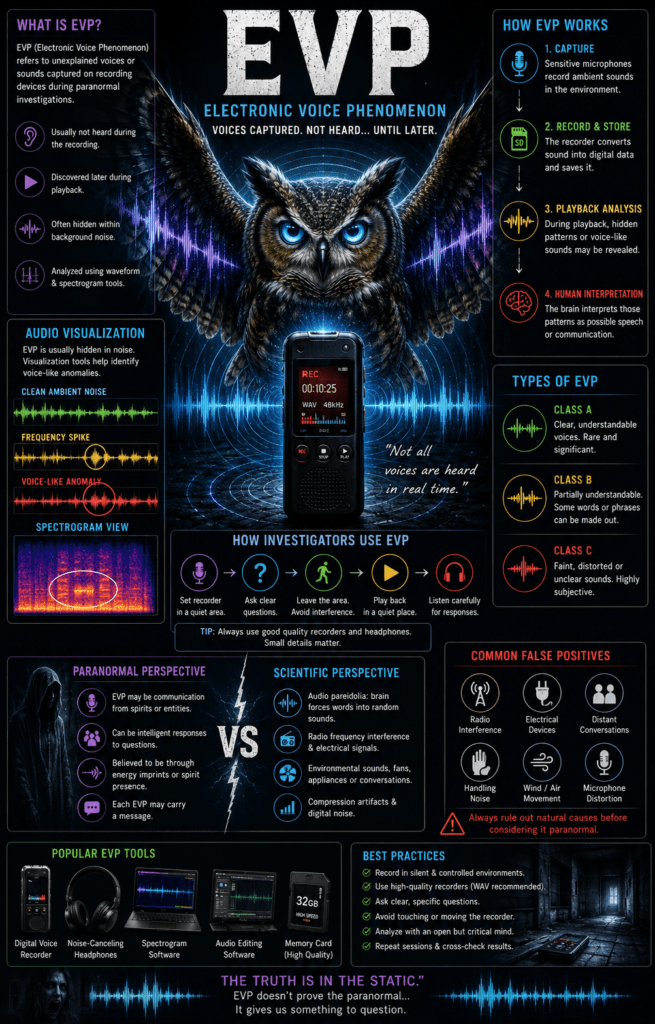
EVP stands for Electronic Voice Phenomenon. In its simplest definition, it refers to sounds — voices, words, or utterances — found on audio recordings that were not audible at the time of recording and cannot be attributed to any identifiable sound source in the environment.
That definition sounds simple. The reality of EVP research is significantly more complicated — and far more interesting — than the definition suggests.
Indian Paranormal Society (IPS) has conducted EVP recording sessions at hundreds of locations across India. What Indian Paranormal Society (IPS) has learned about EVP — what it is, what it is not, how to record it correctly, how to analyse it honestly, and what the genuine anomalies in Indian Paranormal Society (IPS)’s archive actually look like — is the subject of this complete guide.
Truth 1 — EVP Was Not Invented by Ghost Hunters
The history of EVP begins not with paranormal investigators but with an artist.
In 1959, Swedish painter and film producer Friedrich Jürgenson was recording birdsong in his garden in Sweden. On playback, he heard what he believed was a human voice speaking to him — specifically, a voice he identified as his deceased mother. He continued recording and published his findings in a 1964 book that brought EVP to wide attention for the first time.
Jürgenson’s work was picked up by Latvian psychologist Konstantīns Raudive, who conducted thousands of controlled EVP recording experiments through the 1960s and published his findings in 1971. Raudive’s work was reviewed by researchers at Pye Records in the UK, who conducted their own controlled sessions in electromagnetically shielded studios — and still found audio anomalies they could not account for.
What is EVP paranormal in the Indian context? Indian Paranormal Society (IPS) has found that awareness of EVP as a concept — and the specific expectation of hearing voices in recordings — is significantly lower in rural India than in urban centres. This matters for investigation methodology, which Indian Paranormal Society (IPS) will address in Truth 5.
Truth 2 — The Majority of Claimed EVP Is Not EVP
Indian Paranormal Society (IPS) states this directly because it is the most important thing anyone interested in EVP research needs to understand: the overwhelming majority of audio events presented as EVP online and in paranormal entertainment content are not genuine EVP anomalies.
They are one of three things:
Apophenia — the human brain’s tendency to find meaningful patterns, including words and voices, in random or ambiguous sound. This is not a weakness or a flaw. It is a deeply embedded cognitive function that exists because the cost of missing a voice in the environment (failing to hear a predator, missing a warning call) is much higher than the cost of hearing a voice that is not there. In a noisy audio recording, the brain will find words. This is called audio pareidolia when it applies specifically to hearing voices in noise.
Environmental sound misidentified — distant conversations, mechanical equipment, wind through gaps in a structure, animals, plumbing, electrical hum, and dozens of other environmental sound sources that an investigator did not identify during baseline recording. Without a thorough baseline, any sound in the recording becomes a candidate for EVP.
Deliberate fabrication — audio manipulation, AI-generated voice insertion, and selective editing to create the impression of a voice in a recording. This is more common and more technically sophisticated than ever before in 2025–26, and Indian Paranormal Society (IPS) has addressed the AI fabrication problem in a separate investigation.
Indian Paranormal Society (IPS) estimates that less than 1% of audio events widely shared as EVP online would survive rigorous baseline analysis and methodology scrutiny.
Truth 3 — Real EVP Research Requires Exhaustive Baseline Recording
The single methodology step that separates genuine EVP research from confirmation-bias audio review is baseline recording — and it is the step that almost no amateur EVP investigation includes.
A baseline recording is a complete environmental audio survey of the investigation location conducted before any EVP session begins. It documents every identifiable sound source in and around the location: mechanical equipment, ventilation, traffic, wildlife, structural settling, plumbing, electrical interference, neighbouring spaces, and environmental audio that varies with wind direction and speed.
The baseline is what makes anomaly identification possible. An audio event that cannot be matched against the baseline — that does not correspond to any documented sound source in the environment — becomes a candidate for genuine investigation. An audio event in a recording that has no baseline cannot be claimed as anomalous because there is no reference point to identify it against.
Indian Paranormal Society (IPS)’s EVP protocol requires a minimum of 45 minutes of baseline recording at any new location before any EVP session begins. At complex or large locations, baseline recording continues in parallel with EVP sessions throughout the investigation.
Truth 4 — EVP Classification Matters
Not all EVP anomalies are created equal. Indian Paranormal Society (IPS) uses the standard classification system developed by EVP researchers, adapted for Indian Paranormal Society (IPS)’s specific methodology:
Class A EVP — Clearly audible without headphones, identifiable as voice or structured sound, not attributable to any baseline-documented source. Class A is the rarest category and the only one Indian Paranormal Society (IPS) includes in primary case findings.
Class B EVP — Audible with headphones, partially interpretable, with some ambiguity about source or content. Indian Paranormal Society (IPS) logs Class B events as secondary findings requiring further investigation — not as evidence.
Class C EVP — Faint, requires significant volume amplification, highly ambiguous. Indian Paranormal Society (IPS) does not include Class C events in case findings at all. This category is where audio pareidolia operates most powerfully. A quiet, ambiguous sound amplified and listened to repeatedly in the expectation of finding a voice will always produce a voice. This is the brain’s doing, not the recording’s.
The majority of EVP presented in paranormal entertainment content — the dramatic voices that say specific words or names — is presented without classification. Indian Paranormal Society (IPS) notes that much of it, on methodologically rigorous analysis, would fall into Class C or would not survive baseline comparison at all.
Truth 5 — India’s Investigation Environments Present Unique EVP Challenges
What is EVP paranormal in India specifically? The answer is complicated by the acoustic complexity of Indian investigation environments in ways that Western EVP research literature does not fully address.
Indian Paranormal Society (IPS) has found three specific challenges that are more pronounced in Indian investigation environments than in the Western locations where most EVP methodology was originally developed:
Ambient noise density — Indian urban and semi-urban environments have exceptionally high ambient noise levels. Traffic, music from neighbouring properties, street vendors, construction, and the general density of human activity create an audio baseline of considerable complexity. EVP recording in a Mumbai apartment requires significantly more rigorous baseline work than EVP recording in a rural English manor house, for the simple reason that there are more sound sources to document and exclude.
Language ambiguity — India’s linguistic diversity creates a specific EVP analysis problem. Audio pareidolia is language-dependent — people hear words in the language or languages they are most familiar with. An Indian investigator with native Hindi and working English may hear different things in an ambiguous audio event than a Western investigator reviewing the same recording. Indian Paranormal Society (IPS) review protocol requires independent analysis by investigators from different linguistic backgrounds for any audio event being considered as a Class B or Class A finding.
Structural acoustic complexity — Many of India’s historically significant investigation locations — forts, havelis, temples, colonial-era bungalows — have acoustic properties that create sound propagation effects not present in newer construction. Sound carries between rooms in ways that are not immediately obvious. Distant sounds appear to originate from immediately adjacent spaces. Indian Paranormal Society (IPS)’s structural acoustic assessment, conducted as part of every investigation at a heritage location, is essential for EVP work at these sites.
Truth 6 — The Equipment Matters Less Than the Methodology
The paranormal entertainment industry has created a market for increasingly elaborate and expensive EVP recording equipment — spirit boxes, real-time EVP generators, modified radio-frequency scanners, and devices that claim to translate spirit communication into words in real time.
Indian Paranormal Society (IPS)’s position on this equipment category is straightforward: devices that produce output in real time cannot be used for genuine EVP research because they cannot be baseline-compared. A spirit box generates audio continuously. There is no pre-session baseline against which its output can be checked. Every word it produces is a candidate for apophenic interpretation. These devices are not EVP research tools. They are audio pareidolia generators with a paranormal marketing frame.
For genuine EVP recording, Indian Paranormal Society (IPS) uses high-quality digital audio recorders with low self-noise — specifically chosen to minimise the recorder’s own contribution to the audio baseline. The Zoom H series and Tascam DR series are Indian Paranormal Society (IPS)’s preferred recorders in India. Both are available from Indian electronics retailers.
The methodology — baseline protocol, session discipline, post-session analysis procedure — is what produces reliable EVP research. The recorder is simply the instrument the methodology uses.
Truth 7 — Post-Session Analysis Is Where Real EVP Work Happens
The investigation session is not where EVP research happens. It is where audio is collected. The research happens in post-session analysis — and it is significantly more rigorous and time-consuming than paranormal entertainment content suggests.
Indian Paranormal Society (IPS)’s post-session EVP analysis protocol:
Step 1 — Complete playback. Every minute of recorded audio is reviewed in full. Indian Paranormal Society (IPS) does not fast-forward. Audio events are time-stamped and flagged for further review.
Step 2 — Baseline comparison. Every flagged audio event is compared against the baseline recording. Events that match baseline-documented sources are closed. Events with no baseline match proceed to Step 3.
Step 3 — Independent review. Flagged events that survive baseline comparison are reviewed independently by a second Indian Paranormal Society (IPS) investigator who has not been told what the first reviewer heard. This step specifically guards against expectation bias — the tendency to hear in ambiguous audio what you have been told is there.
Step 4 — Spectral analysis. Audio events that survive Steps 1–3 are subjected to spectral analysis — visual examination of the frequency signature of the event. Genuine voice-like audio has a recognisable frequency signature. Mechanical sounds, even when they sound like voices to the human ear, have frequency signatures that differ from speech patterns.
Step 5 — Classification and filing. Events that survive all four steps are classified (A, B, or C) and filed in the case file with full documentation — time stamp, session conditions, baseline comparison result, spectral analysis, independent reviewer notes.
This process takes significantly longer than the recording session itself. A 3-hour EVP session may produce 8–12 hours of analysis work. This is why genuine EVP research is rare and why confirmation-bias review is common — the rigorous process is genuinely laborious.
Truth 8 — EVP and AI Analysis in 2025–26
This is the most rapidly evolving area of EVP research. Indian Paranormal Society (IPS) addressed AI and paranormal investigation in a separate article, but EVP deserves specific treatment.
AI audio analysis tools — using machine learning trained on large audio datasets — can now scan EVP recordings and flag anomalies that deviate from environmental baselines with greater consistency and less subjective bias than human review alone. For Class C events in particular, where human review is most vulnerable to apophenia, AI analysis provides a genuinely useful check.
Indian Paranormal Society (IPS) has been evaluating AI audio analysis tools for integration into the post-session analysis protocol. The principle Indian Paranormal Society (IPS) applies is the same as for all AI tools in investigation: AI analysis is a supplement to rigorous methodology, not a replacement for it. And any EVP finding supported by AI analysis must include the raw, unprocessed audio alongside the analysis output. Raw data always. Without exception.
The risk — which Indian Paranormal Society (IPS) has documented publicly — is that AI audio tools can also be used to fabricate compelling EVP. A model trained on speech patterns can insert voice-like audio into recordings in ways that survive casual spectral analysis. This is the most serious current threat to EVP research credibility and Indian Paranormal Society (IPS) is watching it closely.
Truth 9 — India Has a Unique EVP Landscape
India’s paranormal investigation environment is unlike any other in the world, and the EVP landscape reflects this.
India has thousands of historically significant locations — forts, temples, battlefields, colonial-era buildings, abandoned industrial sites — with centuries of documented human history. The density of genuinely significant investigation sites in India is extraordinary by global comparison.
Indian Paranormal Society (IPS) has conducted EVP sessions at a range of these locations — from Bhangarh Fort in Rajasthan to Mukesh Mills in Mumbai. The acoustic and environmental profiles of each location create specific EVP conditions that a one-size-fits-all methodology cannot address. Indian Paranormal Society (IPS)’s India-specific protocol adaptations — particularly the baseline density requirements and the multi-language review procedure — are the result of 15 years of learning what standard Western EVP methodology misses in the Indian context.
Truth 10 — The Genuinely Unexplained Cases Exist
Indian Paranormal Society (IPS) has, across 15 years of EVP research, documented a small number of audio events that have survived the complete analysis protocol — baseline comparison, independent review, spectral analysis — and remain unclassified.
Indian Paranormal Society (IPS) does not present these recordings as proof of paranormal activity. Indian Paranormal Society (IPS) presents them as what they are: anomalies that the methodology has not been able to explain. They exist in Indian Paranormal Society (IPS)’s archive. They are available for review by accredited researchers.
The existence of unexplained EVP anomalies in Indian Paranormal Society (IPS)’s archive does not validate the thousands of fabricated or misidentified EVP events that circulate online. The two things are entirely separate. What makes Indian Paranormal Society (IPS)’s unexplained recordings significant is precisely that they come from a methodology rigorous enough to make “unexplained” mean something.
Truth 11 — How to Conduct Your First EVP Session in India
If you want to try EVP recording yourself, Indian Paranormal Society (IPS) recommends starting with this basic protocol:
Equipment needed: Digital audio recorder (Zoom H1n or equivalent), notebook and pen, a location you can access safely and legally.
Before you record:
- Document every identifiable sound source in and around the location for at least 30 minutes. This is your baseline.
- Note the time, date, temperature, weather conditions, and who is present.
- Put your phone on silent and place it away from the recorder — phones generate EMF interference in audio.
During the session:
- State the time, date, location, and who is present at the start of the recording.
- Leave at least 30 seconds of silence between any questions or statements — EVP events, if they occur, need clear audio space to be identifiable.
- Any sound made by you or your team — a cough, a movement, a whisper — must be announced immediately on the recording so it can be identified during analysis.
- Session length: 30–60 minutes is sufficient for a first session.
After the session:
- Review the complete recording against your baseline before claiming any event as anomalous.
- Get a second person to review any flagged events independently before drawing any conclusion.
- Apply the classification system: only Class A events are worth reporting.
For formal training in EVP methodology as part of a complete paranormal investigation certification, visit Indian Paranormal Society (IPS)’s GRIP Academy at indianparanormalsociety.in/grip-academy.
Frequently Asked Questions
What is EVP in paranormal investigation? EVP (Electronic Voice Phenomenon) refers to sounds found on audio recordings that were not audible at the time of recording and cannot be attributed to any identifiable environmental source. Indian Paranormal Society (IPS) defines genuine EVP as audio that survives baseline comparison, independent review, and spectral analysis.
Is EVP evidence of ghosts? Indian Paranormal Society (IPS) does not make that claim. Genuine EVP anomalies — audio events that survive rigorous methodology — are unexplained phenomena. “Unexplained” does not mean “paranormal.” Indian Paranormal Society (IPS) maintains open case files for EVP anomalies that have not been resolved.
What equipment do I need for EVP recording in India? A high-quality digital audio recorder with low self-noise — Indian Paranormal Society (IPS) recommends the Zoom H1n or Tascam DR-05X, both available in India. Spirit boxes and real-time EVP devices are not suitable for genuine EVP research.
How does Indian Paranormal Society (IPS) analyse EVP recordings? Indian Paranormal Society (IPS) uses a five-step protocol: complete playback with timestamping, baseline comparison, independent second-reviewer analysis, spectral analysis, and formal classification (Class A, B, or C). Only Class A events are included in primary case findings.
Why is most EVP online fake? The majority of online EVP is either audio pareidolia (the brain hearing words in random noise), environmental sound misidentified due to lack of baseline recording, or deliberate fabrication. Indian Paranormal Society (IPS) estimates less than 1% of widely shared EVP audio would survive rigorous methodology scrutiny.
Indian Paranormal Society (IPS) has conducted EVP research across India since 2009, applying rigorous scientific methodology to audio anomaly documentation. Founded by Gaurav Tiwari, Indian Paranormal Society (IPS) maintains an archive of EVP recordings from 6,000+ investigations. For certified EVP training, enroll in GRIP Academy at indianparanormalsociety.in.