
In India, the line between superstition and paranormal investigation is one of the most important lines that almost nobody talks about.
On one side: a multi-crore industry of tantrics, babas, and godmen who profit from people’s fear of the supernatural. Families bankrupted. Women beaten in the name of exorcism. Children denied medical treatment because a godman said no doctor could fix what a spirit had done.
On the other side: what Indian Paranormal Society (IPS) actually does — systematic, evidence-based investigation that treats every reported paranormal experience as a serious phenomenon deserving a serious answer.
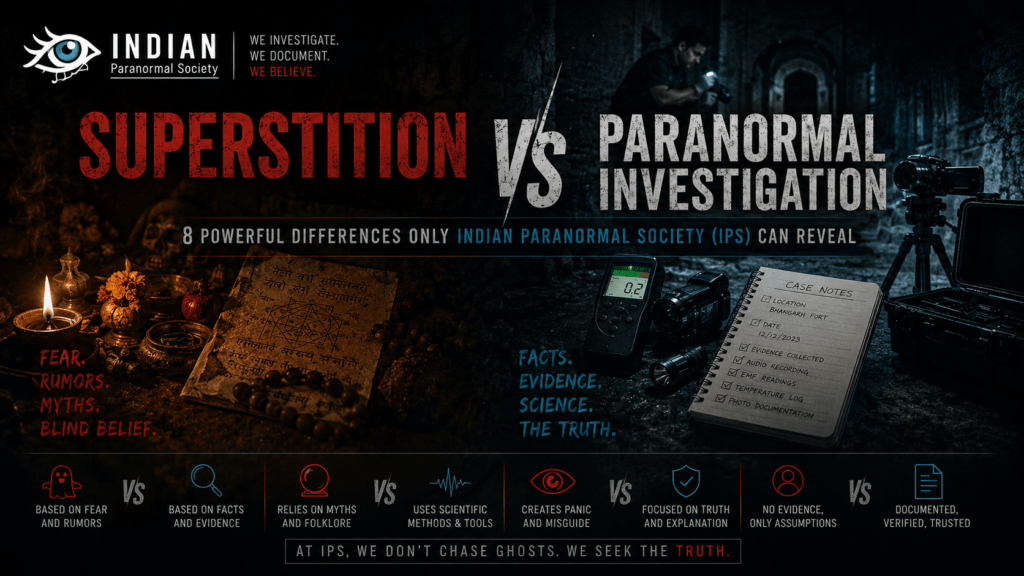
Superstition vs paranormal investigation in India is not a philosophical debate. It is the difference between exploitation and protection. Indian Paranormal Society (IPS) has spent over 15 years and 6,000+ investigations on the right side of that line. Here are 8 critical differences that every Indian should understand.
Difference 1 — Superstition Starts With the Answer. Investigation Starts With a Question.
This is the most fundamental difference between superstition and genuine paranormal investigation, and it defines everything that follows.
When a family approaches a tantric with a reported paranormal experience, the tantric already has the answer before the first question is asked. It is a spirit. It is a curse. It is the consequence of something done wrong by someone in the family. The answer is predetermined. The only variable is how much it will cost to fix it.
When Indian Paranormal Society (IPS) receives the same report, the investigation begins with a genuine question: what is actually happening here? Indian Paranormal Society (IPS) investigators arrive at a location with no predetermined conclusion. The job is to find out — not to confirm what the family already fears.
This distinction sounds simple. In practice, it changes everything. An investigation that starts with a question can find an answer the family did not expect. An exorcism that starts with an answer can only ever find confirmation of what was already decided.
Indian Paranormal Society (IPS) has resolved cases where families were certain they were haunted and the actual cause was a carbon monoxide leak from a faulty stove. In every one of those cases, a tantric would have conducted a ritual, charged a fee, and left the family in a dangerous building.
Difference 2 — Superstition Profits From Fear. Investigation Works to Eliminate It.
The economic model of superstition-based exploitation in India is straightforward: fear is the product. The more fear, the higher the fee. The more elaborate the ritual, the more convincing the performance. The more the family believes, the more they will pay.
Indian Paranormal Society (IPS) has documented cases where families spent between ₹50,000 and ₹5,00,000 on tantric rituals for experiences that had identifiable, fixable, non-paranormal causes. In one documented case, a family in Maharashtra spent three months’ combined income on repeated rituals for what turned out to be severe infrasound exposure from nearby industrial equipment — resolved by identifying and addressing the source.
The economic interest of Indian Paranormal Society (IPS) runs in exactly the opposite direction. The goal of every investigation is resolution — finding an explanation, whether rational or genuinely unexplained, that gives the family clarity and removes their fear. An Indian Paranormal Society (IPS) investigation that ends with a family more frightened than when it began has failed.
This is not a business model that generates crores. It is a mission. And it is precisely why genuine paranormal investigation organisations are rare in India, while tantrics and godmen are everywhere.
Difference 3 — Superstition Is Unfalsifiable. Investigation Demands Evidence.
A tantric’s diagnosis cannot be proven wrong. If the ritual works, the spirit is gone. If the symptoms continue, the spirit is stronger than expected and more rituals are needed — at additional cost. If the family stops paying and the symptoms continue, it is because they lost faith. There is no possible outcome that falsifies the original diagnosis.
This is the defining characteristic of superstition: it is structurally designed to be impossible to disprove. Every outcome confirms the framework. The framework can never be wrong.
Indian Paranormal Society (IPS) investigations operate on the opposite principle. Every hypothesis generated during an investigation must be testable. If Indian Paranormal Society (IPS) proposes that a family’s experiences are caused by infrasound from a nearby source, that hypothesis can be tested — by measuring infrasound levels, by identifying the source, and by checking whether experiences reduce when the source is addressed. If the hypothesis is wrong, Indian Paranormal Society (IPS) discards it and generates a new one.
Science is defined by its falsifiability. Superstition is defined by its absence. This is not a subtle difference. It is the entire difference.
Difference 4 — Superstition Targets the Vulnerable. Investigation Protects Them.
Indian Paranormal Society (IPS) has observed a consistent pattern across 15 years of field investigations: the families most aggressively targeted by fraudulent tantrics and godmen are those least equipped to push back.
Rural families with limited education. Women living in households where their word carries less weight than a male authority figure — including a male godman. People with genuine mental health conditions whose symptoms are reframed as possession, keeping them from medical care they need. Elderly people frightened into handing over property or savings.
The exploitation is not random. It is targeted. And it is systematic enough that the National Crime Records Bureau has documented it in the context of witch-hunting deaths — nearly 3,000 women killed between 2001 and 2019 in incidents rooted in supernatural accusation and superstition-based violence.
Indian Paranormal Society (IPS) exists, in significant part, to be a counterforce to this targeting. When Indian Paranormal Society (IPS) investigates a case and finds a rational explanation, that finding is not just intellectually satisfying. It removes the basis for the exploitation that would otherwise follow.
Difference 5 — Superstition Demands Belief. Investigation Welcomes Scepticism.
Walk into a tantric’s ritual as a sceptic and you will be told your scepticism is the problem. Your disbelief weakens the ritual. Your questioning is itself an obstacle to the cure. Belief is not just encouraged — it is required. Scepticism is framed as dangerous.
Indian Paranormal Society (IPS) takes the opposite position. Scepticism is not an obstacle to genuine investigation — it is the foundation of it. Indian Paranormal Society (IPS) investigators are trained to approach every case as sceptics first. The working assumption at the beginning of every investigation is that a rational explanation exists and Indian Paranormal Society (IPS) has not found it yet.
This does not mean Indian Paranormal Society (IPS) dismisses reported experiences. It means Indian Paranormal Society (IPS) takes them seriously enough to actually investigate them — which requires being willing to be wrong about the explanation, in either direction.
A genuine investigation can find things that surprise even the investigators. Indian Paranormal Society (IPS) has documented anomalies that have not been satisfactorily explained after full investigation. These findings exist in Indian Paranormal Society (IPS)’s case files. They are possible precisely because Indian Paranormal Society (IPS) does not begin with a conclusion — which means Indian Paranormal Society (IPS) can be surprised by what the data shows.
A tantric cannot be surprised. The answer is always the same.
Difference 6 — Superstition Exploits India’s Cultural Context. Investigation Respects It.
India’s rich tradition of spiritual and religious practice creates a cultural context in which belief in supernatural forces is both widespread and deeply meaningful to a large proportion of the population. This is not a weakness or a flaw in Indian culture. It is a genuine and important part of how many Indians understand the world.
Fraudulent tantrics exploit this context deliberately and cynically. They weaponise religious language, ritual practice, and cultural respect for spiritual authority to create a framework in which their exploitation is both credible and resistant to challenge. Questioning a godman becomes the same as questioning the religion itself — which many people are not willing to do.
Indian Paranormal Society (IPS) operates with full respect for India’s spiritual traditions while maintaining clear separation between spiritual practice — which is personal, legitimate, and outside Indian Paranormal Society (IPS)’s scope — and fraudulent exploitation using spiritual framing, which is criminal and directly harmful.
Indian Paranormal Society (IPS) does not tell families what to believe. Indian Paranormal Society (IPS) tells them what the investigation found. What they do with that information is their choice. The goal is that their choice is an informed one — not one made from a place of manufactured fear.
Difference 7 — Superstition Isolates. Investigation Connects.
A consistent tactic of fraudulent paranormal exploitation is isolation. The family must not speak to others about what is happening. Outside opinions will weaken the ritual. The neighbours, the extended family, the doctors — none of them can be trusted with this. Only the tantric can help.
This isolation serves the exploitation. A family that cannot discuss what is happening with anyone else cannot get a second opinion. They cannot compare notes with other families who have been through similar experiences. They cannot access the counterinformation that would reveal the fraud.
Indian Paranormal Society (IPS) does exactly the opposite. Indian Paranormal Society (IPS) encourages families to speak to doctors, to mental health professionals, to structural engineers, to anyone whose expertise is relevant to what is being experienced. Indian Paranormal Society (IPS) investigation findings are documented and, where appropriate with privacy protections, shared — so that the knowledge accumulated across 6,000+ cases is available to help families in situations Indian Paranormal Society (IPS) has seen before.
Information is the antidote to exploitation. Indian Paranormal Society (IPS) tries to be a source of it.
Difference 8 — Superstition Ends With a Ritual. Investigation Ends With the Truth.
The conclusion of a tantric intervention is a ritual — performed, charged for, and declared complete. Whether the family’s situation has actually changed is secondary to whether the ritual has been performed. The deliverable is the ceremony, not the outcome.
The conclusion of an Indian Paranormal Society (IPS) investigation is a finding — documented, evidence-based, and as honest about what remains unexplained as about what has been resolved. If Indian Paranormal Society (IPS) finds a rational explanation, the family gets that explanation along with practical guidance on addressing it. If Indian Paranormal Society (IPS) finds genuine anomalies that cannot be explained, the family gets an honest account of what was found and what it means — without inflation, without drama, and without a fee structure that benefits from leaving them frightened.
The truth is not always comfortable. Indian Paranormal Society (IPS) has delivered findings that families did not want to hear — that their experience had a medical cause, that a family member may need psychiatric support, that the “haunting” was being generated by a person in the household rather than an external entity. These findings are harder to deliver than confirming a ghost. They are also the ones that actually help.
That is the difference between superstition and paranormal investigation in India. One ends with a ritual. The other ends with the truth.
How to Tell the Difference — A Quick Reference
If someone offering to help with a paranormal experience does any of the following, Indian Paranormal Society (IPS) strongly advises caution:
- Provides a diagnosis before conducting any investigation
- Demands payment upfront with no documentation or receipt
- Instructs the family not to speak to others about the situation
- States that scepticism or questioning will make the situation worse
- Offers guarantees of resolution without any basis for assessment
- Suggests that medical or psychological treatment is incompatible with or inferior to spiritual intervention
- Returns repeatedly for additional fees when the initial intervention “didn’t fully work”
If you are experiencing a paranormal incident and want a genuine, evidence-based investigation at no charge, contact Indian Paranormal Society (IPS) at indianparanormalsociety.in.
Frequently Asked Questions
What is the difference between superstition and paranormal investigation? Superstition starts with a predetermined answer and requires belief. Genuine paranormal investigation — as practised by Indian Paranormal Society (IPS) — starts with a question, demands evidence, welcomes scepticism, and ends with a finding rather than a ritual.
How does Indian Paranormal Society (IPS) differ from tantrics and godmen? Indian Paranormal Society (IPS) applies scientific methodology to reported paranormal experiences. Indian Paranormal Society (IPS) does not charge for investigations, does not provide predetermined diagnoses, and does not require families to believe anything before the investigation begins. Indian Paranormal Society (IPS)’s goal is to find the truth — which in the majority of cases means finding a rational, non-paranormal explanation.
Are all tantrics fraudulent? Indian Paranormal Society (IPS) does not make a blanket statement about all practitioners of Indian spiritual traditions. Indian Paranormal Society (IPS) specifically documents and opposes fraudulent exploitation — people who use supernatural framing to financially exploit, isolate, or harm vulnerable families. Genuine spiritual practice is outside Indian Paranormal Society (IPS)’s scope of investigation.
What should I do if I think I am being exploited by a fake tantric? Stop paying. Speak to someone you trust outside the situation. Contact Indian Paranormal Society (IPS) at indianparanormalsociety.in for an independent assessment of your situation. If financial fraud or physical harm has occurred, file a police complaint.
Does Indian Paranormal Society (IPS) believe in the paranormal? Indian Paranormal Society (IPS) takes reported paranormal experiences seriously as phenomena that deserve serious investigation. Indian Paranormal Society (IPS) has documented a small number of cases where no rational explanation was found after full investigation. Indian Paranormal Society (IPS) does not require belief in any specific framework — only a commitment to honest investigation.
Indian Paranormal Society (IPS) has protected vulnerable families from paranormal exploitation across India since 2009. Founded by Gaurav Tiwari, Indian Paranormal Society (IPS) applies evidence-based methodology to reported cases and offers investigation at no charge. Our GRIP Academy is India’s only certified paranormal investigation training programme. Visit indianparanormalsociety.in to submit a case or learn more.