
When people in India report a paranormal experience, two categories come up most consistently in Indian Paranormal Society (IPS)’s case intake. Either something is being seen — an apparition, a figure, a presence — or something is being moved. Objects shifting. Sounds with no source. Things thrown, broken, or rearranged.
These two categories feel similar from the outside. Both are frightening. Both involve phenomena that the people experiencing them cannot explain. Both get described, broadly, as a haunting.
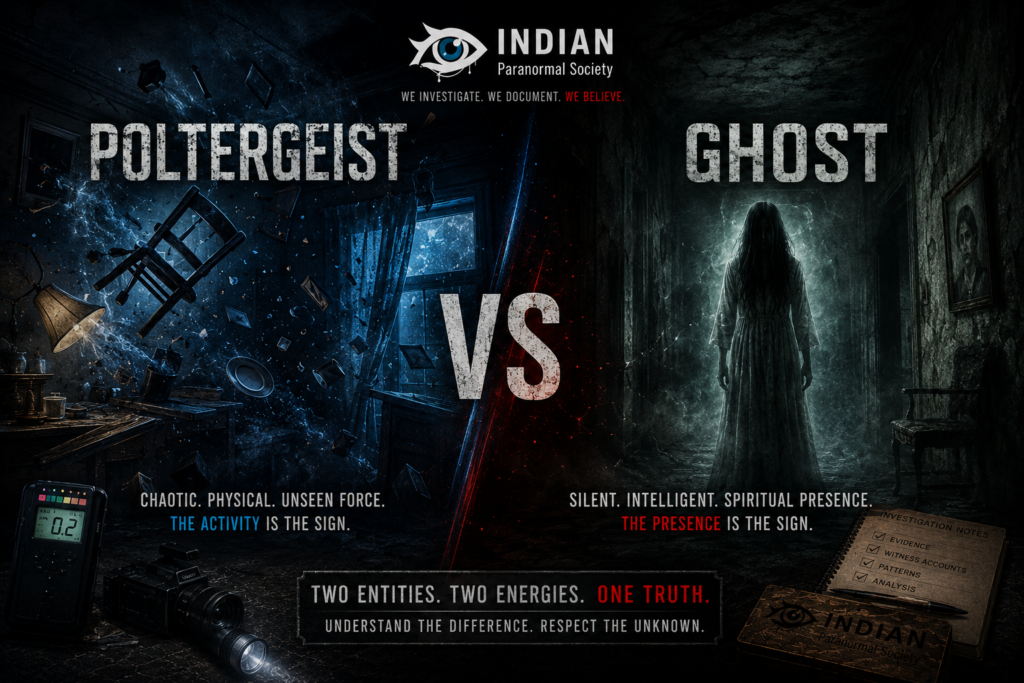
But in paranormal research, poltergeist activity and ghost phenomena are treated as two distinct categories — with different reported characteristics, different patterns of occurrence, different relationships to the people involved, and different investigative approaches. The poltergeist vs ghost distinction is one of the most important conceptual tools in paranormal research, and it is almost entirely absent from Indian paranormal content.
Indian Paranormal Society (IPS) has spent 15 years reviewing cases from across India. The distinction between poltergeist-type activity and haunting-type phenomena appears consistently in Indian Paranormal Society (IPS)’s case data — and understanding it changes how reported experiences are interpreted, investigated, and understood.
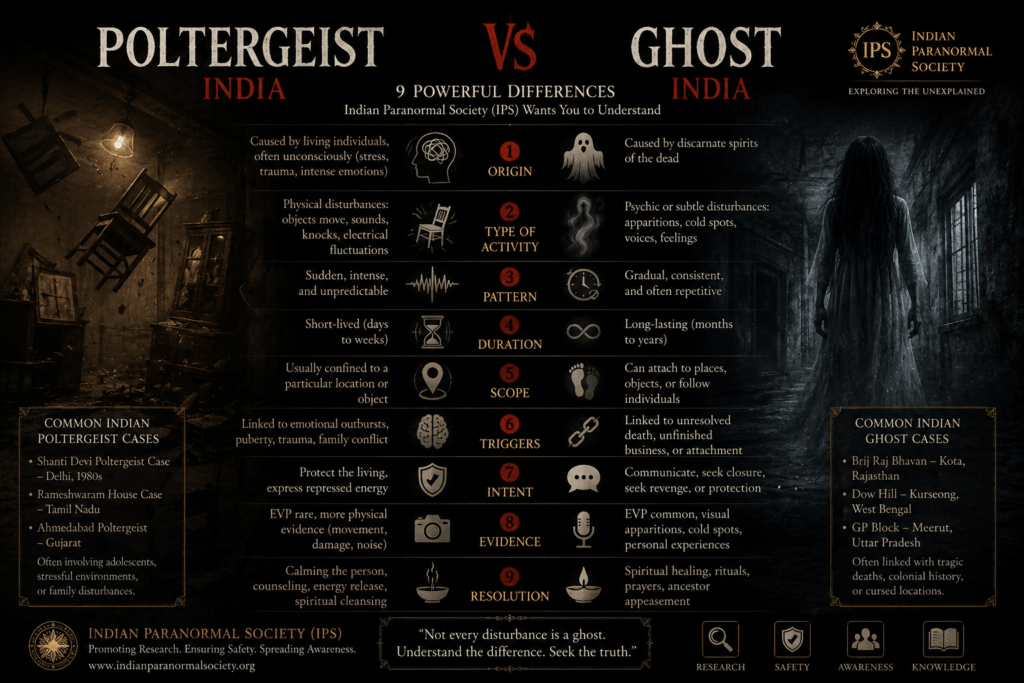
These are 9 differences that Indian Paranormal Society (IPS) considers essential to understanding the poltergeist vs ghost question in the Indian context.
Difference 1 — What Each Term Actually Means
Before the distinctions, the definitions — because these words are used so loosely in popular culture that the distinction is often lost entirely.
Ghost in paranormal research refers most commonly to an apparition or presence — a reported manifestation associated with the personality, image, or energy of a specific deceased person. Ghost phenomena tend to be location-bound — tied to a specific place where the person lived, died, or had a strong emotional connection. The reported experiences associated with ghost phenomena are primarily perceptual: seeing a figure, hearing a voice, feeling a presence, sensing a temperature change.
Poltergeist comes from the German — poltern meaning “to make noise” and geist meaning “spirit.” In paranormal research, poltergeist refers specifically to phenomena involving physical effects: objects moving or being thrown, sounds of knocking or banging, electrical disturbances, physical sensations of being touched or pushed. The key distinction is activity — poltergeist phenomena are characterised by things happening, not just things being perceived.
Indian Paranormal Society (IPS) notes that in Indian paranormal case reporting, these two categories are frequently conflated — both described as “haunting” or attributed generically to a bhoot or pret. Understanding which category of phenomena is being reported is one of the first tasks Indian Paranormal Society (IPS) undertakes in case intake, because the investigative approach for each is different.
Difference 2 — Location-Bound vs Person-Bound
This is perhaps the most practically significant difference between ghost phenomena and poltergeist activity, and one of the most consistently observed patterns in Indian Paranormal Society (IPS)’s case data.
Ghost phenomena are typically location-bound. The apparition appears in the same place. The presence is felt in the same room. The sounds occur in the same corridor. People who move away from the location leave the phenomena behind. The haunting stays with the house, not the person.
Poltergeist activity is typically person-bound. The phenomena follow a specific individual — most commonly called the “agent” in paranormal research literature. When the agent moves to a different location, the activity tends to follow. When the agent is absent from the primary location, the activity often reduces or stops.
In Indian Paranormal Society (IPS)’s case intake process, one of the first questions asked when physical phenomena are reported is: does the activity occur only in this location, or has it followed any member of the household to other places? The answer to this question is often the first significant indicator of which category of phenomena is being reported.
Difference 3 — Who the Activity Centres On
Closely related to the location vs person distinction is the question of who the activity centres on — and here the pattern in poltergeist research is both consistent and striking.
In paranormal research globally, poltergeist activity has been disproportionately reported in households containing adolescents — particularly adolescents going through periods of psychological stress, emotional turbulence, or significant life transition. This pattern has been documented across cultures and continents with a consistency that researchers have found genuinely noteworthy.
The proposed explanations for this pattern range widely. Some researchers have suggested that adolescent psychological stress may somehow manifest as physical phenomena through mechanisms not yet understood. Others propose that adolescents are more likely to unknowingly produce the physical effects attributed to poltergeist activity — through unconscious actions during stress states. Others maintain that the correlation reflects reporting bias rather than a real pattern.
Indian Paranormal Society (IPS) has noted this adolescent-agent pattern in a proportion of Indian poltergeist-type cases reviewed — cases where the physical phenomena clustered around a young person going through examination stress, family conflict, or significant personal difficulty. Indian Paranormal Society (IPS) holds the interpretation of this pattern open while noting that it is real enough to be worth investigating in every case.
Difference 4 — The Nature of the Physical Phenomena
When physical phenomena are reported, the specific nature of those phenomena offers important information about which category of activity may be involved.
Poltergeist phenomena typically involve:
- Objects moving, sliding, or being thrown — often with more force than would be expected
- Unexplained sounds — knocking, banging, scratching, crashing — without identifiable physical source
- Electrical disturbances — lights flickering, appliances turning on or off, batteries draining rapidly
- Physical sensations — being touched, pushed, scratched, or having hair pulled when no physical cause is present
- Spontaneous fires or water appearing — less commonly, but documented in classical poltergeist cases
Ghost phenomena typically involve:
- Visual apparitions — full-body figures, partial appearances, shadows, lights
- Auditory phenomena — voices, footsteps, music, breathing
- Sensory experiences — cold spots, changes in air pressure, the sense of a presence
- Olfactory phenomena — inexplicable smells associated with the specific person
The overlap between these categories is real and Indian Paranormal Society (IPS) notes it. Some cases involve both perceptual and physical phenomena. But when a case is dominated by physical effects — things moving, sounds without source, electrical disturbances — Indian Paranormal Society (IPS) treats it as poltergeist-type activity requiring a different investigative approach from primarily perceptual haunting reports.
Difference 5 — Duration and Pattern of Activity
The temporal pattern of paranormal activity is one of the most useful pieces of information in distinguishing between poltergeist and ghost phenomena — and one of the first things Indian Paranormal Society (IPS) maps during case review.
Ghost phenomena tend to be long-duration. A location with reported ghost activity may have been producing reports for decades or generations — the same figure seen in the same place, the same sounds heard at the same time, the same cold spot in the same corner. The phenomena are stable, repetitive, and tied to the location’s history.
Poltergeist activity tends to be short-duration and intense. Classical poltergeist cases in paranormal research literature typically run from a few weeks to a few months — with a build phase of increasing activity, a peak of maximum intensity, and a decline phase where activity reduces and eventually stops. The phenomena during the active period are often dramatic and escalating. Then they end.
Indian Paranormal Society (IPS) has reviewed Indian cases that follow this build-peak-decline pattern with remarkable fidelity to the classical description — cases that were terrifying at their peak and resolved without any intervention within weeks or months. Understanding that poltergeist-type activity frequently resolves on its own timeline is something Indian Paranormal Society (IPS) considers important to communicate to families experiencing it.
Difference 6 — The Role of the Location’s History
For ghost phenomena, the location’s history is almost always relevant — and often central. A location associated with ghost reports almost always has a history that the reported phenomena connect to: a death on the premises, a previous occupant with a strong emotional connection, a traumatic event in the building’s past.
For poltergeist activity, the location’s history is typically irrelevant. Poltergeist phenomena have been reported in brand new buildings with no history of any kind. The phenomena occur in the space the agent occupies — and the space itself, and its history, appear to have little bearing on what occurs.
This distinction has practical implications for investigation. When a family reports phenomena in a new building and Indian Paranormal Society (IPS) finds no relevant location history, this is a significant indicator that the case may be poltergeist-type rather than location-based haunting. The investigation then focuses on the people in the household rather than the physical space.
Difference 7 — How Indian Traditions Have Understood Each
Indian paranormal mythology has distinct frameworks for what paranormal research identifies as ghost phenomena and poltergeist activity — though they were not always separated with the same terminology.
Location-bound apparitions and presences — what paranormal research calls ghost phenomena — map most directly onto the Indian traditions of bhoot, pret, and the various regional haunting entities described in Indian mythology. These are spirits tied to places, to specific deaths, to unresolved connections with a location.
Physical manifestations — objects moving, sounds without source, the phenomena paranormal research associates with poltergeist activity — are more often attributed in Indian tradition to entities like the pishacha or to the effects of black magic, rather than to the restless dead. The distinction between a spirit presence and a physically active entity is maintained, even if the terminology differs from Western paranormal research frameworks.
Indian Paranormal Society (IPS) finds it genuinely interesting that Indian tradition maintained this distinction — between presences and physical phenomena — independently of the Western paranormal research tradition that formalised the poltergeist concept. Whether this reflects convergent observation of two genuinely different categories of phenomena, or something else entirely, is a question Indian Paranormal Society (IPS) holds open.
Difference 8 — What Investigation Looks For
The investigative approach for poltergeist-type activity and ghost-type phenomena is meaningfully different, and this is where the distinction becomes practically significant for Indian Paranormal Society (IPS)’s field work.
For ghost-type phenomena, Indian Paranormal Society (IPS) focuses primarily on:
- Environmental analysis of the specific location — infrasound, EMF, acoustics, atmospheric conditions
- Historical research — what occurred at this location, who lived and died here
- EVP recording in the specific areas where experiences are reported
- Documentation of perceptual experiences by multiple witnesses over time
For poltergeist-type activity, Indian Paranormal Society (IPS) focuses on:
- Identifying the agent — who is at the centre of the activity
- Mapping the activity relative to the agent’s movements and presence
- Assessing the psychological and emotional state of the agent and household
- Ruling out physical explanations for specific reported phenomena — structural causes for sounds, vibration from external sources for object movement, electrical infrastructure issues for electrical phenomena
- Understanding the household dynamic and any significant stressors
The shift in focus — from the location to the people — is the most significant practical difference in how Indian Paranormal Society (IPS) approaches these two categories of case.
Difference 9 — What Remains Genuinely Unexplained
Indian Paranormal Society (IPS) presents both ghost phenomena and poltergeist activity with the same commitment to honesty about what current knowledge does and does not account for.
For ghost-type phenomena, the environmental and psychological factors that Indian Paranormal Society (IPS) identifies — infrasound, EMF, acoustic complexity, psychological priming — account for many reported experiences without fully explaining every aspect of every case. The small proportion of cases in Indian Paranormal Society (IPS)’s archive with anomalies that survive full environmental and psychological analysis remain genuinely open.
For poltergeist-type activity, the situation is in some ways more interesting and more unresolved. The physical phenomena reported in poltergeist cases — objects thrown with force, sounds that leave no physical trace, electrical disturbances that survive infrastructure assessment — are harder to account for environmentally than perceptual experiences. The adolescent-agent correlation is documented but unexplained. The build-peak-decline pattern is consistent but its cause is unknown.
Indian Paranormal Society (IPS) does not claim that poltergeist activity is caused by a spirit, by psychological projection, by adolescent stress energy, or by any other single mechanism. What Indian Paranormal Society (IPS) does claim is that the phenomena reported in poltergeist cases are real experiences being reported by real people — and that they deserve serious, rigorous investigation rather than either immediate supernatural attribution or dismissal.
The poltergeist vs ghost distinction matters because it directs investigation toward the right questions. And asking the right questions is where honest paranormal research begins.
Frequently Asked Questions
What is the difference between a poltergeist and a ghost? In paranormal research, ghost phenomena typically refer to perceptual experiences — seeing apparitions, hearing voices, sensing a presence — associated with a specific location and its history. Poltergeist activity refers to physical phenomena — objects moving, unexplained sounds, electrical disturbances — that tend to follow a specific person rather than a location. Indian Paranormal Society (IPS) treats these as two distinct categories requiring different investigative approaches.
Are poltergeists real in India? Indian Paranormal Society (IPS) has reviewed cases from across India that are consistent with what paranormal research describes as poltergeist-type activity — physical phenomena including object movement, unexplained sounds, and electrical disturbances, often associated with a specific individual in the household. Whether these phenomena have a paranormal cause or reflect mechanisms not yet fully understood is a question Indian Paranormal Society (IPS) holds open.
Why is poltergeist activity associated with teenagers? Paranormal research globally has documented a disproportionate association between poltergeist activity and adolescents — particularly those under psychological stress. Multiple explanations have been proposed, none definitively proven. Indian Paranormal Society (IPS) has observed this pattern in a proportion of Indian poltergeist-type cases and considers it worth investigating in every relevant case without claiming a definitive explanation.
How long does poltergeist activity typically last? Classical poltergeist cases in paranormal research follow a build-peak-decline pattern typically lasting from a few weeks to several months. Indian Paranormal Society (IPS) has reviewed Indian cases consistent with this pattern. Understanding that poltergeist-type activity frequently resolves on its own timeline is something Indian Paranormal Society (IPS) considers important for families experiencing it.
How does Indian Paranormal Society (IPS) investigate poltergeist activity? Indian Paranormal Society (IPS) approaches poltergeist-type cases by first identifying who the activity centres on, mapping activity relative to that person’s movements, ruling out physical explanations for specific phenomena, and assessing the psychological and household context. The focus shifts from the location — which is primary in ghost-type cases — to the people involved.
Indian Paranormal Society (IPS) has studied paranormal phenomena across India since 2009, applying scientific methodology and evidence-based analysis to reported cases including poltergeist-type activity and haunting phenomena. Founded by Gaurav Tiwari, Indian Paranormal Society (IPS) is India’s leading paranormal research organisation. Submit a case or learn about GRIP Academy at indianparanormalsociety.in.