
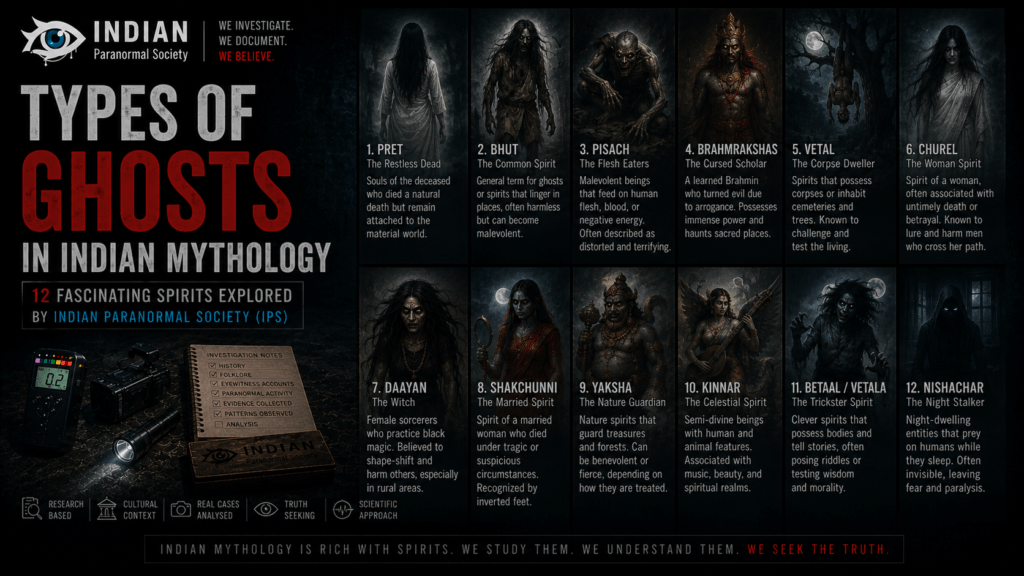

India has one of the richest and most varied traditions of ghost lore in the world. While Western paranormal culture tends toward a relatively uniform conception of ghosts — the spirit of a deceased person, usually trapped, usually unhappy — Indian mythology recognises a vast taxonomy of supernatural beings, each with its own origin, characteristics, behaviour, and the specific conditions under which it is said to manifest.
The types of ghosts in Indian mythology are not simply folk tales. They represent thousands of years of human observation, cultural interpretation, and transmitted experience — a body of knowledge that Indian Paranormal Society (IPS) considers genuinely worthy of serious attention, even as the organisation applies scientific methodology to understanding what may underlie these traditions.
Indian Paranormal Society (IPS) does not claim to know whether the entities described in Indian mythology are real in a literal sense. What Indian Paranormal Society (IPS) does note is that these traditions have persisted across millennia, across thousands of kilometres, and across dozens of distinct regional cultures — and that persistence itself is something worth understanding rather than dismissing.
This is Indian Paranormal Society (IPS)’s exploration of 12 of the most significant types of ghosts in Indian mythology — their cultural origins, their described characteristics, and where relevant, what paranormal research and Indian Paranormal Society (IPS)’s own case experience suggests about the reported phenomena associated with each.
1 — Bhoot (भूत)
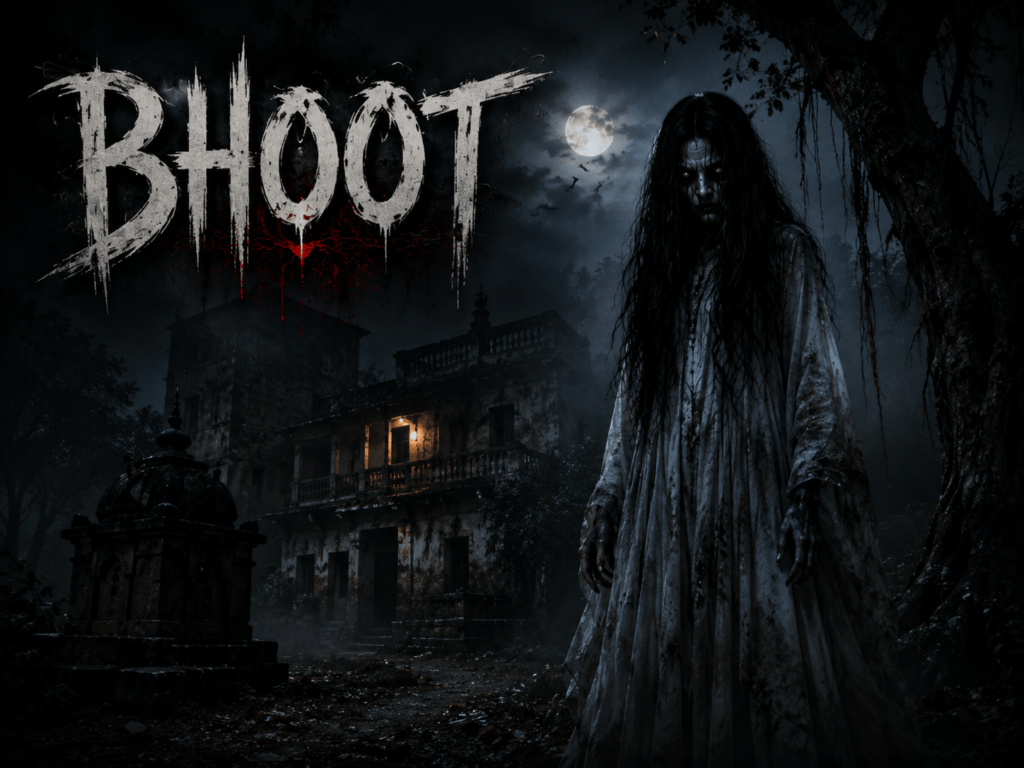
The bhoot is the most widely recognised term for a ghost across North India and much of the subcontinent. The word itself derives from the Sanskrit root meaning “past” or “that which has been” — pointing to the core concept that a bhoot is the spirit of a person who has died, lingering in the world of the living.
In Indian mythology, bhoots are most commonly said to arise from deaths that were sudden, violent, or unnatural — accident, murder, suicide, or death without proper last rites. The spirit, unable or unwilling to move on to the next stage of existence, remains attached to a specific place, person, or unfulfilled desire.
Bhoots are typically described as having feet that face backwards — one of the most consistent identifying characteristics across regional traditions. They are said to avoid touching the ground, which is why they are sometimes described as hovering slightly above it. They may appear in the form of the deceased person or as a shadowy, indistinct figure.
Indian Paranormal Society (IPS) notes that bhoot reports in India span from urban apartments to remote forest locations, and that the “haunting” pattern associated with bhoot belief — a spirit tied to a specific location, experienced consistently by multiple people over time — maps onto one of the most documented categories of reported paranormal experience globally.
2 — Pret (प्रेत)
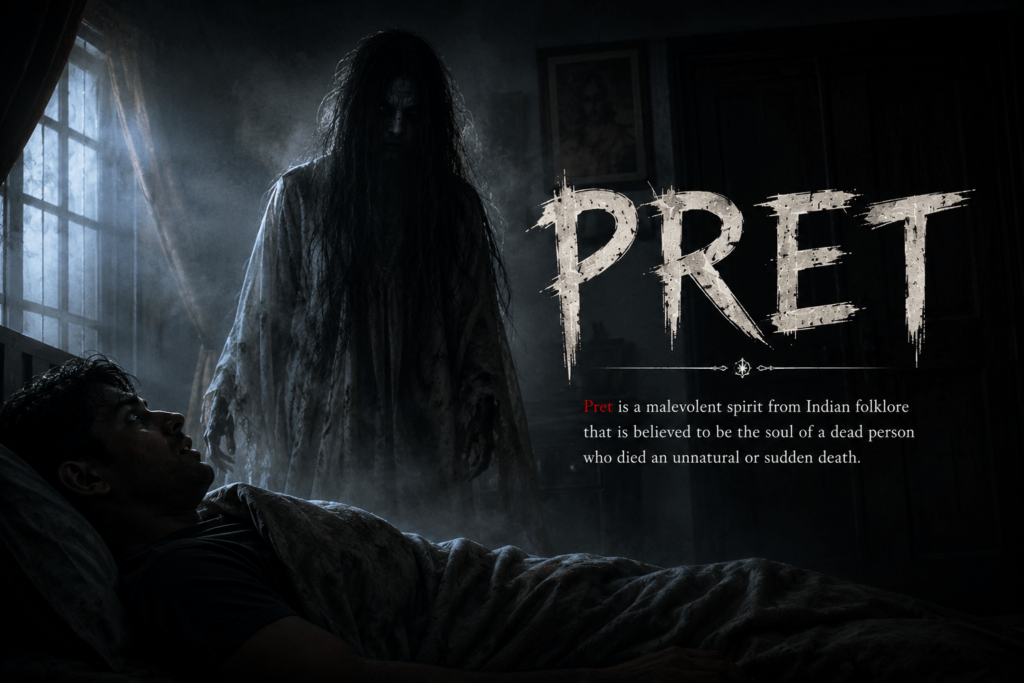
The pret is distinct from the bhoot in important ways that Indian philosophical and religious traditions have always been careful to maintain. While the bhoot is simply a restless spirit, the pret occupies a specific transitional state in the cycle of death and rebirth described in Hindu cosmology — a state between death and the next life, characterised by hunger, thirst, and suffering.
Prets are described in texts including the Garuda Purana as entities of intense craving — perpetually hungry, perpetually thirsty, unable to satisfy their desires because they no longer have a physical body capable of consumption. They are said to be drawn to places where food and water are present and to living people who carry the warmth and vitality they no longer possess.
Reported pret encounters in Indian Paranormal Society (IPS)’s case data frequently involve a strong sense of presence accompanied by feelings of cold, energy drain, and an inexplicable sense of melancholy or hunger — a category of reported experience that Indian Paranormal Society (IPS) approaches with interest given that some of these sensations may have environmental correlates (temperature differentials, poor ventilation, infrasound at specific frequencies affecting mood).
Whether these correlates fully account for the reported experiences, or whether they interact with something not yet fully understood, is a question Indian Paranormal Society (IPS) holds open.
3 — Churail (चुड़ैल)
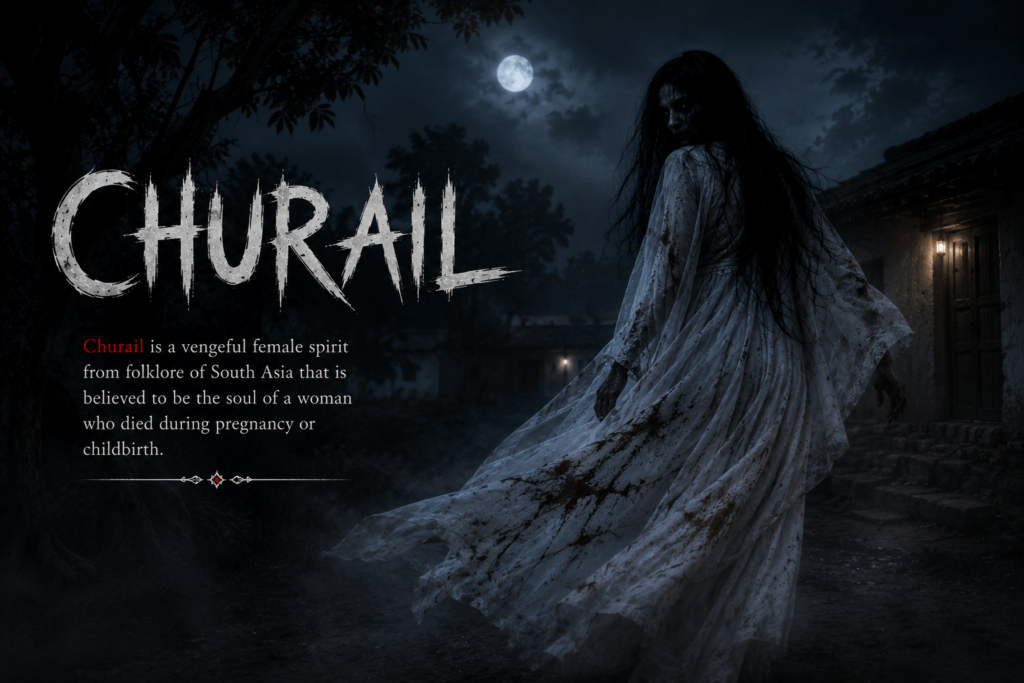
The churail is one of the most widely feared types of ghosts in Indian mythology and one of the most consistently described across regional traditions. She is almost universally described as the spirit of a woman who died during childbirth, pregnancy, or immediately postpartum — a death considered particularly inauspicious in Indian tradition because it represents life cut short at the moment of giving life.
The churail is described as having inverted feet — like the bhoot — and is sometimes depicted as beautiful in appearance but with feet facing backwards, revealing her true nature to those who look carefully. She is said to be drawn to men, particularly young men, and to be associated with crossroads, old trees (particularly the peepal), and abandoned places.
Regional variations of the churail concept are found across virtually every part of India — in Rajasthan, Uttar Pradesh, Bengal, Maharashtra, and South India — with broadly consistent characteristics despite the geographic and cultural distance between traditions. Indian Paranormal Society (IPS) finds this cross-regional consistency in supernatural entity descriptions one of the more interesting patterns in Indian paranormal folklore.
4 — Daayan (डायन)
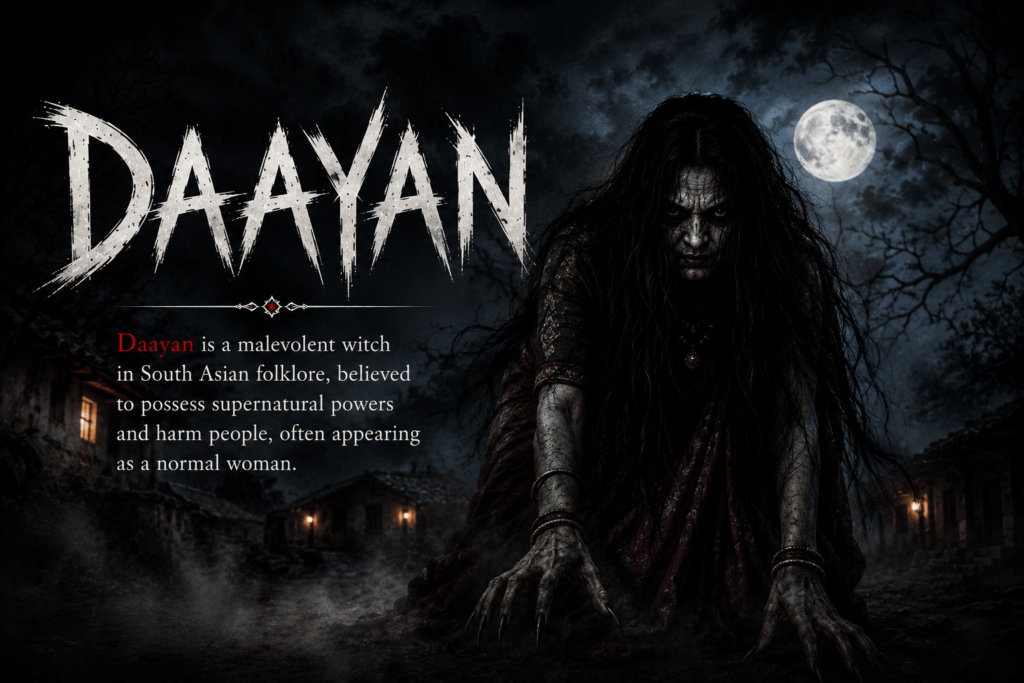
The daayan — sometimes written as daini — is both a type of supernatural being and a social category that has caused enormous real-world harm in India, as Indian Paranormal Society (IPS) has addressed in other publications. In mythological terms, the daayan is a witch figure — a living or recently deceased woman believed to have supernatural powers including the ability to harm others through magical means, to leave her body at night, and to consume life force from living people.
In the mythological tradition, daaayans are associated with specific ritual knowledge — the ability to perform harmful magic, to communicate with malevolent spirits, and to cause illness, death, and misfortune through supernatural means.
Indian Paranormal Society (IPS) notes that the daayan concept occupies a difficult dual position — as a mythological entity with a long cultural history, and as an accusation that has been weaponised against real women with devastating consequences. These two aspects of the daayan tradition exist separately and should be understood separately. The mythology is part of India’s cultural heritage. The accusation is a social harm.
5 — Brahmarakshasa (ब्रह्मराक्षस)
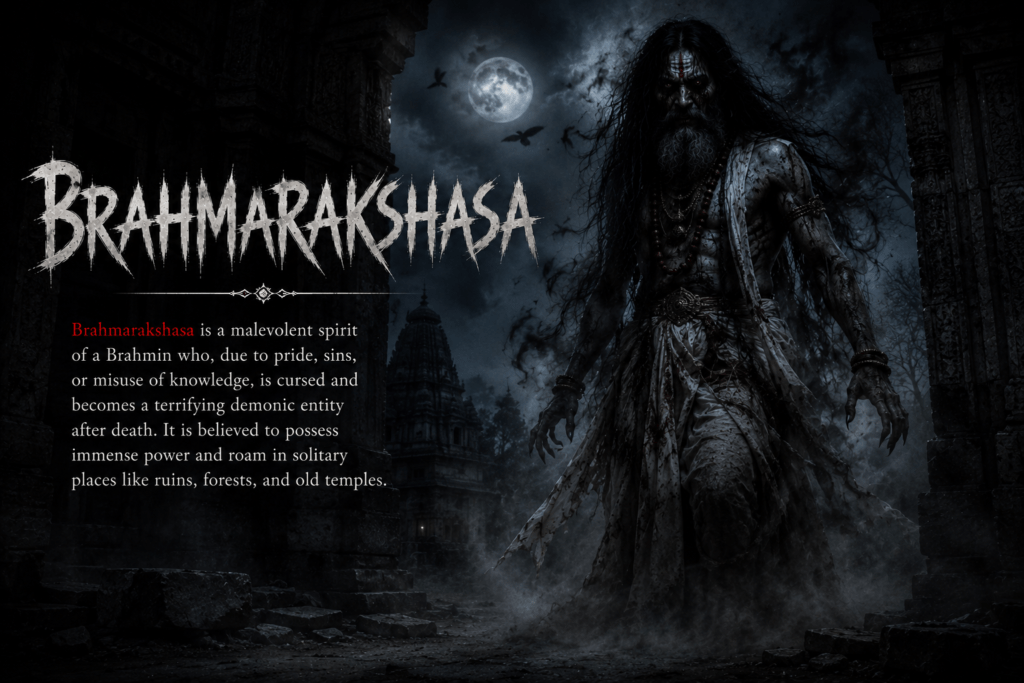
The brahmarakshasa is one of the most powerful and feared entities in Indian mythology — a spirit said to arise from the death of a Brahmin who misused their knowledge or violated sacred duties during their lifetime. The brahmarakshasa is described as extraordinarily powerful, highly intelligent, and deeply malevolent — combining the spiritual power of a learned person with the rage and corruption of an entity denied liberation.
Brahmarakshasa are typically associated with specific locations — ancient temples, sites of old learning, sacred groves that have fallen into disuse. They are said to be among the most difficult of supernatural entities to address or appease, requiring specific ritual knowledge and expertise.
In paranormal terms, the brahmarakshasa concept is interesting because it represents a class of reported entity associated specifically with locations of former spiritual significance — a category of location that Indian Paranormal Society (IPS) notes does generate a distinctive and consistent type of report in its case archive.
6 — Vetala (वेताल)
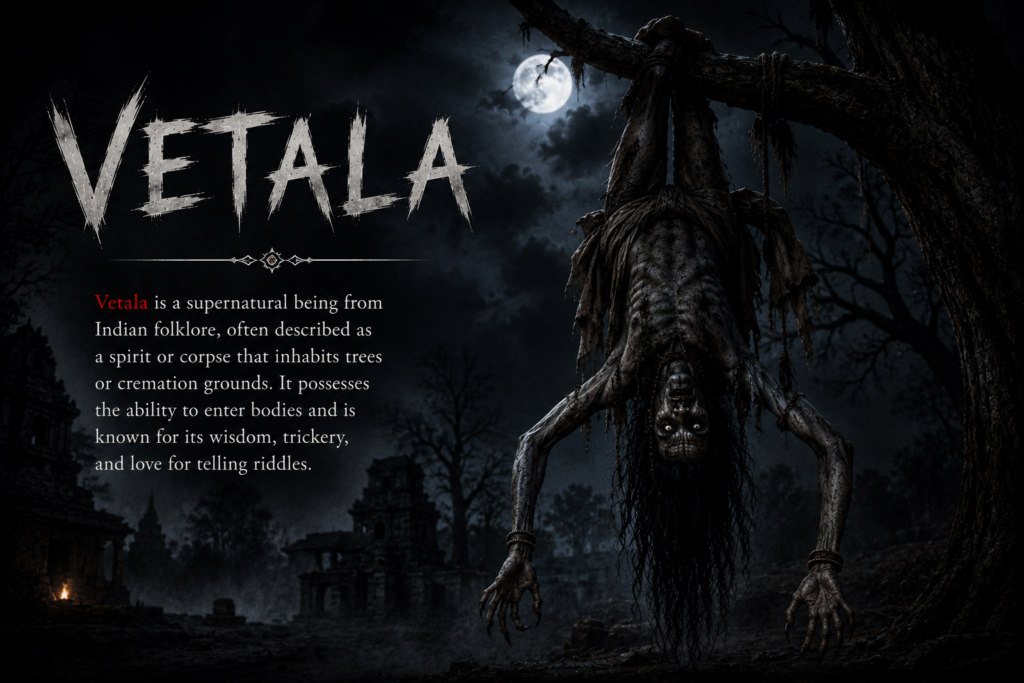
The vetala is one of the most ancient and philosophically significant entities in Indian supernatural tradition — an entity that inhabits and animates corpses, associated in classical Sanskrit literature with the great stories of the Baital Pachisi (Twenty-Five Tales of Baital). The vetala is characterised not primarily by malevolence but by extraordinary knowledge — the vetala is said to see past, present, and future simultaneously, and its riddling exchanges with King Vikramaditya in the classical texts are among the most celebrated in Sanskrit literature.
The vetala occupies a unique position in Indian supernatural taxonomy — neither purely malevolent nor protective, but associated with the margins between life and death and with a kind of dark wisdom that ordinary beings do not possess. It is associated with cremation grounds, which in Indian tradition are liminal spaces between the world of the living and the world of the dead.
7 — Pishacha (पिशाच)
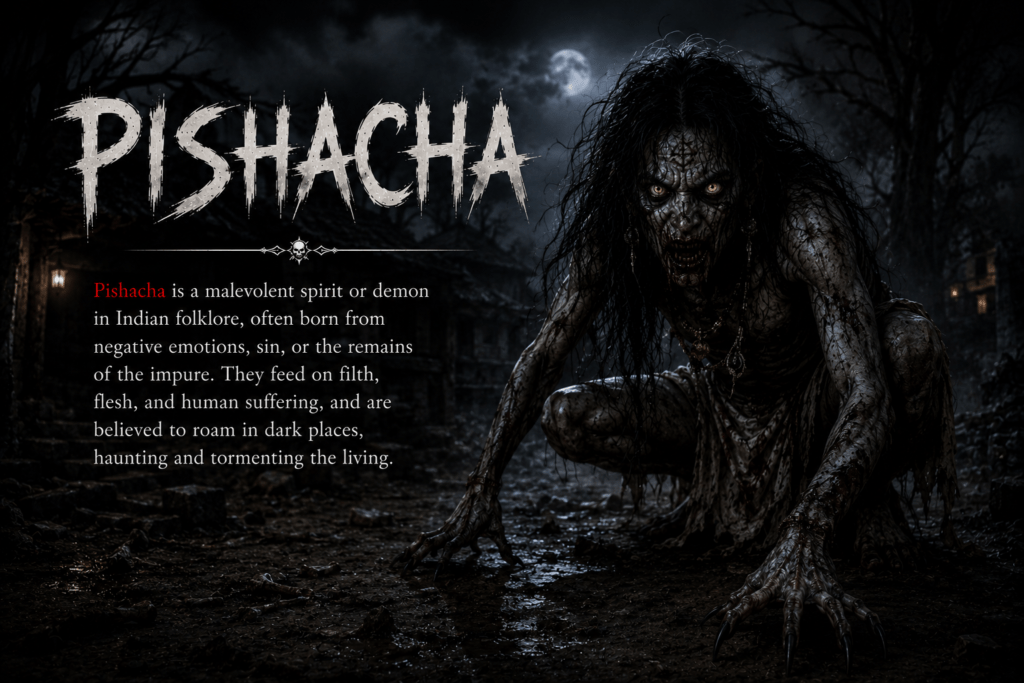
The pishacha is described in ancient Indian texts including the Atharvaveda — making it one of the oldest documented supernatural entities in Indian tradition. Pishachas are flesh-eating entities associated with disease, madness, and possession. They are said to inhabit cremation grounds, crossroads, and places where the dead are treated improperly.
The Pishacha tradition is notable for its medical dimension — Ayurvedic texts describe pishacha possession as a cause of specific mental states including sudden personality change, unusual behaviour, and loss of the normal self. The overlap between the pishacha possession concept and documented psychiatric conditions is something that anthropologists of Indian medicine have studied extensively.
Indian Paranormal Society (IPS) notes this overlap without claiming that psychiatric conditions and pishacha possession are the same thing. What it does suggest is that Indian tradition maintained, for thousands of years, a sophisticated awareness of the relationship between supernatural experience and mental health that modern research is only now beginning to fully map.
8 — Yaksha (यक्ष) and Yakshini (यक्षिणी)
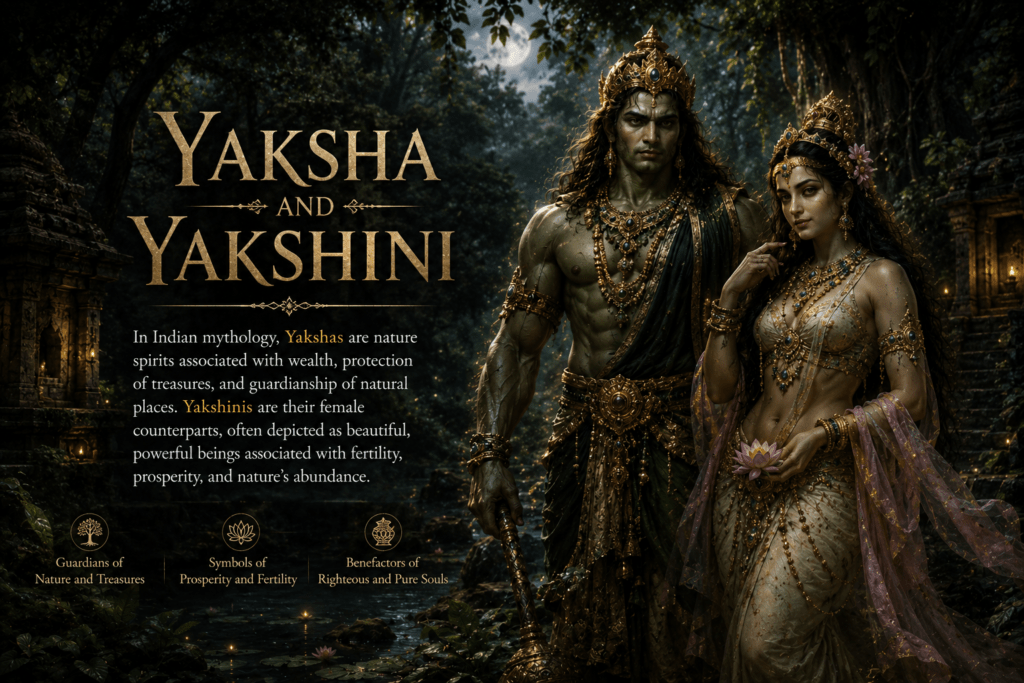
Yakshas and yakshinis occupy a complex position in Indian supernatural taxonomy — they are not simply ghosts but semi-divine nature spirits associated with trees, rivers, and the natural world. They can be protective or harmful depending on how they are treated and the specific circumstances of encounter.
Yaksha and yakshini traditions are among the oldest in Indian culture, predating many of the later Hindu, Buddhist, and Jain texts that incorporated and developed them. The yaksha is frequently depicted as a large, powerful male figure associated with the earth and its treasures. The yakshini is typically depicted as a beautiful female figure associated with specific trees — particularly the ashoka and the peepal.
Reports from forested locations, ancient tree sites, and river banks in Indian Paranormal Society (IPS)’s case archive sometimes include characteristics that map onto yaksha and yakshini descriptions — notably encounters that feel neither purely threatening nor purely benign, but rather weighted with a sense of the location’s own history and character.
9 — Masan (मसान)
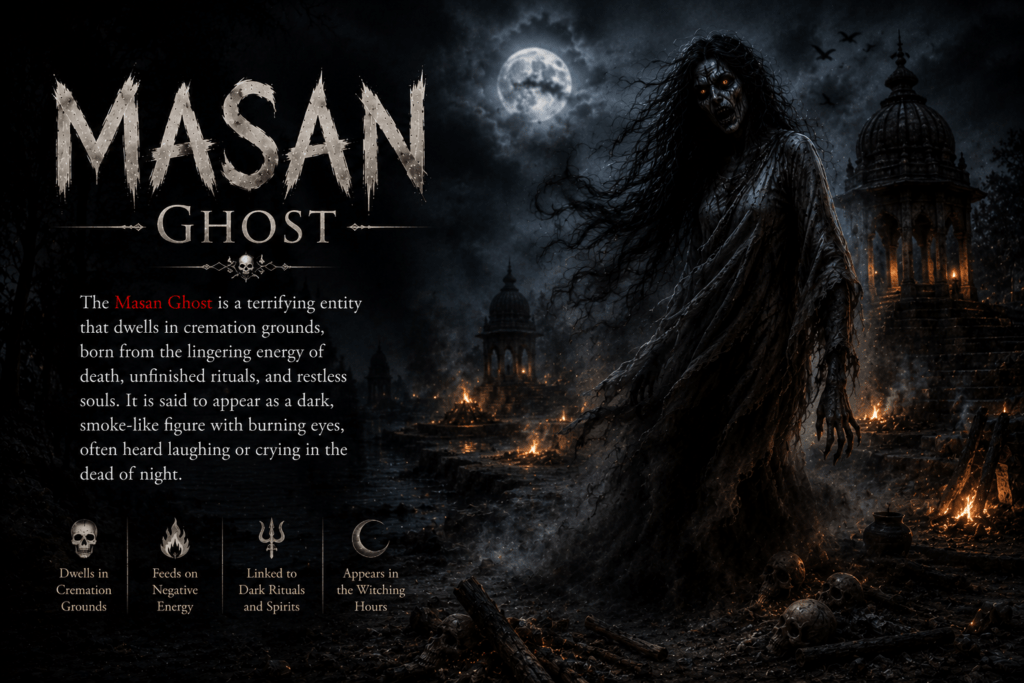
The masan is a ghost type specific primarily to North Indian tradition and closely associated with cremation grounds. The masan is said to be the spirit of a child who died young — a particularly poignant category of death in Indian tradition — and is associated with a mischievous or sometimes harmful quality rather than the pure malevolence of entities like the pishacha or brahmarakshasa.
Masans are said to be attracted to children and to sometimes attach themselves to families where young children are present. The masan tradition reflects a broader pattern in Indian supernatural belief — that children who die before completing the normal arc of human life occupy a particular category of spiritual existence, caught between the innocence of childhood and the unresolved quality of an incomplete life.
10 — Mohini (मोहिनी)
The mohini is a spirit of seduction and entrapment — described as the ghost of a woman who died of heartbreak, betrayal, or unrequited love. The mohini appears beautiful and alluring but carries within her the grief and anger of her death, which she directs toward those who remind her of what was taken from her.
The mohini concept is found across South India and parts of Maharashtra with particular strength, and regional variations include the yakshini tradition as well as more specific local entities. The mohini is associated with rivers, crossroads, and the hours between midnight and dawn — the liminal times of Indian supernatural tradition.
11 — Kichkandi
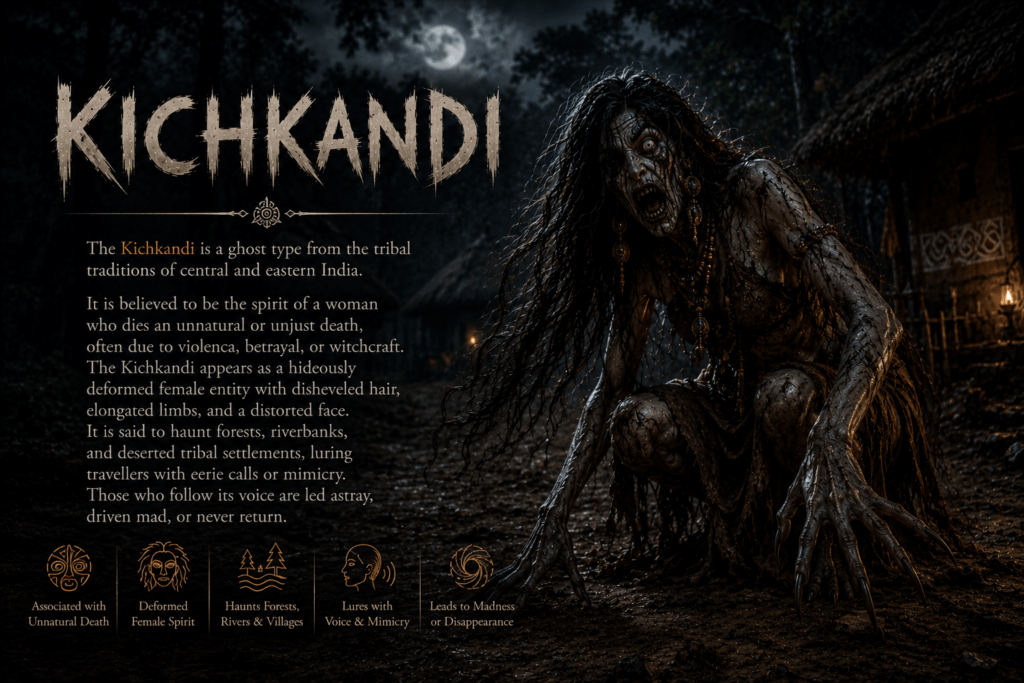
The kichkandi is a ghost type from the tribal traditions of central and eastern India — particularly Jharkhand, Odisha, and Chhattisgarh — and is one of the less widely known types of ghosts in Indian mythology outside its home regions. The kichkandi is associated with the deep forest and is described as a spirit that mimics the voices of people known to the person it encounters — calling out in familiar voices to lure people deeper into the forest or away from safety.
The mimicry aspect of the kichkandi tradition is particularly interesting from Indian Paranormal Society (IPS)’s perspective. The phenomenon of hearing familiar voices in the absence of their source — particularly in forested or isolated locations — has both documented environmental explanations (acoustic reflection, wind through specific vegetation) and a persistent presence in the case reports Indian Paranormal Society (IPS) receives from forested areas.
Whether the acoustic phenomena fully account for the specific quality of recognition that makes kichkandi encounters so disturbing — the sense that the voice is genuinely that of a known person, not merely similar — is a question Indian Paranormal Society (IPS) finds genuinely open.
12 — Nishi (নিশি)
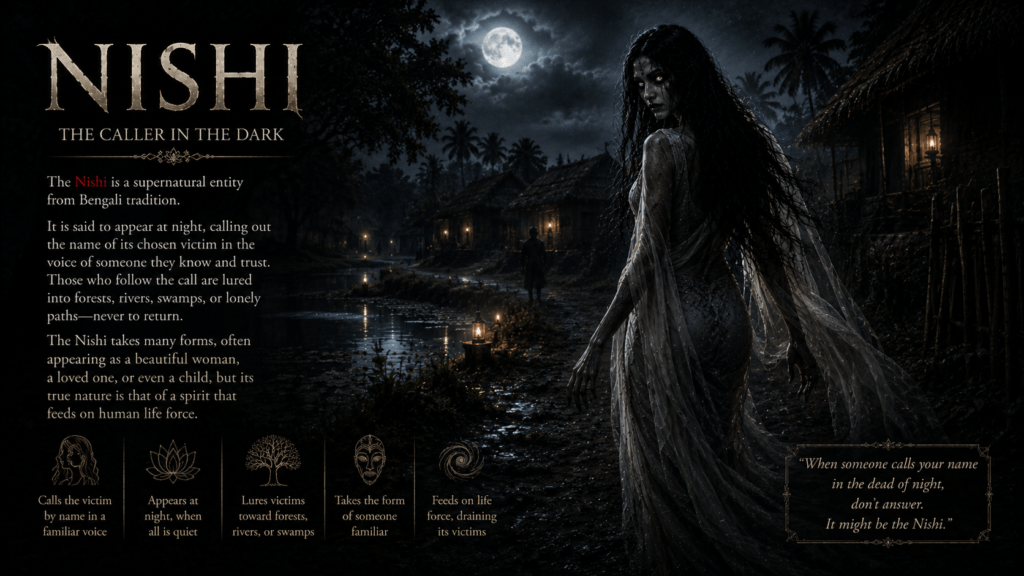
The nishi is a supernatural entity from Bengali tradition — perhaps one of the most specific and psychologically sophisticated types of ghosts in Indian mythology. The nishi calls out in the voice of a known and loved person, always between midnight and dawn, always twice. The rule — well-established in Bengali folk tradition — is that you must never answer a call in the night until the third repetition, because the nishi only ever calls twice. To answer a nishi’s call is to be led away into the darkness, never to return.
The nishi tradition encodes a specific psychological wisdom about the vulnerability of the human mind in the night hours — the lowered critical thinking, the heightened emotional response to familiar voices, the desire to respond to the known and beloved. Whether the nishi tradition reflects a purely cultural wisdom about nighttime vulnerability, or whether it encodes observation of a phenomenon that existed before the tradition named it, is a question that Indian Paranormal Society (IPS) finds genuinely fascinating.
What These Traditions Tell Us
Across these 12 types of ghosts in Indian mythology, Indian Paranormal Society (IPS) identifies several consistent patterns worth noting.
First — the specificity of conditions. Indian supernatural entities are not generic. Each has specific conditions of origin, specific locations of manifestation, specific behaviours, and specific characteristics that identify it. This specificity suggests a tradition of careful observation rather than vague fear — generations of people paying close attention to what they or others experienced and building a taxonomy around those observations.
Second — the moral and psychological dimension. Many Indian ghost types are explicitly connected to moral failures, incomplete lives, or unresolved emotional states. The bhoot arises from improper death. The pret from unfulfilled craving. The brahmarakshasa from misused knowledge. This moral framework reflects a tradition that understood supernatural experience as connected to the ethical and psychological dimensions of human life.
Third — the remarkable cross-regional consistency. Entities with broadly similar characteristics — the inverted-feet spirit, the seductive female ghost, the voice-mimicking forest entity — appear across Indian regional traditions that developed largely independently. This consistency may reflect shared cultural inheritance, or it may reflect shared observation of experiences whose ultimate nature remains an open question.
Indian Paranormal Society (IPS) does not claim to know which of these explanations is correct. What Indian Paranormal Society (IPS) does believe is that India’s supernatural traditions represent a body of accumulated human experience that deserves serious attention — both from researchers who approach it through a scientific lens and from those who approach it through cultural, philosophical, or experiential ones.
Frequently Asked Questions
What are the most common types of ghosts in Indian mythology? The most widely recognised types of ghosts in Indian mythology include the bhoot (spirit of the improperly deceased), pret (transitional spirit between death and rebirth), churail (spirit of a woman who died in childbirth), daayan (witch figure), and brahmarakshasa (spirit of a misguided learned person). Regional traditions across India add many more specific entity types.
What is the difference between a bhoot and a pret in Indian mythology? In Indian tradition, a bhoot is the spirit of a person who died suddenly or improperly, lingering in the world of the living. A pret occupies a specific transitional state in the cycle of death and rebirth — characterised by suffering and intense craving. The pret is often understood as a temporary state that resolves with proper ritual observance, while the bhoot is described as a more persistent haunting presence.
What is a churail? A churail is the spirit of a woman who died during childbirth or pregnancy in Indian mythology. She is typically described as having feet that face backwards and is associated with abandoned places, old trees, and crossroads. The churail tradition is found across virtually every region of India with broadly consistent characteristics.
Does Indian Paranormal Society (IPS) believe Indian ghost mythology is real? Indian Paranormal Society (IPS) takes India’s supernatural traditions seriously as accumulated cultural and observational knowledge without making definitive claims about their literal reality. Indian Paranormal Society (IPS) notes that many characteristics of mythological entities — specific locations, specific conditions of manifestation, specific sensory experiences — appear in case reports that Indian Paranormal Society (IPS) receives, and considers these correspondences worth investigating rather than dismissing.
Which Indian ghost is considered most dangerous? Different regional traditions identify different entities as most dangerous. The brahmarakshasa is frequently cited in classical texts as among the most powerful and difficult supernatural entities. The vetala is associated with extraordinary knowledge and unpredictability. Indian Paranormal Society (IPS) notes that questions of “most dangerous” reflect cultural frameworks rather than investigated findings.
Indian Paranormal Society (IPS) has studied reported paranormal phenomena across India since 2009, approaching India’s rich supernatural traditions with both scientific rigour and genuine cultural respect. Founded by Gaurav Tiwari, Indian Paranormal Society (IPS) is India’s leading paranormal research organisation. Submit a case or learn about GRIP Academy at indianparanormalsociety.in.