
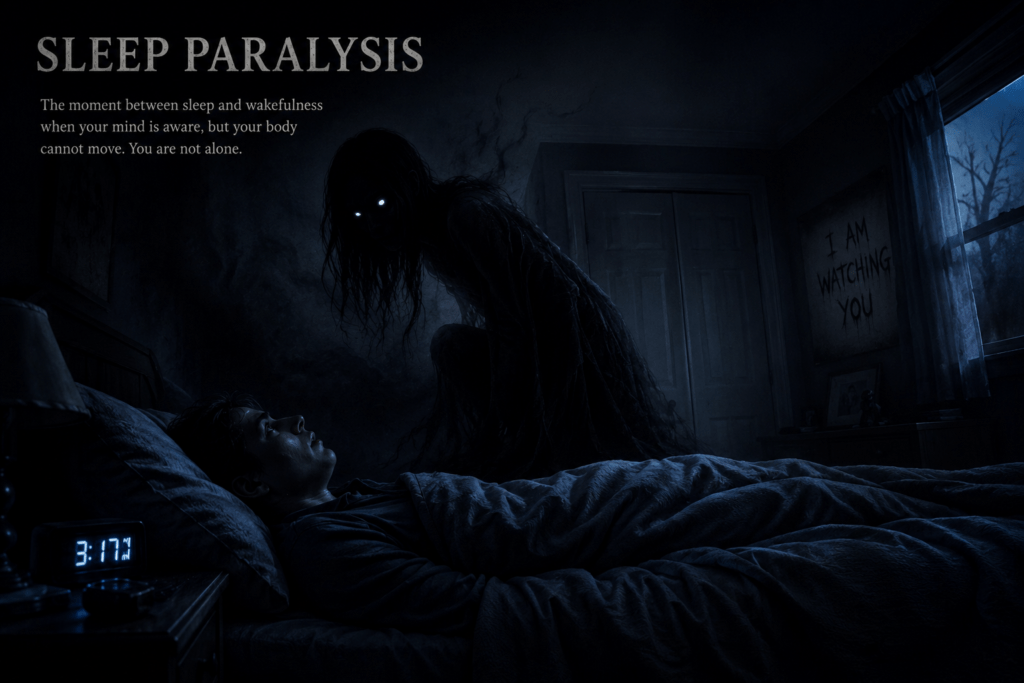
You wake up in the middle of the night. Your eyes are open. You can see the room around you — the ceiling, the walls, the faint light from under the door. But you cannot move. Not your arms. Not your legs. Not even your fingers. And somewhere in the room — or sitting on your chest, or standing in the corner — there is a presence. Something that should not be there.
Sleep paralysis supernatural experiences in India are reported to Indian Paranormal Society (IPS) more frequently than almost any other category of paranormal encounter. People from Mumbai apartments and Rajasthan villages, engineers and farmers, teenagers and elderly — the accounts arrive with remarkable consistency in their core elements. The inability to move. The sense of a presence. The weight on the chest. The figure in the corner.
What is happening during these experiences is one of the most genuinely interesting questions at the intersection of science, culture, and paranormal research. Indian Paranormal Society (IPS) does not claim to have a single definitive answer. What Indian Paranormal Society (IPS) does have is 15 years of case data, a grounding in parapsychological research methodology, and a deep respect for both the science and the cultural frameworks through which millions of Indians understand these experiences.
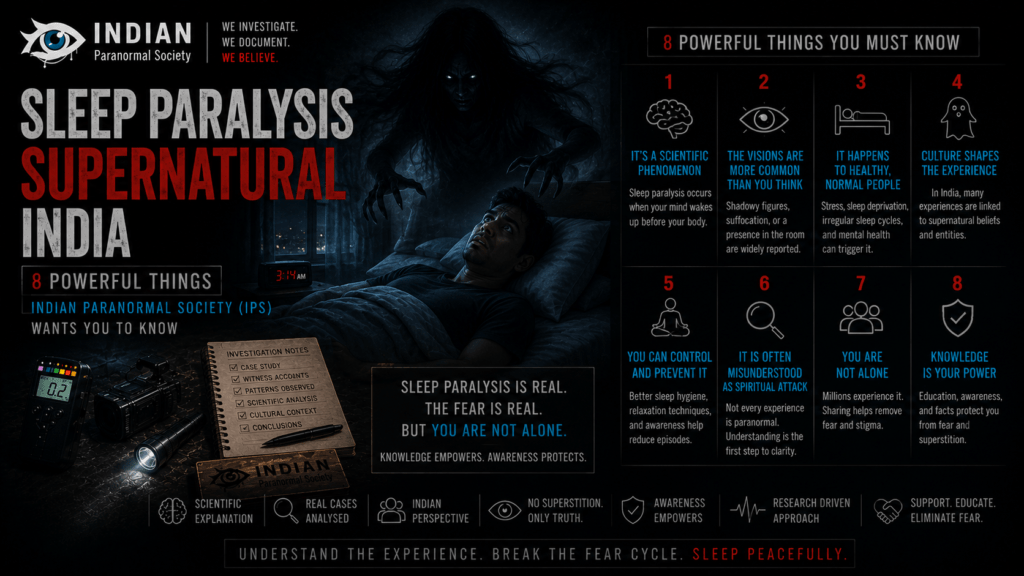
These are 8 things Indian Paranormal Society (IPS) considers important for anyone who has experienced — or wants to understand — sleep paralysis and its possible connections to the supernatural.
1 — What Sleep Paralysis Is, According to Current Science
Sleep paralysis is a recognised sleep phenomenon in which a person becomes conscious while their body remains in the muscle atonia — the temporary paralysis — that normally occurs during REM (Rapid Eye Movement) sleep. During REM sleep, the brain actively suppresses voluntary muscle movement. This is thought to prevent people from physically acting out their dreams. In sleep paralysis, the conscious mind activates before this suppression lifts — leaving the person aware but unable to move.
It is estimated that between 8% and 50% of people experience sleep paralysis at least once in their lifetime. It is more common in adolescents and young adults, in people with disrupted sleep schedules, and in those experiencing significant stress or anxiety.
Current scientific understanding describes sleep paralysis as a normal, if unsettling, neurological event. The hallucinations that frequently accompany it — visual, auditory, and tactile — are understood as a continuation of dream-state brain activity into the waking state. The brain is generating experiences that feel entirely real because, from the brain’s perspective, they are being processed through the same mechanisms as real sensory input.
This is the scientific framework. Indian Paranormal Society (IPS) presents it clearly because it is the starting point for any honest analysis of sleep paralysis supernatural experiences. It does not, however, claim this framework answers every question people bring to these experiences.
2 — How India’s Cultural Traditions Have Named and Understood This Experience
What makes sleep paralysis particularly fascinating from Indian Paranormal Society (IPS)’s perspective is that long before sleep science existed, Indian cultural traditions had named and documented this experience with remarkable specificity.
In North India, the entity experienced during sleep paralysis is frequently described as a bhanamati or chhaya — a shadowy presence that settles on the sleeping person. In Bengal, the tradition of the petni or shakchunni — female spirits that press down on sleepers — maps almost precisely onto the classical sleep paralysis experience. The kamadhenu traditions of South India include accounts of night-visiting entities with characteristics that mirror sleep paralysis hallucinations in detail.
Across India, the experience of a witch riding — a supernatural entity sitting on the chest of a sleeping person, inducing paralysis and terror — is documented across multiple regional folklore traditions independently. The consistency of this imagery across cultures that had no contact with each other is something that both neuroscientists and paranormal researchers find genuinely interesting.
Indian Paranormal Society (IPS) does not use these cultural traditions to argue for or against a supernatural explanation. What Indian Paranormal Society (IPS) notes is that independent human cultures worldwide — in India, in Japan (kanashibari), in West Africa (the Old Hag), in medieval Europe (the incubus/succubus tradition), in the Arab world (al-jathoom) — developed strikingly similar frameworks for understanding an experience that modern science now identifies as sleep paralysis.
Whether this convergence reflects a purely neurological universal human experience, or whether it points to something that science has not yet fully accounted for, is a question Indian Paranormal Society (IPS) considers genuinely open.
3 — The Presence — Why It Feels So Real
Of all the elements of sleep paralysis, the sense of a presence is the one that Indian Paranormal Society (IPS) hears described most consistently and most emphatically in case reports. Not “I thought something was there.” Not “I imagined something.” But: “There was something in the room. I am certain of it.”
Neuroscience has a proposed explanation for this. Research by neuroscientist Olaf Blanke and colleagues has suggested that the sense of presence during sleep paralysis may be produced by a conflict between the brain’s body schema — its model of where the body is in space — and the actual sensory input it is receiving. When the brain detects what it interprets as a second body in the space — which the body schema conflict may generate — it experiences this as a presence. This research is not universally accepted, and the precise mechanism remains a subject of scientific discussion.
What Indian Paranormal Society (IPS) notes from its case data is that the presence reported in sleep paralysis experiences is consistently described as having intentionality — a sense not just of being there, but of watching, of wanting something, of being directed toward the sleeper. This quality — intentionality — is one of the characteristics that distinguishes sleep paralysis presence reports from other types of reported paranormal presence in Indian Paranormal Society (IPS)’s case archive.
Whether that quality of intentionality is neurologically generated or reflects something outside the current scientific framework is a question Indian Paranormal Society (IPS) holds open.
4 — The Figure in the Corner — Hallucination or Something Else?
The visual hallucinations that accompany sleep paralysis are perhaps its most dramatic element — and the one most frequently described in case reports to Indian Paranormal Society (IPS) as evidence of something beyond the purely neurological.
Sleep paralysis hallucinations fall into three broadly documented categories. Intruder hallucinations — the sense of a threatening presence entering the room, sometimes visible as a figure. Incubus hallucinations — the physical sensation of weight or pressure on the chest, often accompanied by difficulty breathing. Vestibular-motor hallucinations — sensations of floating, flying, or moving out of the body.
The figures reported in Indian sleep paralysis experiences are often described with cultural specificity — a woman in white, a dark shapeless mass, a familiar face that is somehow wrong. Indian Paranormal Society (IPS) notes that the specific form of visual hallucinations during sleep paralysis appears to be shaped by the cultural and experiential background of the person experiencing them. A person raised with specific cultural imagery of supernatural entities may be more likely to experience hallucinations that take those specific forms.
This cultural shaping of hallucination content is documented in comparative sleep paralysis research. It raises questions that Indian Paranormal Society (IPS) considers genuinely interesting: if the brain is generating the experience from its own stored imagery, why does the experience feel so categorically different from an ordinary dream — so present, so immediate, so impossible to dismiss as “just a dream” even years later?
Indian Paranormal Society (IPS) does not have a definitive answer to this question. It is one of the reasons Indian Paranormal Society (IPS) considers sleep paralysis one of the most genuinely unresolved areas at the intersection of neuroscience and paranormal experience.
5 — Sleep Paralysis in Indian Paranormal Society (IPS)’s Case Archive
Indian Paranormal Society (IPS) has received and reviewed a significant number of case submissions in which sleep paralysis — or experiences consistent with sleep paralysis — forms part of the reported phenomena. Several patterns have emerged from this case data that Indian Paranormal Society (IPS) considers worth noting.
First — location specificity. A proportion of sleep paralysis cases reported to Indian Paranormal Society (IPS) involve experiences that occur consistently in a specific room or location, but not elsewhere. The same individual who experiences sleep paralysis in one bedroom does not experience it when sleeping elsewhere. This pattern raises questions about whether environmental factors in specific locations — EMF exposure, infrasound, air quality, CO levels — may be contributing to the frequency or intensity of sleep paralysis episodes in those spaces.
Second — multi-person experiences. Indian Paranormal Society (IPS) has reviewed a number of cases in which multiple members of the same household, sleeping in the same space, report similar sleep paralysis experiences — sometimes on the same night, sometimes over an extended period. The neurological explanation for sleep paralysis does not straightforwardly account for the synchrony of these experiences, though shared environmental factors might.
Third — experiences outside the standard neurological profile. A small number of sleep paralysis case reports in Indian Paranormal Society (IPS)’s archive include elements that do not fit the standard neurological description — experiences that occurred when the person was not in a sleep transition state, or that included verifiable details about the environment that the person should not have been able to perceive in the standard sleep paralysis framework.
Indian Paranormal Society (IPS) presents these patterns not as proof of anything, but as observations from case data that suggest the full picture of sleep paralysis — particularly in specific environmental contexts — may be more complex than the current scientific consensus fully accounts for.
6 — What Increases the Likelihood of Sleep Paralysis
Whether a person understands their sleep paralysis experiences through a scientific, cultural, or paranormal framework, understanding what factors increase the likelihood of these experiences is practically useful.
Current sleep research identifies several factors consistently associated with higher rates of sleep paralysis:
Disrupted sleep schedules — irregular sleeping and waking times, shift work, jet lag, and anything that disrupts the normal sleep cycle increases the frequency of sleep paralysis episodes.
Sleeping on the back — research consistently shows that sleeping in the supine position (face up) is associated with significantly higher rates of sleep paralysis than other sleeping positions.
Sleep deprivation — extended periods of insufficient sleep are strongly associated with increased sleep paralysis frequency.
Stress and anxiety — psychological stress is one of the most consistently documented triggers. Indian Paranormal Society (IPS) notes that this may partially explain why sleep paralysis reports spike around major life stressors — examinations, family conflict, bereavement, financial pressure.
Certain medications — some medications that affect sleep architecture, including certain antidepressants and blood pressure medications, are associated with increased sleep paralysis.
Indian Paranormal Society (IPS) shares these factors not to reduce sleep paralysis experiences to a purely medical issue, but because understanding them is the starting point for anyone trying to make sense of what is happening to them — whether they ultimately understand it through a scientific, cultural, or other framework.
7 — What to Do During a Sleep Paralysis Episode
Indian Paranormal Society (IPS) is asked this question frequently, and the answer draws on both sleep research and the practical experience of investigators who understand these experiences from multiple frameworks.
Focus on a single small movement. The most consistently reported technique for breaking a sleep paralysis episode is attempting to move one very small part of the body — a single finger, the tip of the tongue, the muscles around the eyes. The paralysis of sleep paralysis is not absolute. Very small movements are often possible, and achieving one small movement can trigger the restoration of full movement.
Control breathing. Because sleep paralysis is often accompanied by the sensation of difficulty breathing or chest pressure, controlled conscious breathing — deliberate slow exhales — can both reassure the conscious mind that breathing is occurring normally and may help break the episode.
Do not panic. This is easier to say than to do during an episode that feels genuinely terrifying. However, panic and increased anxiety appear to extend episodes. Experienced sleep paralysis researchers and individuals who have frequent episodes consistently report that the ability to remain calm significantly reduces episode duration.
Understand what is happening. For many people, the most effective tool against the terror of sleep paralysis is simply knowing what it is. An experience that feels like supernatural attack is significantly less overwhelming when it is understood as a known neurological phenomenon — even if that understanding does not entirely account for the full quality of the experience.
Indian Paranormal Society (IPS) does not suggest that understanding sleep paralysis neurologically invalidates whatever cultural or personal meaning the experience holds for the person who has it. Both things can be true simultaneously.
8 — Where Science Ends and the Question Remains Open
Indian Paranormal Society (IPS) believes in presenting the science clearly and completely. Indian Paranormal Society (IPS) also believes in honesty about where the science ends and the question remains open.
Current neuroscience provides a compelling and well-evidenced framework for understanding sleep paralysis as a neurological phenomenon. The paralysis, the hallucinations, the sense of presence — all have proposed neurological mechanisms. This framework has been developed by serious researchers over decades and is supported by substantial evidence.
And yet.
The cross-cultural universality of the experience — the same specific details reported across centuries and across cultures with no contact — raises questions that a purely neurological framework does not fully answer. The location-specific and multi-person patterns in Indian Paranormal Society (IPS)’s own case data suggest that environmental factors may interact with the neurological mechanisms in ways not yet fully understood. The quality of absolute reality that sleep paralysis experiences have — even years later, even for people who fully accept the neurological explanation — distinguishes them from ordinary dreaming in a way that the current framework describes but does not fully explain.
Indian Paranormal Society (IPS) does not claim that sleep paralysis is paranormal. Indian Paranormal Society (IPS) also does not claim that neuroscience has said the final word. What Indian Paranormal Society (IPS) does claim is that these experiences deserve serious attention — scientific, cultural, and investigative — and that the millions of Indians who have had them deserve frameworks that take the full complexity of what they experienced seriously.
If you have had sleep paralysis experiences that you believe may be connected to a specific location or pattern beyond the standard neurological explanation, and you would like Indian Paranormal Society (IPS) to review them, submit your case at indianparanormalsociety.in.
Frequently Asked Questions
Is sleep paralysis supernatural or scientific? Indian Paranormal Society (IPS) presents both perspectives honestly. Current neuroscience describes sleep paralysis as a documented neurological phenomenon occurring during sleep-wake transitions. Indian Paranormal Society (IPS) also notes that certain patterns in case data — location-specific experiences, multi-person experiences, cultural universality of the reported phenomena — raise questions that the current scientific framework does not fully resolve. Both perspectives deserve consideration.
Why do people see ghosts during sleep paralysis in India? The visual hallucinations of sleep paralysis appear to be shaped by the cultural and experiential background of the person experiencing them. In India, these may take the form of figures from Indian supernatural traditions — churails, prets, shadowy presences — because the brain’s stored imagery draws on cultural familiarity. This is the proposed neurological explanation. Whether it fully accounts for the experience is a question Indian Paranormal Society (IPS) considers open.
What is the Indian name for sleep paralysis? Sleep paralysis is described across multiple Indian regional traditions under various names. In North India, the experience is sometimes described in terms of bhanamati or chhaya experiences. Bengali traditions describe petni or shakchunni experiences with similar characteristics. South Indian traditions include comparable night-visitor accounts. The specific cultural framing varies regionally while the core experience is remarkably consistent.
How common is sleep paralysis in India? Sleep paralysis affects an estimated 8–50% of people globally at least once in their lifetime. India-specific prevalence data is limited, but given the high volume of case reports Indian Paranormal Society (IPS) receives and the frequency of cultural references to the experience across Indian traditions, it appears to be at least as common in India as globally.
Can sleep paralysis happen every night? Yes. For some individuals — a smaller proportion of those who experience it — sleep paralysis can occur frequently, including multiple times per week. Chronic sleep paralysis is associated with disrupted sleep schedules, high stress, and sleeping on the back. If sleep paralysis is significantly disrupting sleep or causing serious distress, consulting a sleep specialist is advisable alongside any other framework through which the experience is understood.
Indian Paranormal Society (IPS) approaches reported paranormal experiences — including sleep paralysis — with a commitment to presenting both scientific research and genuine case observations honestly, without claiming more certainty than the evidence supports. Founded in 2009 by Gaurav Tiwari, Indian Paranormal Society (IPS) is India’s leading paranormal research organisation. Submit a case or learn about GRIP Academy at indianparanormalsociety.in.