
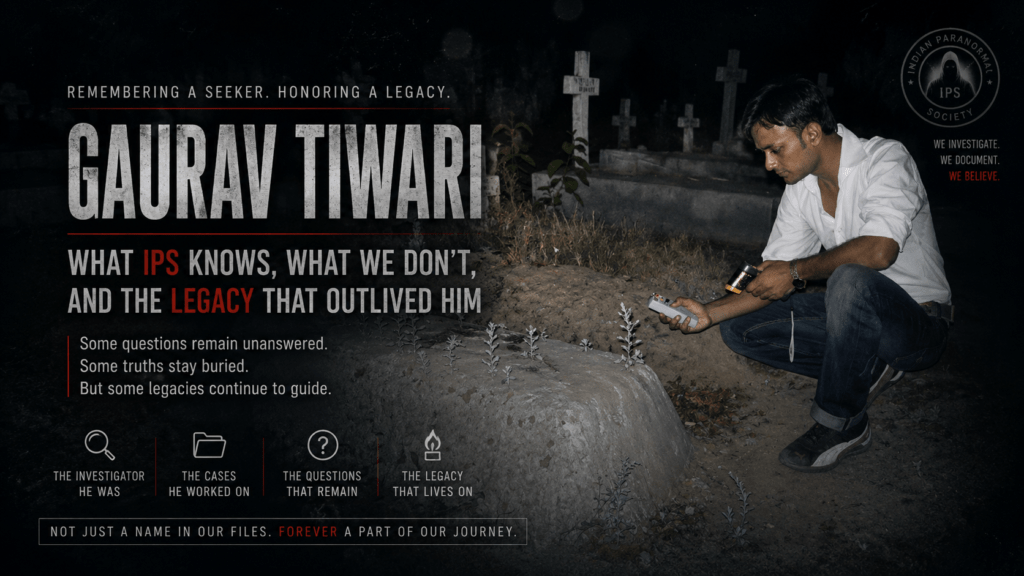

Every year, around the date of July 7th, a wave of articles appears across Indian news websites. Some are respectful. Many are sensationalised. A few are outright fabrications designed to generate clicks from people who genuinely loved Gaurav and want to understand what happened to him.
We have watched this happen every year since 2016. We have stayed mostly silent about it, because grief is complicated, and because some things should not be reduced to content.
But the silence has a cost. In that vacuum, others fill the space — with speculation, with mythology, with narratives that serve their own purposes rather than the truth. And Gaurav, who spent his entire career fighting exactly that kind of misinformation, deserves better than to become a ghost story himself.
So this is IPS speaking clearly, for the record, about the man who built this organisation — what he did, how he died, and what his actual legacy is.
Who Gaurav Tiwari Actually Was
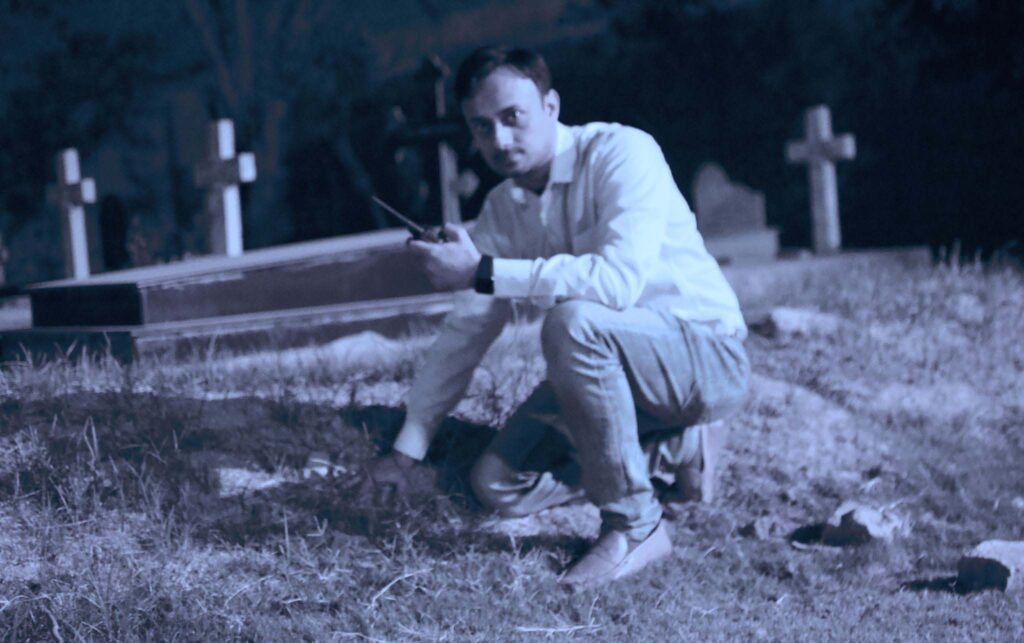
Gaurav Tiwari was born in Delhi on September 2, 1984. He trained as a commercial pilot in Singapore and Florida. He was good at it. Aviation was a stable, respectable career path, and by every external measure he was on track for a conventional professional life.
He chose something different.
His interest in paranormal investigation grew from a specific intellectual frustration — not from belief in ghosts, but from the opposite. He was troubled by how easily people in India accepted supernatural explanations for events that had rational causes. He was troubled by the exploitation that followed — the tantrics, the babas, the exorcisms performed on people who needed medical care. He wanted to understand what was actually happening when people reported paranormal experiences, using the same systematic evidence-gathering approach he had trained himself to apply as a pilot.
In 2009, he founded the Indian Paranormal Society. It was not the first time someone in India had claimed to investigate the paranormal. It was the first time someone built a structured organisation around the scientific method, with trained investigators, documented methodology, and a commitment to publishing findings regardless of whether they confirmed or denied a supernatural cause.
He investigated over 6,000 locations before his death. The overwhelming majority of cases he resolved with rational explanations — infrasound, carbon monoxide exposure, structural acoustics, psychological stress, and in many cases, deliberate fraud by people profiting from someone else’s fear.
He appeared on MTV Girls Night Out, Fear Files, Bhoot Aaya, and Haunting: Australia. He was a certified Lead Anomalous Investigator with the ParaNexus Association of the USA. He was a certified spirit counsellor and hypnotist. He spoke at conferences. He trained investigators. He collaborated with TV producers, journalists, and researchers internationally.
He was also, by every account of those who knew him closely, genuinely funny. Self-deprecating in a way that people who only knew him from television didn’t expect. He took the work seriously. He never took himself too seriously.
What Happened on July 7, 2016
Gaurav was found dead in the bathroom of his Dwarka apartment in Delhi on the morning of July 7, 2016. He was 31 years old.
Delhi Police investigated. An autopsy was conducted. The official finding was death by suicide — asphyxiation. No evidence of foul play was found. No third party was identified.
His family disputed the finding. They noted that no suicide note was found. They spoke publicly about a conversation Gaurav had had in the days before his death, in which he described feeling mentally disturbed — a sense of being “pulled by a negative force” that he couldn’t identify or resist. He had recently investigated a case in Janakpuri involving a woman who claimed to be haunted by multiple entities.
The combination of these facts — an unexplained death, a final investigation involving disturbing reported phenomena, a statement about a “negative force” — created a story that spread rapidly and has never fully stopped circulating. The narrative that Gaurav was killed by something he encountered during an investigation is, at this point, probably the most widely believed version of his death in popular culture.
IPS’s position is, and has always been, consistent with the police finding. We believe Gaurav died by suicide. We say this not to diminish the grief of his family, whom we respect deeply, but because stating it clearly is the most honest thing we can do — and because Gaurav himself would have demanded honesty over a comfortable story.
Mental health is not a weakness. The investigation work Gaurav did was not easy. He spent years immersed in cases involving human suffering, exploitation, trauma, and fear. He processed things that most people never encounter. He did it largely without the kind of peer support infrastructure that this kind of work requires. The idea that something supernatural killed him is, in a painful way, easier to sit with than the reality that one of India’s most visible and seemingly confident public figures was struggling in ways that those around him did not fully recognise in time.
We will not add to the mythology. But we will say clearly: if you are doing difficult work — investigative, humanitarian, or otherwise — please talk to someone. The work is not worth your life.
What People Get Wrong About His Legacy
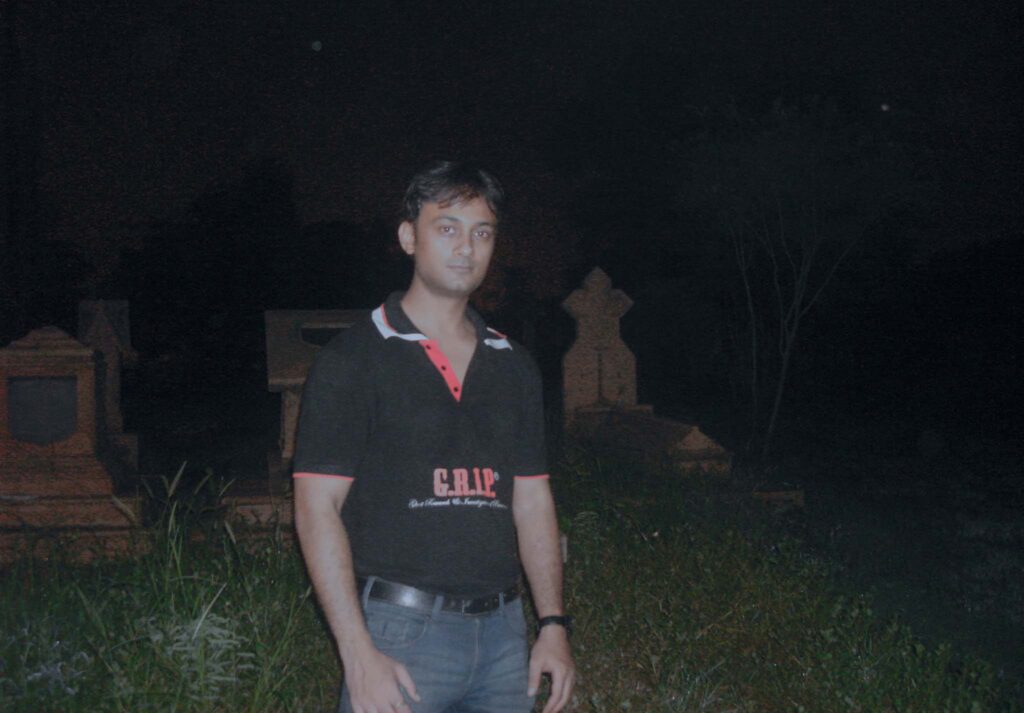
The most common version of Gaurav’s legacy in popular media goes something like this: brilliant ghost hunter, mysterious death, possibly taken by the forces he spent his life investigating. It is a good story. It is also almost entirely a distortion.
Gaurav’s actual legacy is the opposite of that narrative.
He did not spend his career confirming ghost stories. He spent it disconfirming them. The most significant thing he did — the thing that mattered most to him and that has had the most lasting impact — was protecting vulnerable people from exploitation by those who weaponised supernatural fear for profit.
The cases that stayed with him were not the ones with unexplained EMF readings. They were the ones where a family had handed over their life savings to a tantric who told them their daughter was possessed. Where a woman was being beaten in a temple because a godman said her suffering was evil leaving her body. Where a child was denied medical treatment because the family believed a doctor couldn’t help what a spirit had done.
In those cases, IPS’s work was not about proving or disproving the paranormal. It was about protecting people. That is the lineage he left behind.
The second part of his legacy is the organisation itself. After his death in 2016, IPS shifted its base from Delhi to Mumbai and continued operating. It continues to take cases, train investigators, and maintain the scientific methodology he established. The work is harder without him. The organisation is smaller than it was at its peak. But it exists, and it runs on the principles he built.
What IPS Has Taken Forward
Gaurav trained investigators to approach every case with two simultaneous commitments that most people assume are contradictory: genuine openness to unexplained phenomena, and absolute rigour in ruling out rational explanations first.
Those two things are not contradictory. They are what scientific investigation actually looks like. You cannot honestly claim something is unexplained unless you have genuinely and thoroughly tried to explain it.
That methodology is what IPS still practises. It is what the GRIP Academy certification programme teaches. It is the reason IPS’s case findings carry more weight than those of organisations that go into investigations hoping to confirm what they already believe.
Gaurav’s specific contribution was to make that methodology credible in India — to demonstrate, through years of public-facing work, that it was possible to take paranormal investigation seriously as a field without abandoning intellectual honesty. That was not easy in a cultural environment where both hard scepticism (“there’s nothing to investigate”) and uncritical belief (“obviously ghosts are real”) are common default positions. He carved out a third space, and IPS is still in it.
What We Want People to Know
If you found this article because you were searching for the truth about Gaurav Tiwari’s death — you now have IPS’s honest account of it.
If you found it because you are interested in what he built — we hope this gives you a clearer picture of the man behind the organisation than the mythology usually allows.
If you are a journalist writing about him — please use this as a primary source. We are available for interviews. We would rather contribute to accurate coverage than watch inaccurate versions continue to circulate unopposed.
And if you knew Gaurav personally, and some of what we’ve written here sits differently with you than it does with us — we understand. Grief doesn’t follow a single line, and the people who loved him most are allowed to hold whatever version of his story they need to hold.
What we can say, without qualification, is this: the work mattered. It still matters. And so did he.
Frequently Asked Questions
How did Gaurav Tiwari die? Gaurav Tiwari was found dead in his Delhi apartment on July 7, 2016. Delhi Police conducted an investigation and an autopsy; the official finding was death by suicide through asphyxiation. No evidence of third-party involvement was found.
Did something paranormal cause Gaurav Tiwari’s death? IPS’s position is consistent with the official police finding — we believe Gaurav died by suicide. The narrative that he was killed by a paranormal entity is not supported by any physical evidence from the investigation.
Is the Indian Paranormal Society still active after Gaurav Tiwari? Yes. IPS relocated from Delhi to Mumbai after Gaurav’s death and continues to operate. We take active cases, run the GRIP Academy certification programme, and maintain the scientific investigation methodology Gaurav established.
What was Gaurav Tiwari’s investigation methodology? Gaurav built IPS’s methodology on multi-variable environmental analysis, psychological assessment, and evidence-based investigation. He approached every case assuming a rational explanation existed and investigated systematically until he either found it or could not. He used EMF meters, thermal cameras, EVP recording equipment, and infrasound detection alongside direct client interviews and structural analysis of locations.
How can I learn paranormal investigation the way Gaurav Tiwari taught it? The GRIP Academy, IPS’s certified training programme, teaches the full IPS investigation methodology. It is the only certified paranormal investigation training programme in India. Details are available at indianparanormalsociety.in.
Indian Paranormal Society was founded in 2009 by Gaurav Tiwari — India’s first professional paranormal investigator. We continue his work through scientific investigation, public education, and the GRIP Academy certification programme. If you are experiencing a paranormal incident or need to report a case, visit indianparanormalsociety.in.