
For fifteen years, IPS investigators have walked into dark buildings armed with EMF meters,thermal cameras, audio recorders, and a trained human gut. We have investigated over 6,000cases across India. We have debunked superstitions in villages where women were being beatenfor alleged possession. We have sat in Bhangarh at 3 AM and in Mukesh Mills at midnight. Wehave heard things we cannot fully explain.
And now, artificial intelligence is entering our field — and the paranormal community worldwideis divided about what that means.
This is IPS’s honest take.
What AI Is Actually Doing in Paranormal Investigations Right Now
Let’s be clear about what we mean. AI in paranormal research is not a ghost-detecting robot. It isnot a spirit box with a neural network. It is a set of software tools — primarily machine learningalgorithms — that are being used to process and analyse investigation data faster and with lesshuman bias than before.
In 2025 and 2026, paranormal investigators globally are using AI in three specific ways:
- EVP (Electronic Voice Phenomenon) analysis
Traditionally, reviewing EVP recordings is one of the most tedious and subjective parts of anyinvestigation. An investigator sits for hours listening to audio, marking timestamps where theythink they hear a voice. The problem is obvious: human ears are pattern-seeking machines. Wehear words in random noise because our brains are wired to find meaning. This is calledapophenia, and it has produced more fake EVPs than any deliberate hoax.
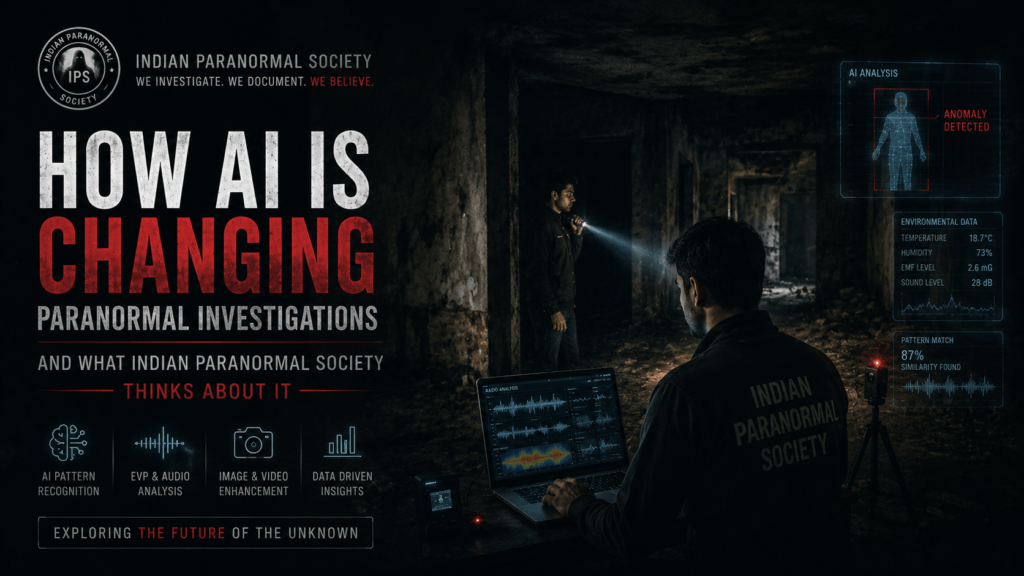
AI audio tools — some using the same underlying technology as Whisper AI and Deepgram —can now scan hours of audio and flag anomalies that fall outside the frequency range ofidentifiable environmental sounds. They do not confirm a ghost. What they do is eliminate themost common sources of false positives and give investigators a cleaner data set to work with.
IPS has been watching this space closely. Our position: this kind of tool, used correctly, is agenuine step forward for scientific investigation. Anything that reduces confirmation bias inevidence review is valuable. - Thermal imaging pattern recognition
Thermal cameras have been a staple of paranormal investigation for over a decade. The problemhas always been interpretation — a warm patch on a wall could be a pipe, insulation, sun
exposure, or something investigators jump to call a manifestation. Human review of thermalfootage is inconsistent. Two investigators looking at the same image often disagree.
Machine learning models trained on thermal datasets can now flag temperature anomalies thatdeviate from baseline environmental readings with far greater precision. They can track how ananomaly moves, whether it follows airflow patterns, and whether it correlates with structuralfeatures of the building. Again — this does not prove anything paranormal. But it producesbetter data. - Environmental data correlation
This is where things get genuinely interesting from a scientific standpoint. AI can now processsimultaneous data streams — EMF fluctuations, temperature variation, infrasound readings,barometric pressure, and audio — and look for correlations between them in real time. A singledata spike means very little. The same spike occurring simultaneously across three differentsensors at a location with no identifiable structural explanation is a different conversation.
IPS has long advocated for multi-variable analysis in investigations. Gaurav Tiwari built hisinvestigation methodology around the principle that single-sensor anomalies prove nothing —only convergent data from multiple independent sources carries any evidential weight. AI makesthat kind of correlation analysis possible at a scale and speed no human team can match.
The Problem We Have With AI in Paranormal Work
We would be misleading you if we only talked about the benefits. There is a serious problem withAI entering the paranormal field, and it has nothing to do with the technology.
It has to do with how it will be used.
The paranormal content space — particularly on YouTube — already has a significant honestyproblem. Investigators fake EVPs. They stage thermal anomalies. They edit audio tomanufacture voices from white noise. This is not the entire community, but it exists, and it doesreal damage to the credibility of legitimate research.
AI makes fakery significantly easier. A convincing deepfake “ghost” on thermal footage. AI-generated “voices” inserted into EVP recordings that sound genuinely anomalous. Machine-learning filters applied to noise to “find” patterns that were not there in the raw data. The sametools that improve legitimate investigation can be weaponised by anyone willing to manufactureevidence for views and engagement.
IPS’s position on this is unambiguous:
any investigation claiming AI-assisted evidence mustpublish the raw, unprocessed data alongside the AI analysis.
No raw data, no credibility. Fullstop.
The Benjamin Radford piece in Skeptical Inquirer (July/August 2025) made a point we agree with— AI filters do not deepen understanding of noise, they deepen the illusion of intent behindnoise. Used honestly, that is a useful research tool. Used dishonestly, it is the most sophisticatedhoax machine the paranormal world has ever seen.
What IPS Is Not Going to Do
We want to be direct about where our boundaries are.
We are not going to start using AI to generate “evidence” for case presentations. We are not goingto run our audio through enhancement filters and present the output as proof of spiritcommunication. We are not going to let algorithmic pattern recognition replace human judgmentin interpreting what an investigation actually means.
The foundation of IPS’s methodology since 2009 has been this: we approach every caseassuming there is a rational explanation, and we investigate until we either find it or we cannotfind it. “We cannot find a rational explanation” is not the same as “a ghost did it.” It means thecase remains open and the investigation continues.
AI does not change that methodology. It gives us better tools to find the rational explanationfaster.
Where IPS Sees AI Actually Helping Indian Paranormal Research
India presents specific investigation challenges that AI is genuinely well-suited to address.
The sheer scale of case reporting in India is unlike anything investigators in the West deal with.IPS receives reports from across the country — from remote villages in Rajasthan to high-riseapartments in Mumbai. A significant proportion of these cases involve people in genuinepsychological distress, sometimes in dangerous situations (black magic exploitation,superstition-driven abuse, financial fraud by fake tantriks).
AI-assisted case intake — triaging incoming reports, identifying patterns that suggest mentalhealth crisis versus environmental factors versus possible investigation value — could allow IPSto direct its limited investigator resources to the cases where field investigation is mostwarranted, while ensuring people in distress get appropriate support faster.
Additionally, India’s vast stock of colonial-era buildings, ancient forts, and abandoned industrialsites presents a cataloguing challenge. A systematic, AI-assisted archive of investigation datafrom Indian locations — cross-referenced by building type, geographic region, reportedphenomena, and environmental readings — would be the most comprehensive paranormalresearch database ever built for this country. It does not exist yet. It should.
The Honest Conclusion
AI is not going to prove the existence of ghosts. It is also not going to disprove them. What it isgoing to do — if used with integrity — is make paranormal investigation more scientificallyrigorous than it has ever been.
For IPS, that is the entire point. We have never been in this field to confirm what people want tobelieve. We are here to find out what is actually happening. Fifteen years of investigations havetaught us that the truth — whether it is a carbon monoxide leak, an infrasound frequency, astructural anomaly, or something we genuinely cannot explain — is always more interesting thanthe story people invented before we arrived.
AI is a better tool for finding that truth. We will use it that way.
Frequently Asked Questions
Can AI detect ghosts?
No AI system currently available can detect or confirm paranormalentities. AI tools used in investigations analyse environmental data — audio, thermal,electromagnetic, and atmospheric readings — and identify anomalies that deviate from baseline.Whether those anomalies have a paranormal cause is a separate question that AI cannot answer.
Does the Indian Paranormal Society use AI in investigations?
IPS is actively evaluating AI-assisted audio and multi-sensor data analysis tools for integration into our investigationmethodology. Any AI-assisted findings will always be published alongside the raw, unprocessedsource data.
What is EVP analysis with AI?
EVP (Electronic Voice Phenomenon) AI analysis uses machinelearning to scan audio recordings for sound anomalies that fall outside identifiableenvironmental frequency patterns. It is a data-cleaning tool, not an evidence generator. It helpsinvestigators isolate genuinely anomalous audio from background noise with greaterconsistency than human review alone.
Are AI-generated ghost videos real?
No. Generative AI can create photorealistic simulations ofparanormal events, including “ghost” footage indistinguishable to the naked eye from realthermal recordings. This is a serious credibility problem for the field. Any claimed paranormalevidence produced or enhanced by AI must be accompanied by unprocessed source data to haveany investigative value.
How do I report a paranormal incident to IPS?
Visit indianparanormalsociety.in and use theincident report form. Our team reviews all submissions. Cases involving potential safetyconcerns — mental health distress, financial exploitation, physical harm — are prioritised.
Indian Paranormal Society has been India’s leading paranormal research organisation since2009. Founded by Gaurav Tiwari, IPS has conducted over 6,000 investigations across India usingscientific methodology, environmental analysis, and evidence-based research. Learn more aboutour GRIP Academy certification courses or submit a paranormal incident report atindianparanormalsociety.in.