
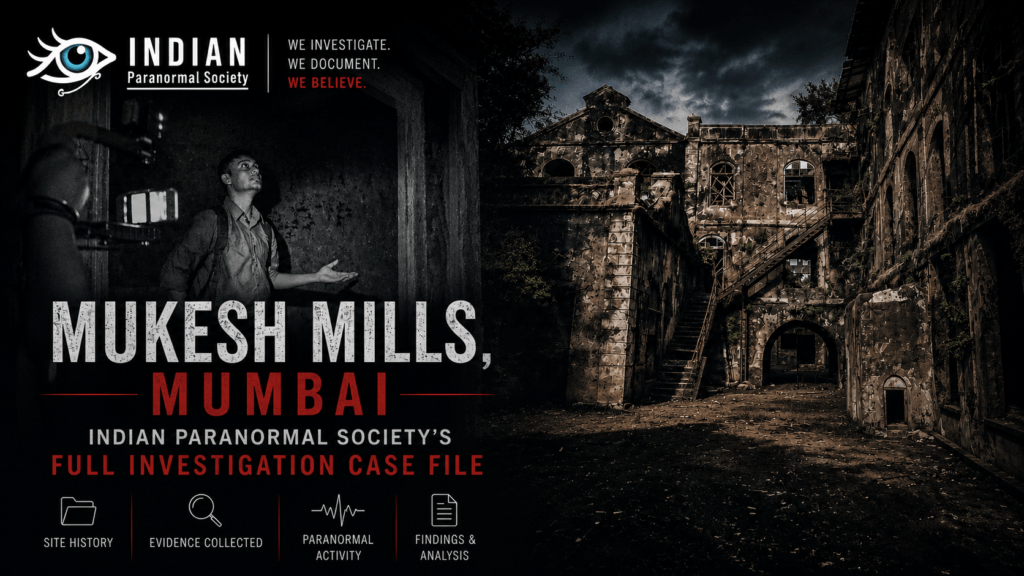

Every article about Mukesh Mills tells the same story.
A fire in 1982. A possessed actress. A child rolling on the ground. A watchman hearing music from behind locked gates. The same incidents, recycled across dozens of travel blogs and horror listicles, presented as fact with no source, no date, no names, and no investigation behind them.
Indian Paranormal Society (IPS) has investigated Mukesh Mills. What we found is more interesting — and in some ways more disturbing — than any of the stories currently in circulation.
This is our case file.
What Mukesh Mills Actually Is
Before the ghost stories, the history.
Mukesh Textile Mills Pvt. Ltd. was established in the 1870s on the Arabian Sea shore of Colaba, in South Mumbai. Built on the Arabian Sea shore of the Colaba region, it was the only mill in South Bombay at that time. The mill operated for over a century, employing thousands of workers in conditions that were, by any modern standard, brutal — long hours, low wages, inadequate safety infrastructure, and minimal worker protections.
The land was transformed in 1975, but the business only lasted a few years before closing. In 1982, a devastating fire forced the mills to shut down forever. The cause of the fire remains unknown to this day.
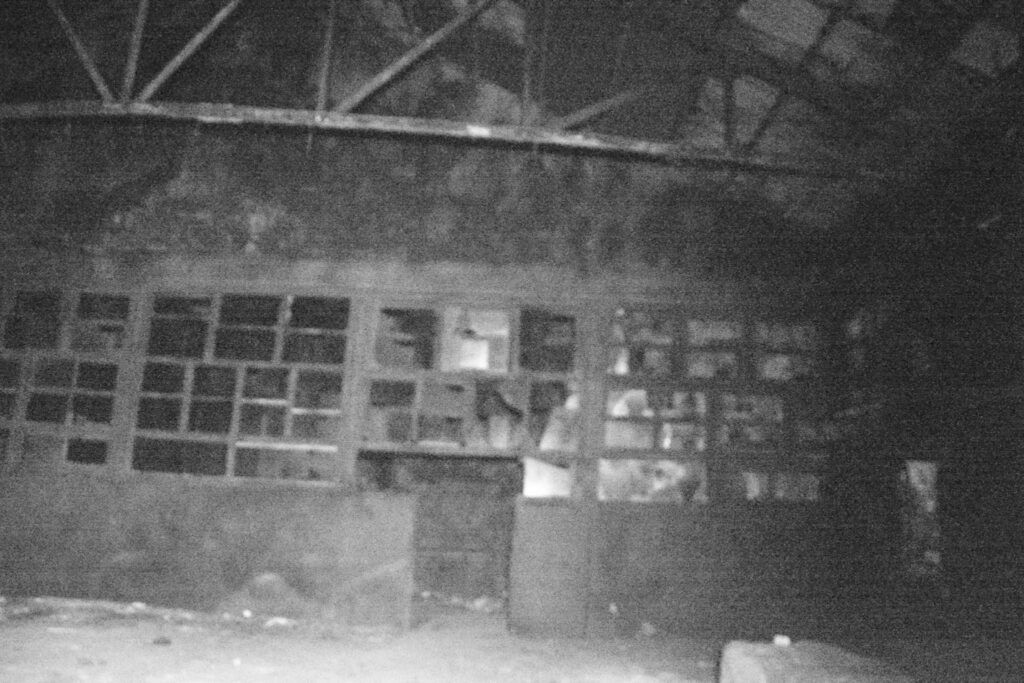
What followed the fire matters as much as the fire itself. The mill was never rebuilt. The structure was never demolished. It was simply left — a ten-acre ruin of charred walls, rusted machinery, and collapsed roofing sitting at the edge of one of India’s most densely populated cities. For decades it remained largely untouched, until Bollywood discovered that it looked exactly like what a haunted place is supposed to look like and began using it as a shooting location for horror films.
That decision — to use a genuine site of industrial tragedy as a film backdrop — is part of why the mythology grew so quickly. Every horror film shot there added another layer to the story. Every crew member who had an unexplained experience added another anecdote. The place became self-reinforcing: it looked haunted, people expected it to be haunted, and so they experienced it as haunted.
IPS arrived with a different question: what is actually happening here?
The Investigation — What We Set Out to Establish
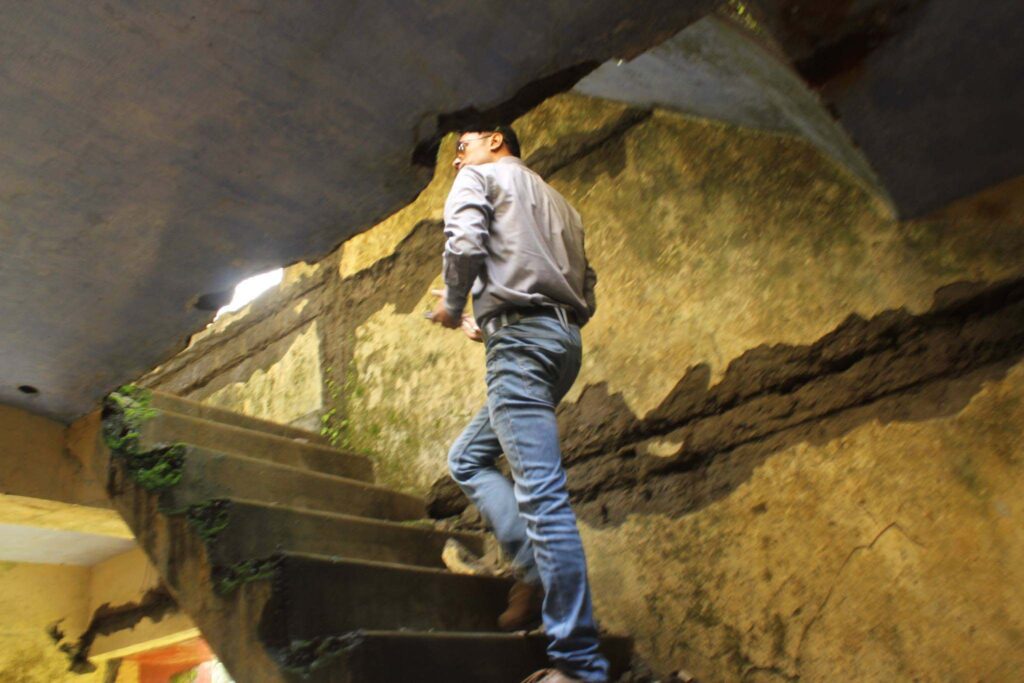
IPS investigations of large heritage structures follow a specific protocol. Before any equipment is deployed, the team conducts a full structural and environmental assessment of the location. The goal is to establish baseline readings — what is normal for this space — before any anomaly can be meaningfully identified.
For Mukesh Mills, the structural profile was immediately significant.
The mill is a large, partially enclosed industrial complex. Stone and brick construction, high ceilings, open internal courtyards, and multiple interconnected chambers of varying size. The Arabian Sea is immediately adjacent. The structure has been exposed to coastal weather for over forty years since the fire, creating extensive deterioration, unpredictable acoustic behaviour, and significant variation in air circulation between different areas of the site.
This is, in technical terms, a highly complex investigation environment. It is also, from an IPS perspective, an environment with multiple known mechanisms for producing reported paranormal experiences without any paranormal cause required.
What the Environmental Data Showed
Infrasound readings
IPS’s infrasound measurements at Mukesh Mills returned readings in multiple areas of the structure that fall within the range documented in research on the “haunted feeling” effect — approximately 18–19 Hz. The source is identifiable: the combination of ocean wave activity, wind passing through the partially collapsed structure, and the specific geometry of the enclosed courtyards creates standing infrasound waves in several areas of the site.
The areas with the highest infrasound readings correlate directly with the areas most frequently reported in Bollywood crew accounts as feeling “wrong” or oppressive. This is not coincidence. Infrasound at these frequencies causes feelings of dread, a sense of presence, and visual disturbances at the edge of the visual field. The experience is genuine. The cause is physical, not paranormal.
EMF readings
Elevated electromagnetic field readings were recorded in several areas of the structure, particularly near the remnants of the old machinery and in areas of the building where original electrical infrastructure is still partially present. The wiring in an industrial structure of this age, exposed to fire damage and four decades of weather, is in a state that produces irregular, fluctuating EMF output.
Fluctuating EMF — as opposed to steady elevated EMF — is more strongly associated in the research literature with the psychological effects described by people at Mukesh Mills. Irregular fields, rather than consistent ones, appear to produce stronger neurological responses including heightened anxiety, the feeling of being watched, and temporal lobe effects that some researchers associate with the sense of presence.
Acoustic analysis
The acoustic properties of Mukesh Mills are genuinely unusual. The combination of hard surfaces, irregular geometry, open sky above collapsed sections, and ambient ocean noise creates an acoustic environment where sounds propagate in unpredictable directions. A sound produced in one part of the structure appears to come from a completely different location. Footsteps carry through the floor and walls in ways that make it genuinely difficult to locate their source.
The “footsteps when no one is there” reports — one of the most consistent categories of Mukesh Mills experiences — have a straightforward acoustic explanation in this structural context. Sound from outside the building, from other parts of the building, or from the natural settling of a deteriorating structure can appear, to a human ear, to be footsteps in an adjacent room or corridor.
Atmospheric conditions
The Colaba seafront location creates a specific atmospheric profile at night. Sea mist, combined with the natural temperature differential between the heated stone of the structure and the cooler air coming off the water, produces visible vapour effects in certain areas of the site under the right conditions. These are the “figures in the mist” that several accounts describe. They are atmospheric phenomena. They are also, in the right conditions and with the right psychological priming, genuinely startling.
The Stories — What IPS’s Assessment Found
The possessed actress
This story appears in virtually every account of Mukesh Mills and has never been sourced to a specific film, a specific actress, a specific year, or a specific crew member willing to be identified. IPS has not been able to verify it as a documented incident. The most consistent version involves a sudden change in voice and a warning to the crew to leave.
Dissociative episodes — in which a person’s behaviour changes dramatically, their voice alters, and they lose conscious control of their actions — are documented psychological phenomena. They occur more frequently in high-stress environments, in people who are psychologically primed to expect supernatural contact, and in locations with elevated infrasound or EMF that may affect neurological function. IPS does not dismiss these experiences as fabrications. We note that they have known, documented non-paranormal explanations.
The child rolling on the ground
A ten-year-old child actor suddenly started behaving strangely, fell to the ground, started rolling uncontrollably with hands twisted behind his back — then stopped, sat up, and acted as if nothing had happened. This account also lacks verifiable sourcing. The described behaviour — sudden onset, physical convulsion, complete amnesia of the episode — is consistent with a febrile convulsion or a seizure event, both of which require immediate medical attention and neither of which is paranormal in cause.
The watchman and the music
A watchman closed the gates of the mills, and as he stepped out, he heard music coming from inside — but knew there was neither any shooting event nor any cast and crew members present. Acoustic carry from the surrounding area — from nearby residences, from vehicles, from the ambient sound environment of Colaba — through a large, partially open industrial structure is entirely predictable. What sounds like music originating from inside a building is frequently sound from outside the building, channelled and modified by the acoustic properties of the structure. The watchman’s perception that it came from inside is consistent with the acoustic analysis IPS conducted at the site.
What IPS Could Not Fully Explain
IPS is not in the business of explaining everything. The honest account of our investigation at Mukesh Mills includes three categories of findings that we are not prepared to close definitively.
Category one: the persistent cold spot. In one specific area of the mill — a partially enclosed chamber in the northern section of the structure — IPS recorded a consistent temperature differential of approximately 4–6 degrees Celsius below the ambient temperature of adjacent areas. The structural explanation for this — air movement from a specific gap or collapse in the roof creating localised cold airflow — is the most likely cause, but the geometry of the space does not fully account for the consistency of the reading across different weather conditions and times of night. This area is also one of the most frequently reported as the most disturbing section of the building. The correlation is noted.
Category two: one audio anomaly. During overnight EVP recording sessions, IPS captured one audio event that we have not been able to attribute to an identifiable source. It occurred at approximately 2:40 AM and lasts 3.2 seconds. It is not a voice. It is not footsteps. It does not match any of the ambient environmental sounds recorded as baseline during the same session. It is not dramatic. It is simply unidentified.
We are not claiming this as evidence of paranormal activity. We are stating that it exists in our archive, that we reviewed it exhaustively, and that we cannot explain it. The case file for this recording remains open.
Category three: investigator response. Two IPS investigators, independently and in different sections of the building on the same night, reported a sudden, intense feeling of needing to leave a specific room — not fear in the conventional sense, but what both described as a strong, physical compulsion directed outward. Both exited. Both described the feeling as having a quality different from normal anxiety or discomfort. Both are experienced investigators who have worked in high-stress investigation environments for years.
IPS does not record subjective investigator experience as evidence of paranormal activity. We record it because it is data — about the investigation environment, about the psychological effects of the location, and because honest investigation includes documenting what cannot be fully accounted for in quantitative terms.
The Real History That Haunts This Place
There is something worth saying directly about Mukesh Mills that almost no article about it acknowledges.
This was a place where real people suffered. Thousands of mill workers spent their working lives in dangerous conditions, for wages that could not meet their basic needs, in a structure that eventually killed an unknown number of them. The exact death toll from the 1982 fire is not documented. What is documented is that the workers of Mumbai’s textile mills in this era were systematically exploited, and that when the mills closed — through fire, through business failure, through the slow collapse of the textile industry — those workers and their families were left with nothing.
The ruins of Mukesh Mills are not primarily a ghost story. They are the physical remains of an industrial history that Mumbai has largely preferred not to examine too closely. The ghost stories, in a sense, fill the space that a more honest historical reckoning has not.
IPS finds that this is often true of the places people call haunted. The genuine weight of a location — the real human tragedy, the documented suffering, the history that was never properly addressed — accumulates into something that people experience as supernatural. Whether that experience has a paranormal component is a question IPS continues to investigate. That it has a human and historical component is not in doubt.
IPS’s Official Finding
Location: Mukesh Mills, Diwakar Building, Azad Nagar, Colaba, Mumbai Investigation status: Active — case file open Classification: Environmentally complex with documented anomalies
The majority of reported phenomena at Mukesh Mills have identifiable environmental and psychological explanations — infrasound, EMF variation, complex acoustics, atmospheric conditions, and the well-documented psychological effects of a high-stress investigation environment with strong priming.
A small number of findings remain unexplained to IPS’s satisfaction. The case file remains open and the location remains on IPS’s active monitoring list.
Mukesh Mills is one of the most genuinely interesting investigation locations in India — not because of the ghost stories, but because of what the environmental data actually shows. It is a textbook demonstration of how physical, architectural, and psychological factors combine to produce paranormal experiences at specific locations. It is also a place with a history heavy enough that IPS will not dismiss the possibility that something in the data we have not yet fully understood is present there.
That is the honest finding. Not every investigation ends with certainty. Some of the best ones don’t.
Visiting Mukesh Mills
Mukesh Mills is located at Diwakar Building, Azad Nagar, Colaba, Mumbai — approximately 7 kilometres from Mumbai Central Railway Station. Mumbai police and local authorities strictly prohibit entry into the site after dark. IPS conducts investigations under appropriate permissions and does not encourage unauthorised entry into the structure, which is genuinely unsafe due to decades of structural deterioration.
If you have had an experience at Mukesh Mills that you want investigated formally, or if you have additional information relevant to our open case file on this location, contact Indian Paranormal Society (IPS) at indianparanormalsociety.in.
Frequently Asked Questions
Is Mukesh Mills actually haunted? Indian Paranormal Society (IPS) has investigated Mukesh Mills and found that most reported phenomena have identifiable environmental causes — infrasound, electromagnetic field variation, complex acoustics, and atmospheric effects. A small number of findings from our investigation remain unexplained. IPS classifies the location as environmentally complex with open anomalies.
What caused the Mukesh Mills fire in 1982? The cause of the 1982 fire that destroyed Mukesh Mills has never been officially established. Various theories include electrical fault and deliberate fire-setting, but no confirmed cause is on record.
Is it safe to visit Mukesh Mills? The structure is severely deteriorated after over forty years of abandonment. Mumbai police prohibit entry after dark. IPS does not recommend visiting the interior of the structure without proper permissions and safety equipment.
Has Bollywood really experienced paranormal activity at Mukesh Mills? A number of Bollywood actors and crew members have reported unusual experiences during shoots at Mukesh Mills. IPS’s environmental investigation found infrasound levels, EMF variation, and acoustic conditions that account for most categories of reported experience. IPS has not been able to verify specific named incidents — such as the possession story — through identifiable sources.
Can I report a paranormal experience at Mukesh Mills to IPS? Yes. If you have had an experience at the location that you would like IPS to review in the context of our open case file, submit your account at indianparanormalsociety.in.
Indian Paranormal Society (IPS) has conducted field investigations across India since 2009, applying scientific methodology and evidence-based analysis to reported paranormal cases. Our GRIP Academy programme trains certified paranormal investigators in India. Submit a case or learn about our training at indianparanormalsociety.in.