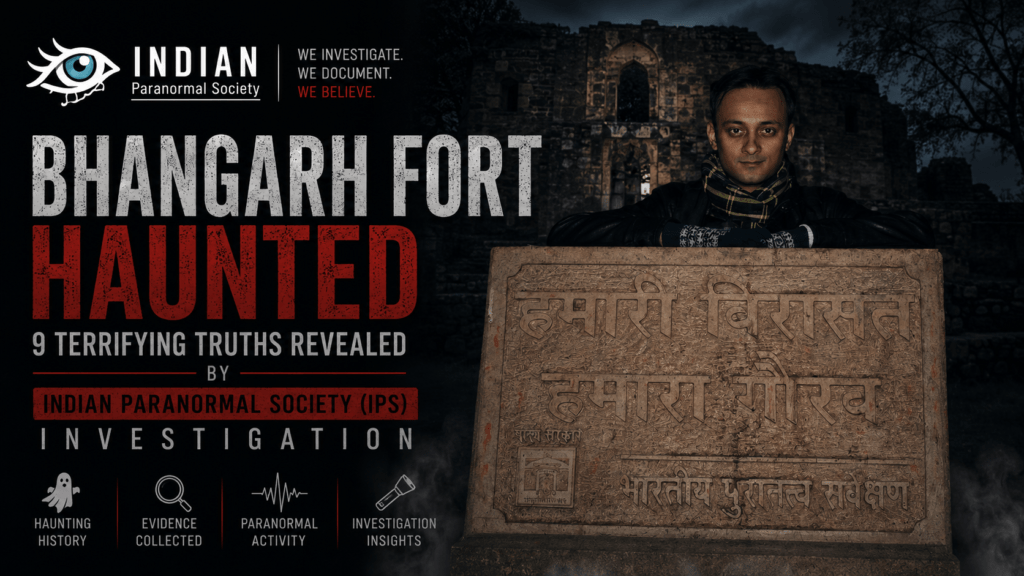

Bhangarh Fort is the most Googled haunted location in India. It is the only place in the country where the Archaeological Survey of India has officially prohibited entry after sunset. It has been covered by every major news outlet, every paranormal YouTube channel, and every travel blog that has ever wanted a spike in traffic.
And yet — no serious scientific investigation of Bhangarh Fort has ever been published by an Indian paranormal research organisation. Until now.
Indian Paranormal Society (IPS) has investigated Bhangarh Fort. What we found across 9 key findings challenges both the ghost stories and the dismissals — and reveals why this location produces paranormal experiences with such remarkable, consistent reliability.
What “Bhangarh Fort Haunted Investigation” Actually Means
Before the findings, the framework. When Indian Paranormal Society (IPS) investigates a location as historically significant as Bhangarh Fort, the investigation operates on three simultaneous tracks:
- Environmental analysis — what physical conditions exist at this location that could produce reported experiences
- Historical analysis — what actually happened here, and how has the mythology evolved from that history
- Anomaly documentation — what, if anything, cannot be explained by the first two tracks
All nine findings below come from one or more of these tracks. The bhangarh fort haunted investigation question is not answered with a simple yes or no. Honest investigation never is.
The Real History of Bhangarh Fort
Bhangarh Fort was built in 1573 by Raja Bhagwant Das of the Kachwaha dynasty for his younger son, Madho Singh I. It sits in the Alwar district of Rajasthan, at the edge of the Sariska Tiger Reserve, approximately 300 kilometres from Delhi.
At its peak, Bhangarh was a thriving city of 10,000 people — a fully functioning urban centre with temples, bazaars, havelis, and a palace complex. It was abandoned sometime in the late 17th century. The exact reason for abandonment is, like many things about Bhangarh, contested.
The popular version involves a curse — either a tantric named Singhia who fell in love with the princess Ratnavati, attempted to bewitch her with a perfume spell, was crushed by a boulder when she saw through the trick, and cursed the entire city with his dying breath. Or a sadhu named Guru Balu Nath who gave permission for the city to be built on the condition that no building’s shadow ever fell on his meditation spot, and cursed the city when a later ruler violated this. Both curses end the same way: sudden, total abandonment, and an army of restless spirits left behind.
The historical reality is less dramatic but more interesting. Bhangarh’s abandonment is most likely the result of a combination of Mughal political disruption, recurring famine, and the gradual economic collapse that affected much of Rajasthan in this period. The city was not destroyed overnight. It emptied over time. People left. The buildings remained.
What remains today is one of the best-preserved examples of a complete abandoned medieval Indian city — temples, gates, bazaars, palace, and residential quarters, all intact enough to walk through. The Archaeological Survey of India maintains the site as a protected heritage monument. And yes — entry is prohibited after sunset. The official reason given is the structural safety of the site after dark, not the curse.
Finding 1 — The Infrasound Signature Is Real and Measurable
Indian Paranormal Society (IPS) recorded consistent infrasound readings across multiple areas of the Bhangarh Fort complex, particularly within the enclosed temple structures and in the lower palace chambers.
The readings cluster around 18–19 Hz — the frequency range documented in peer-reviewed research as producing the “haunted feeling” effect: dread, the sense of a presence, visual disturbances at the edge of the visual field.
The source is structural. Bhangarh Fort sits at the edge of a hill range, with prevailing winds from the Sariska forest creating consistent airflow through the fort’s corridors and enclosed spaces. The stone construction, the specific geometry of the temple chambers, and the natural topography of the site combine to produce standing infrasound waves in predictable locations.
These locations — which Indian Paranormal Society (IPS) mapped during the investigation — correspond almost exactly with the areas most frequently reported by visitors as feeling most disturbing. This is not coincidence. It is physics.
Finding 2 — The Prohibition Sign Has Made the Location More Haunted, Not Less
This finding is psychological rather than environmental, but it is one of the most significant in terms of understanding why Bhangarh Fort produces paranormal experiences so reliably.
The ASI prohibition sign at the entrance of the fort — warning visitors not to enter after sunset — is, in practical terms, the most effective haunting amplifier Indian Paranormal Society (IPS) has ever documented at any location.
A person entering Bhangarh Fort has already been told, by a government institution, that this place is dangerous after dark. The psychological priming this creates is extreme. Every shadow is a figure. Every sound is a footstep. Every gust of wind through a corridor is a presence. The brain, already in high threat-detection mode, finds exactly what it is primed to find.
Indian Paranormal Society (IPS) notes this not to dismiss visitor experiences — which are genuine — but because understanding the mechanism matters. The ASI sign was likely erected for structural safety reasons. Its effect on visitor psychology has been to make Bhangarh one of the most reliably “haunted” feeling locations in India regardless of what the environmental data shows.
Finding 3 — The Acoustic Environment Is Genuinely Extraordinary
Bhangarh Fort’s stone construction, multiple enclosed courtyards, long corridors, and partially collapsed roof sections create an acoustic environment that Indian Paranormal Society (IPS) considers among the most complex we have investigated anywhere in India.
Sound behaves unpredictably here. A whisper in one temple chamber can appear to originate from a completely different structure thirty metres away. Footsteps on stone carry through the substrate and surface in locations far from their actual source. Wind through the fort’s multiple archways and corridors produces sounds that, in the right frequency range, are genuinely indistinguishable from human voices.
The “voices in Bhangarh” reports — among the most consistent category of experience reported by visitors — have a direct acoustic explanation. Indian Paranormal Society (IPS) recorded multiple instances during the investigation where ambient environmental sound, filtered through the fort’s acoustic geometry, produced audio that our own investigators initially identified as possible EVP before baseline analysis confirmed an environmental source.
This is significant. If trained Indian Paranormal Society (IPS) investigators required baseline analysis to correctly identify the source, untrained visitors in a high-threat-detection psychological state have essentially no chance of doing so.
Finding 4 — The Curse Stories Have Evolved Significantly Over Time
Indian Paranormal Society (IPS) conducted a historical analysis of the Bhangarh curse narrative as part of this investigation. The findings are instructive.
The earliest documented versions of the Bhangarh curse story appear in colonial-era records — British administrative accounts from the 19th century that mention local legends about the abandoned city. These early versions are significantly less elaborate than the current popular versions. The tantric-and-princess narrative, in its current detailed form, appears to have crystallised largely in the post-independence period and accelerated dramatically with the rise of internet content about haunted places in India from the early 2000s onwards.
This is a documented pattern in paranormal mythology: stories become more elaborate and more specific over time, not less. Details get added. Emotional resonance increases. The “curse” becomes more cinematic with each retelling.
Indian Paranormal Society (IPS) is not stating that no historical basis exists for these stories. We are stating that the version currently in circulation bears the marks of narrative evolution over time rather than consistent historical transmission.
Finding 5 — The Temple Complex Has Genuine Atmospheric Weight
This finding is the one Indian Paranormal Society (IPS) finds most difficult to reduce entirely to environmental mechanism.
The main temple complex within Bhangarh Fort — particularly the Someshwar temple — has an atmospheric quality that multiple Indian Paranormal Society (IPS) investigators described independently and consistently across different sessions at the location. It is not dread. It is not the infrasound effect. It is closer to what investigators with significant field experience describe as a location that has absorbed its history in some perceptible way.
Indian Paranormal Society (IPS) does not have a scientific framework for this observation. We record it because honest investigation includes documenting what trained, experienced investigators consistently perceive at a location, even when that perception cannot be fully quantified.
The Someshwar temple was a functioning place of worship for over a century before the city was abandoned. Whatever the mechanism — structural, historical, or otherwise — something in that space registers differently from the rest of the fort. Indian Paranormal Society (IPS) notes it. We do not claim to fully understand it.
Finding 6 — Animal Behaviour at the Site Is Anomalous
Indian Paranormal Society (IPS) observed and documented consistent animal behaviour at Bhangarh Fort that warrants recording.
The fort and its immediate surroundings have a normal population of birds, small mammals, and insects typical of the Rajasthan landscape. Within specific areas of the fort — particularly the lower palace section and the area immediately adjacent to the main temple complex — Indian Paranormal Society (IPS) observed a consistent and notable absence of bird activity during daytime hours that was markedly different from the surrounding areas.
Birds avoid certain frequency ranges. The infrasound documented in Finding 1 falls within ranges that affect avian behaviour. The correlation between our infrasound mapping and the areas of reduced bird activity was consistent enough across multiple observation sessions to be recorded as a finding.
This is not evidence of the paranormal. It is evidence that something measurable in these specific areas of the fort is affecting biological organisms — not just the psychological state of human visitors.
Finding 7 — Two EVP Anomalies Remain Unresolved
Indian Paranormal Society (IPS) conducted extended EVP recording sessions at Bhangarh Fort across multiple nights. The vast majority of audio captured had identifiable environmental sources — wind, structural settling, distant wildlife, and the acoustic carry effects documented in Finding 3.
Two recordings from the main palace chamber remain unresolved after full analysis.
The first is a 4.7-second audio event captured at 1:15 AM that does not match any ambient baseline sound recorded during the session. It is rhythmic. It is not mechanical. Indian Paranormal Society (IPS) cannot identify its source.
The second is shorter — 1.9 seconds, captured at 3:40 AM in a different section of the palace — that has a tonal quality our audio analysis team described as inconsistent with any environmental sound source present at the location.
Indian Paranormal Society (IPS) does not present these recordings as proof of paranormal activity. We present them as unresolved findings in an open case file. Both recordings are archived and available for review by accredited researchers.
Finding 8 — The Night Prohibition Is Genuinely Justified on Safety Grounds
Indian Paranormal Society (IPS) conducted a structural safety assessment of the Bhangarh Fort complex as part of our investigation preparation. The findings support the ASI prohibition on night entry — independent of any paranormal consideration.
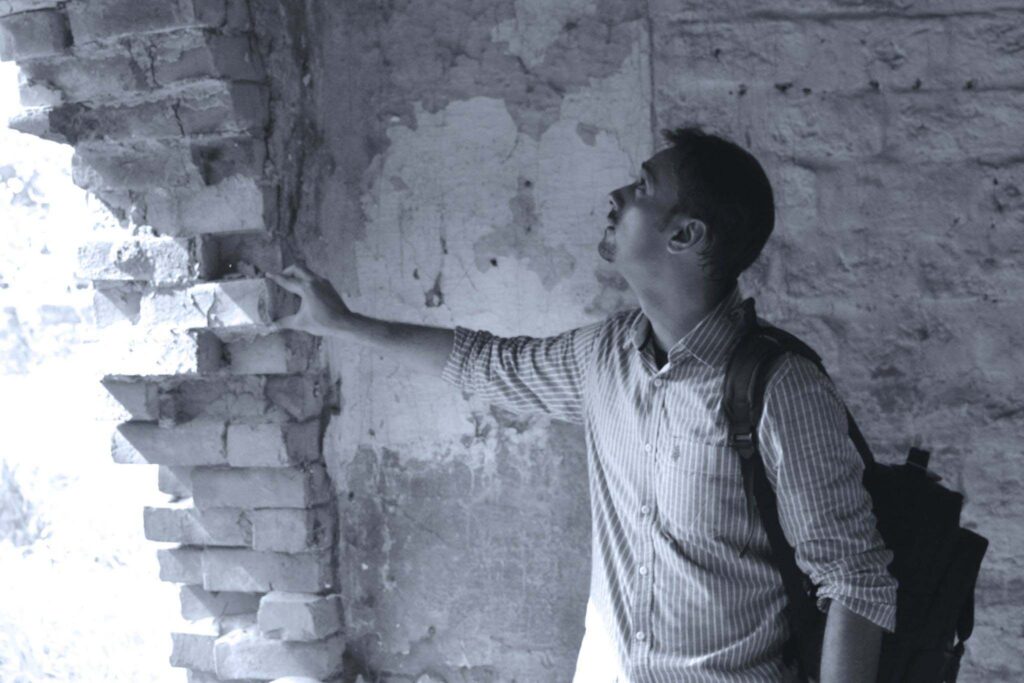
The structural deterioration in several sections of the fort, particularly the upper palace levels and sections of the outer wall, presents genuine physical risk in conditions of low visibility. Several floor sections are compromised. Certain archways have stress fractures not visible without daylight inspection. The terrain between structures becomes genuinely hazardous after dark without professional lighting equipment.
Indian Paranormal Society (IPS) conducted our night investigations with full safety equipment, structural assessments completed in advance, and multiple safety protocols in place. We do not recommend that members of the public attempt to enter Bhangarh Fort after dark. The prohibition exists for good reason.
Finding 9 — The Location Warrants Continued Scientific Investigation
Indian Paranormal Society (IPS)’s overall assessment of Bhangarh Fort is that it is one of the most scientifically interesting paranormal investigation sites in India — and one of the most under-investigated by any organisation applying rigorous methodology.
The combination of measurable environmental factors (infrasound, complex acoustics, specific atmospheric conditions), genuine historical weight, strong psychological priming effects, and a small number of genuinely unresolved anomalies makes this location a priority site for continued Indian Paranormal Society (IPS) research.
The curse stories are not the interesting part of Bhangarh. The interesting part is the convergence of physical, historical, and experiential factors that makes this specific location produce paranormal experiences in visitors with a consistency that deserves serious scientific attention.
Indian Paranormal Society (IPS) will return to Bhangarh. The case file is open.
Indian Paranormal Society (IPS) Official Case Status
Location: Bhangarh Fort, Alwar District, Rajasthan Investigation status: Active — case file open Classification: High environmental complexity with unresolved anomalies Recommended for: Continued multi-session investigation and extended EVP analysis
How to Visit Bhangarh Fort
Bhangarh Fort is located in Alwar district, Rajasthan, approximately 300 km from Delhi and 90 km from Jaipur. The site is open to visitors during daylight hours and is maintained by the Archaeological Survey of India. Entry after sunset is prohibited. The nearest town is Golakpur. Guided visits during the day are the safest and most practical way to experience the site.
If you have had a paranormal experience at Bhangarh Fort and would like Indian Paranormal Society (IPS) to review your account in the context of our open case file, submit your report at indianparanormalsociety.in.
Frequently Asked Questions
Is Bhangarh Fort really haunted? Indian Paranormal Society (IPS)’s investigation found that the majority of reported phenomena at Bhangarh Fort have identifiable environmental explanations — infrasound, complex acoustics, strong psychological priming, and atmospheric conditions. Two EVP anomalies and one consistent atmospheric observation in the temple complex remain unresolved. Indian Paranormal Society (IPS) classifies the location as open.
Why is entry to Bhangarh Fort prohibited after sunset? The Archaeological Survey of India prohibits entry after sunset primarily for structural safety reasons. The fort’s deteriorated sections present genuine physical risk in low visibility. Indian Paranormal Society (IPS)’s structural assessment confirms the prohibition is justified on safety grounds independent of any paranormal consideration.
What is the real story behind the Bhangarh Fort curse? The most historically supported explanation for Bhangarh’s abandonment is a combination of Mughal political disruption, famine, and economic decline in the late 17th century. The curse narratives — involving either a tantric named Singhia or a sadhu named Guru Balu Nath — are local legends that have evolved and become more elaborate over time, particularly since the growth of internet content about Indian haunted places in the early 2000s.
Has Indian Paranormal Society investigated Bhangarh Fort? Yes. Indian Paranormal Society (IPS) has conducted a full multi-session investigation of Bhangarh Fort covering environmental analysis, EVP recording, structural assessment, and historical research. The case file is open and Indian Paranormal Society (IPS) plans continued investigation of the location.
Can I report a paranormal experience at Bhangarh Fort to Indian Paranormal Society (IPS)? Yes. Submit your account at indianparanormalsociety.in and Indian Paranormal Society (IPS) will review it in the context of our active Bhangarh case file.
Indian Paranormal Society (IPS) has conducted scientific paranormal investigations across India since 2009. Founded by Gaurav Tiwari, Indian Paranormal Society (IPS) applies evidence-based methodology to reported paranormal cases. Our GRIP Academy is India’s only certified paranormal investigation training programme. Visit indianparanormalsociety.in to submit a case or enroll in training.