
When most people think about paranormal investigation in India, they think about haunted forts, ghost sightings, and things that go bump in the night. They think about Bhangarh and Mukesh Mills. They think about television programmes and YouTube channels and thrill-seeking investigators with thermal cameras.
Indian Paranormal Society (IPS) thinks about something else entirely.
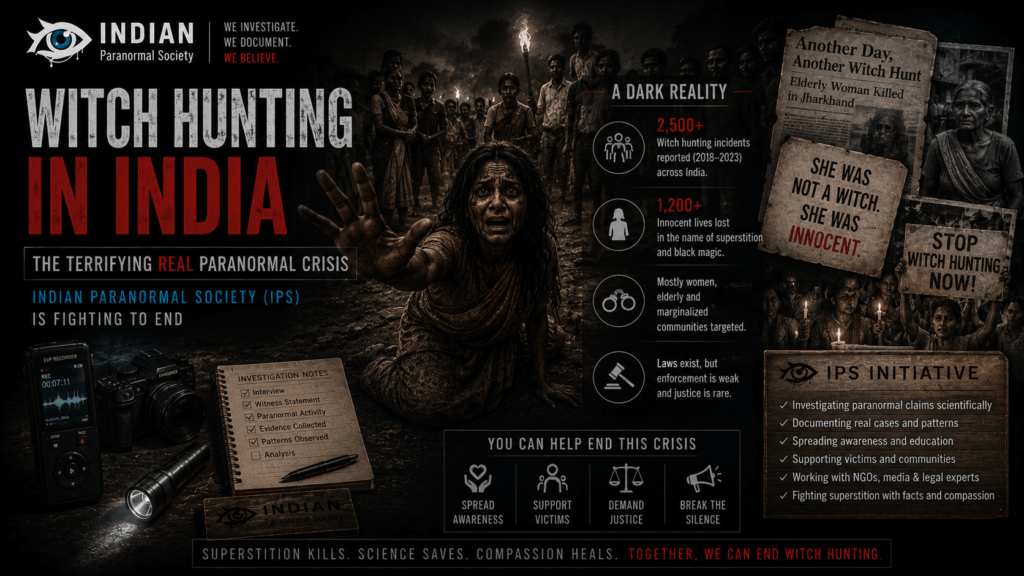
Witch hunting in India is the real paranormal crisis of this country — and it is killing people. According to the National Crime Records Bureau, more than 2,500 people were murdered in India between 2000 and 2020 on alleged charges of practising witchcraft. These are the reported deaths only. Researchers and civil society organisations estimate the actual number is significantly higher, because witch hunting deaths in rural India are routinely misclassified, under-reported, or simply never recorded.
In Jharkhand alone — the state with the highest recorded witch hunting deaths in the country — civil society organisations estimate over 1,800 murders in 18 years. That is one woman lynched every third day in the name of supernatural belief.
This is the paranormal crisis in India that no television programme covers. This is what Indian Paranormal Society (IPS) was built, in significant part, to fight.
What Witch Hunting in India Actually Is
The term “witch hunting” in India refers to a specific pattern of violence rooted in supernatural accusation. A woman — overwhelmingly it is a woman — is identified by a socially recognised sorcerer, ojha, or witch doctor as a dayan, daini, or chudail: a witch who has caused a misfortune in the community. That misfortune might be a death, an illness, a failed crop, the loss of livestock, or any unexplained bad outcome that the community needs to attribute to a cause.
Once accused, the woman faces a brutal progression. Social ostracism comes first. Then physical violence — beating, stripping, public humiliation, tonsuring, blackening of the face. Then, in the worst cases, murder. Rape is documented as a common element of the violence. The accused woman’s family is frequently targeted alongside her.
The accusation is almost always false. The misfortune that triggered it — a death in the family, a failed harvest, an illness — has a real cause that has nothing to do with witchcraft. Crop failure has agricultural causes. Illness has medical causes. Death has physical causes. The witch accusation is a supernatural framing imposed on a natural event — and a woman pays for it with her safety, her dignity, or her life.
This is not ancient history. Between 2023 and 2025, 24 people were killed in Jharkhand alone in witch hunting incidents, according to the state’s Criminal Investigation Department. In 2023, witch hunting murders in Jharkhand saw a 100% rise compared to 2022. This is happening now, in modern India, in 2025 and 2026.
Who Gets Targeted — And Why
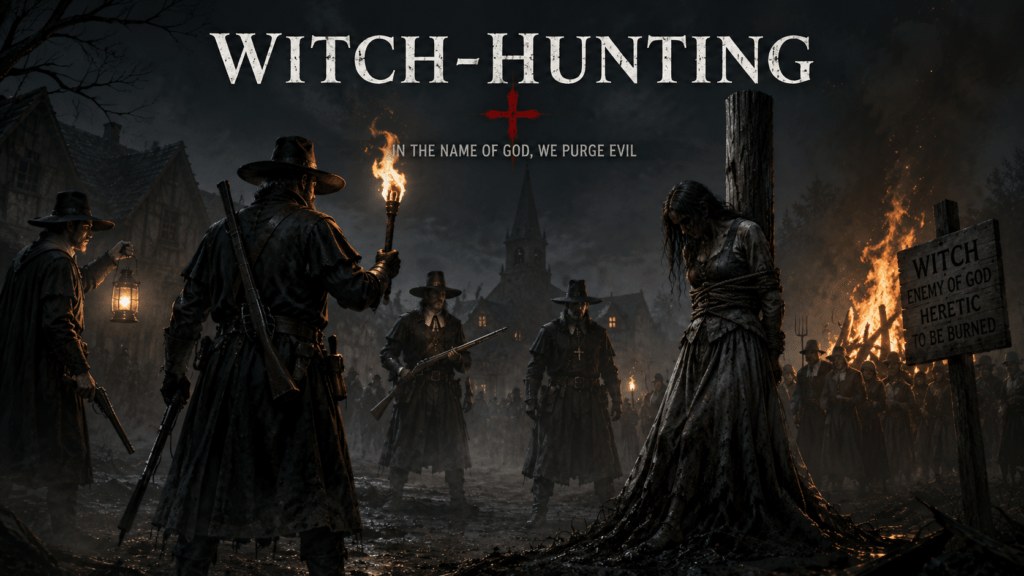
Understanding who gets accused as a witch in India is essential for understanding what witch hunting actually is. It is not random. It is not driven purely by superstition. It is a pattern of targeting that follows specific social logic.
A 2023–24 survey by Nirantar Trust found that 48% of witch hunting accusations come from in-laws and 42% of cases are linked to women’s increased income. Read those numbers carefully. Nearly half of all accusations come from within the accused woman’s own family network. Nearly half are connected to the woman gaining economic independence.
Witch hunting in India is a mechanism of social control. The supernatural framing — the dayan accusation — provides community cover for targeting women who threaten existing social hierarchies: widows who control property, women who earn their own income, women who reject abuse, women who are inconvenient to powerful men in their community.
The supernatural belief is real. The people who accuse and the communities who participate genuinely believe in the dayan. But the belief is being instrumentalised — consciously or unconsciously — to serve social and economic interests that have nothing to do with the paranormal.
In Bihar alone, an estimated 75,000 women live under the daily threat of being branded as witches — two or more per village. Only 31% of victims report the violence. Of those who do, 62% receive no resolution. And 85% of village leaders are unaware of the anti-witch hunting laws that exist.
This is a public health crisis, a human rights crisis, and a legal crisis — all wrapped in a supernatural frame that makes it harder to address because it requires confronting deeply held beliefs rather than simply enforcing laws.
The States Where It Is Worst
Jharkhand has recorded the highest total number of murders where the motive was witchcraft — 593 women killed on the grounds of witchcraft between 2001 and 2021 according to the National Crime Records Bureau. The states of Assam, Bihar, Chhattisgarh, Madhya Pradesh, and Odisha also record many cases of witch branding.
These are not coincidental geographies. They share specific characteristics: high proportions of Adivasi and Dalit populations, significant poverty, limited access to medical care, strong traditional authority structures, and low rates of formal education. The conditions that make witch hunting possible are conditions of structural disadvantage — which means addressing witch hunting requires addressing the structural conditions, not just the supernatural belief.
Indian Paranormal Society (IPS) notes that urban India’s distance from this reality is itself a problem. Witch hunting is not a rural curiosity. It is a national crisis that kills dozens of people every year — predominantly women, predominantly from India’s most marginalised communities — and it receives a fraction of the public attention it deserves.
The Role of the Ojha — And Why This Matters for Paranormal Investigation
At the centre of every witch hunting incident is a figure who claims paranormal authority: the ojha, sokha, or witch doctor. This person — almost always male — is the one who identifies the witch, declares the accusation, and in many cases directs the subsequent violence.
The ojha’s authority is entirely supernatural in basis. He claims the ability to identify spiritual causes of misfortune, to communicate with spirits, to distinguish between ordinary illness and supernatural attack. His diagnosis is accepted by the community because it is framed in terms of a belief system the community shares and trusts.
This is the intersection of witch hunting and paranormal investigation that Indian Paranormal Society (IPS) understands with particular clarity. The ojha is doing something that looks, from the outside, like paranormal investigation — identifying and addressing supernatural phenomena. What he is actually doing is providing confident supernatural explanations for natural events, in a context where those explanations have lethal consequences for the women he identifies.
The antidote is exactly what Indian Paranormal Society (IPS) practises: investigation that begins with scepticism, demands evidence, and prioritises finding the real cause over confirming a predetermined supernatural conclusion. When the real cause of a family’s misfortune is found — the medical cause of an illness, the agricultural cause of a crop failure, the structural cause of a death — the basis for the witch accusation collapses.
This is why Indian Paranormal Society (IPS) considers its work to be, at its core, protective work. Every rational explanation Indian Paranormal Society (IPS) finds for a reported paranormal experience is a data point against the culture of supernatural attribution that enables witch hunting. It is a small contribution to a large problem. But it is a real one.
The Legal Framework — And Its Failures
India does not have a central law specifically criminalising witch hunting. This is a significant failure of the legal system given the documented scale of the violence.
Some states have passed their own legislation. Bihar passed the Prevention of Witch (Daain) Practices Act in 1999. Jharkhand passed the Prevention of Witch (Daain) Practices Act in 2001. Rajasthan passed a similar law in 2015. Odisha, Assam, and Chhattisgarh have enacted comparable legislation.
The enforcement record is poor. 85% of village leaders are unaware of anti-witch hunting laws. Police in rural areas frequently classify witch hunting deaths under general homicide categories rather than as witch hunting-motivated murders, which means the NCRB data almost certainly undercounts the actual scale of the problem. Fast-track courts for witch hunting cases are rare. Survivor rehabilitation is largely absent.
The UN Human Rights Council passed a resolution in 2021 to eliminate harmful practices related to witchcraft accusations and ritual attacks. India is a signatory. The distance between that commitment and the reality on the ground — where women are still being killed for witchcraft accusations in 2025 — is enormous.
What Scientific Investigation Can Actually Do
Indian Paranormal Society (IPS) is not a law enforcement agency. Indian Paranormal Society (IPS) cannot arrest ojhas or enforce the Prevention of Witch Practices Acts. What Indian Paranormal Society (IPS) can do — and does — is something more foundational.
Provide rational explanations for the events that trigger accusations. Crop failures have causes. Unexplained deaths have causes. Illness outbreaks have causes. When Indian Paranormal Society (IPS) investigates a case in which a supernatural accusation has been made or is at risk of being made, finding the real cause removes the basis for the accusation. This is the most direct protective intervention available to a paranormal research organisation.
Challenge the credibility of fraudulent supernatural authority. The ojha’s power rests on the community’s belief that no alternative explanation exists. Scientific investigation that provides a credible, evidence-based alternative challenges that belief. This is slow work. It is cultural work. But it is work that matters.
Document and publicise the scale of the problem. Indian Paranormal Society (IPS) is one of India’s most recognised paranormal organisations — with a platform and a credibility that can draw attention to witch hunting as the real paranormal crisis of this country. This article is part of that effort. The more visibility this issue gets, the more pressure exists on legislators, law enforcement, and communities to address it.
Support survivors. Women who have survived witch hunting accusations and violence have experienced real trauma. Indian Paranormal Society (IPS) advocates that survivors be connected with appropriate medical, psychological, and legal support — and that the paranormal framing of their experience never be allowed to be used as a reason to deny them that support.
The Myth vs The Fact
The myth: Witch hunting in India is a rural superstition problem that will disappear as India modernises and becomes more educated.
The fact: In 2023, witch hunting murders in Jharkhand increased 100% compared to the previous year. Awareness campaigns have not stopped the killings. The problem is not only superstition — it is gender violence, economic targeting, and structural disadvantage using superstition as a weapon. Modernisation alone does not address any of these underlying factors.
The myth: The people who conduct witch hunts are uneducated and ignorant. Education will fix it.
The fact: 42% of witch hunting cases are linked to women’s increased income — meaning the accusations increase as women become more economically independent, not less. This is not ignorance seeking an explanation for misfortune. This is a social control mechanism responding to a perceived threat. Education matters. But it is not sufficient on its own.
The myth: This is a problem in a few remote states and does not reflect mainstream India.
The fact: The NCRB has tracked witch hunting murders in India since 1953. The phenomenon spans 12 states and has documented roots in the country’s history going back centuries. It is not a regional anomaly. It is a national problem that affects India’s most marginalised communities — Adivasi women, Dalit women, widows, women who live alone — with lethal regularity.
What Indian Paranormal Society (IPS) Asks of You
If you have read this far, you understand something that most consumers of paranormal content in India never engage with: that the real stakes of paranormal belief in this country are not ghost sightings or haunted locations. They are human lives.
Indian Paranormal Society (IPS) asks three things:
Know the law. If you live in or near a state with a Prevention of Witch Practices Act — Bihar, Jharkhand, Rajasthan, Odisha, Assam, Chhattisgarh — know that the law exists and that witch hunting accusations and the violence that follows are criminal offences. Share this information.
Challenge supernatural attribution of natural events. When someone you know attributes a death, an illness, or a misfortune to a supernatural cause — ask for the evidence. Ask what the medical explanation is. Ask what investigation has been done. The culture of unquestioned supernatural attribution is the soil in which witch hunting grows.
Support the organisations working on the ground. Organisations like the Association for Social and Human Awareness (ASHA) in Jharkhand, ActionAid India, and others are doing the direct work of supporting survivors and challenging the practice in the communities where it occurs. Their work deserves recognition and support.
Indian Paranormal Society (IPS) investigates what cannot be easily explained. Witch hunting in India is not a mystery. The causes are known. The solutions are known. What is missing is the will — social, political, and legal — to implement them.
That is the paranormal crisis that matters most.
Frequently Asked Questions
What is witch hunting in India? Witch hunting in India refers to the practice of accusing a person — overwhelmingly women — of being a witch (dayan, daini, chudail) and subjecting them to violence, ostracism, and in many cases murder. According to the NCRB, over 2,500 people were killed in witch hunting incidents in India between 2000 and 2020.
Which states in India have the most witch hunting cases? Jharkhand has recorded the highest number of witch hunting murders, with Assam, Bihar, Chhattisgarh, Madhya Pradesh, and Odisha also recording significant cases.
Is witch hunting illegal in India? There is no central Indian law specifically criminalising witch hunting. Several states have enacted their own Prevention of Witch Practices Acts — including Bihar, Jharkhand, Rajasthan, Odisha, Assam, and Chhattisgarh. Enforcement of these laws is inconsistent.
What is the connection between witch hunting and paranormal investigation? Indian Paranormal Society (IPS) identifies witch hunting as a direct consequence of unchallenged supernatural attribution — the practice of explaining natural events (illness, death, crop failure) through supernatural causes without investigation. Scientific paranormal investigation that finds rational explanations for reported phenomena directly challenges the culture of supernatural attribution that enables witch hunting.
What can I do to help address witch hunting in India? Know and share awareness of the anti-witch hunting laws in your state. Challenge supernatural attribution of natural events in your community. Support organisations like ASHA (Association for Social and Human Awareness) and ActionAid India that work directly with survivors. Report witch hunting incidents to police under the relevant state laws.
Indian Paranormal Society (IPS) has applied scientific methodology to reported paranormal cases across India since 2009, protecting vulnerable people from supernatural exploitation. Founded by Gaurav Tiwari, Indian Paranormal Society (IPS) believes that honest investigation is one of the most effective tools against the harmful consequences of unchallenged supernatural belief. Submit a case or learn about GRIP Academy at indianparanormalsociety.in.